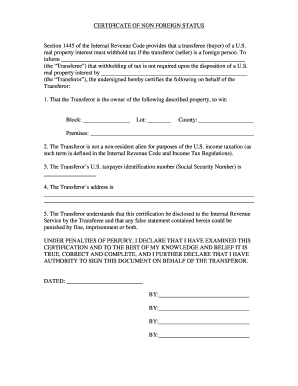
CERTIFICATE OF NON FOREIGN STATUS Section 1445 of the Internal Revenue Code provides that a transferee buyer of a U.S. real property interest must withhold tax if the transferor seller is a foreign person. To inform the Transferee that withholding of tax is not required upon the disposition of a U.S. Transferor 1. That the Transferor is the owner of the following described property to wit Block Lot County Premises 2. The Transferor is not a non-resident alien for purposes of the U*S* income taxation as such term is defined in the Internal Revenue Code and Income Tax Regulations. Service by the Transferee and that any false statement contained herein could be punished by fine imprisonment or both. UNDER PENALTIES OF PERJURY I DECLARE THAT I HAVE EXAMINED THIS CERTIFICATION AND TO THE BEST OF MY KNOWLEDGE AND BELIEF IT IS TRUE CORRECT AND COMPLETE AND I FURTHER DECLARE THAT I HAVE AUTHORITY TO SIGN THIS DOCUMENT ON BEHALF OF THE TRANSFEROR* DATED BY. That the Transferor is the owner of ....

How it works
  • Open form

    Open form follow the instructions

  • Easily sign form

    Easily sign the form with your finger

  • Share form

    Send filled & signed form or save

How to fill out the Certificate of Non Foreign Status online

Filling out the Certificate of Non Foreign Status is a crucial step in ensuring proper tax compliance when dealing with U.S. real property interests. This guide provides clear instructions on how to complete this form online, ensuring that you understand each component and its significance.

Follow the steps to complete the Certificate of Non Foreign Status online

  1. Press the ‘Get Form’ button to obtain the form and open it in your editor.
  2. In the designated space, enter the name of the Transferee (buyer) who is required to provide this certificate.
  3. Next, provide the name of the Transferor (seller) who is certifying their status.
  4. Specify the property details, including Block, Lot, County, and Premises. This information identifies the real property involved in the transaction.
  5. Indicate that the Transferor is not a non-resident alien for U.S. income taxation purposes, ensuring compliance with tax regulations.
  6. Enter the Transferor’s U.S. taxpayer identification number (Social Security Number). This is critical for the IRS records.
  7. Fill in the Transferor's complete address in the designated section to ensure accurate communication.
  8. Review the certification statement thoroughly to confirm that all entered information is accurate and complete. Understand the implications of false statements.
  9. Ensure the document is signed and dated by the appropriate person authorized to act on behalf of the Transferor.
  10. After completing the form, you can save your changes, download, print, or share the form as needed.

Complete your documents online to ensure accuracy and compliance.

Get form

Experience a faster way to fill out and sign forms on the web. Access the most extensive library of templates available.

Related content

Instructions for Form 8288 (01/2023)

Nov 30, 2020 — A certification of nonforeign status includes a valid Form W-9 submitted...

Learn more
26 CFR § 1.1445-2 - Situations in which...

Rather, the owner of the disregarded entity is treated as the transferor of property and...

Learn more
How do I extend my nonimmigrant stay in the United...

The admissions stamp in your travel document or the I-94/I-94W shows your nonimmigrant...

Learn more
Questions & Answers

Get answers to your most pressing questions about US Legal Forms API.

Contact support

How do I complete a certificate of foreign status on PayPal?

To complete a certificate of foreign status on PayPal, you'll need to fill out the required forms that verify your non-resident status. This process ensures that PayPal can appropriately classify your account for tax purposes. Utilizing a Certificate of Non Foreign Status can simplify this process, ensuring you meet all requirements efficiently.

A certificate that certifies a seller is not a foreign person is often referred to as a Certificate of Non Foreign Status. This document is essential in real estate transactions to confirm that the seller is a U.S. resident, which helps avoid higher withholding taxes for foreign sellers. By using this certificate, you can streamline your real estate transactions.

Non-residency refers to a status where an individual or entity does not reside in a specific jurisdiction for tax purposes. This status affects tax liabilities and obligations in many ways. Understanding your non-residency status can help you navigate complex tax regulations and avoid unnecessary penalties.

A certificate of non-residency is a document that provides proof that an individual or business does not reside in a particular area for tax purposes. This certificate can be critical for those dealing with taxation related to sales or income on properties. Obtaining a Certificate of Non Foreign Status can simplify matters and ensure clarity in tax obligations.

To qualify as a non-resident, you typically need to meet specific criteria related to your physical presence in a jurisdiction. In the U.S., this often means maintaining a primary residence outside the country for a certain period. Properly completing a Certificate of Non Foreign Status is an effective way to assert your non-resident status.

The certification of non-foreign status is a document that confirms an individual or entity is not considered a foreign person under U.S. law. It is often required in real estate transactions to avoid higher withholding taxes for foreign sellers. When you apply for a Certificate of Non Foreign Status, you demonstrate compliance with tax regulations, making this certification a valuable resource.

A certificate of non-residence serves as a formal document that states an individual or business does not reside in a specific jurisdiction for tax purposes. This certificate can be essential when dealing with transactions that involve tax withholding, such as property sales or real estate transactions. Understanding this certificate is crucial to ensure compliance with local tax laws.

resident usually refers to an individual or entity that does not meet the residency requirements of a given jurisdiction. In the context of a Certificate of Non Foreign Status, it typically means that the individual does not reside within the U.S. for tax purposes. Nonresidents often have different tax obligations and reporting requirements, making this classification important to understand.

To submit FIRPTA withholding to the IRS, you must complete IRS Form 8288 along with any accompanying payments. This involves providing accurate information about the transaction, including the withholding amount, and submitting these forms by the required deadline. Timely submissions ensure compliance and avoid penalties for both buyers and sellers. For assistance in properly filing, resources on platforms such as uslegalforms can be invaluable.

The certificate of foreign status for nonresident aliens is a document that confirms the individual's status to the IRS in relation to U.S. tax withholding requirements. This certificate establishes whether taxes should be withheld on income generated from U.S. sources. Properly filling out this certificate helps prevent potential tax liabilities for both the individual and the payers. Navigating this process can be simplified with templates available on platforms like uslegalforms.

Get This Form Now!

Use professional pre-built templates to fill in and sign documents online faster. Get access to thousands of forms.

If you believe that this page should be taken down, please follow our DMCA take down process here.

Get Certificate of Non Foreign Status