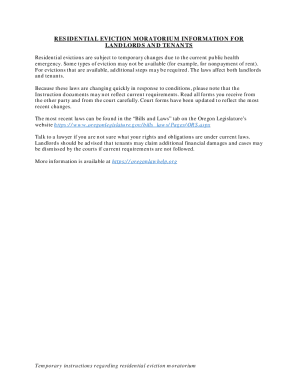
RESIDENTIAL EVICTION MORATORIUM INFORMATION FOR LANDLORDS AND TENANTS Residential evictions are subject to temporary changes due to the current public health emergency. Some types of eviction may.

How it works
  • Open form

    Open form follow the instructions

  • Easily sign form

    Easily sign the form with your finger

  • Share form

    Send filled & signed form or save

How to use or fill out the OR Residential Eviction Information For Landlords online

Filling out the OR Residential Eviction Information For Landlords form correctly is crucial for ensuring a smooth eviction process. This guide provides comprehensive, step-by-step instructions to assist landlords in completing the form accurately and efficiently in an online format.

Follow the steps to fill out the OR Residential Eviction Information For Landlords form online:

  1. Press the ‘Get Form’ button to retrieve the OR Residential Eviction Information For Landlords form. This will allow you to access the document and open it in an editor for completion.
  2. Review the detailed instructions included in the form. Make sure to understand the eviction process, particularly focusing on the types of notices you must issue to the tenant before proceeding.
  3. Complete the sections requiring your information, including your name, address, and contact details as the landlord. Ensure that all data is entered accurately.
  4. Fill in the tenant's information, including their full name and address where they currently reside. Providing precise details in this section is essential.
  5. Indicate the reason for eviction by selecting from the options such as nonpayment of rent or violation of lease terms. Reference specific laws that apply to your situation.
  6. Attach any necessary documentation, such as copies of the eviction notices you issued to the tenant. Ensure these are included as instructed.
  7. Review the completed form for accuracy, ensuring that all required fields are filled and that your reasons for eviction are properly documented and justified.
  8. If required, print the form and sign it where indicated, or sign electronically if the platform allows. Then, save the form to ensure your changes are not lost.
  9. Finally, download or print the completed form for your records. Follow any additional prompts for sharing or submitting the form as needed.

Start preparing your eviction documents online today to ensure compliance and efficiency in your eviction process.

Get form

Experience a faster way to fill out and sign forms on the web. Access the most extensive library of templates available.

Related content

Oregon Judicial Department : Landlord and Tenant :...

COVID-19 – Oregon's new Declaration of Financial Hardship and Notice of Eviction...

Learn more
Eviction - Wikipedia

The eviction process — Such evictions are generally illegal at any time during the...

Learn more
Questions & Answers

Get answers to your most pressing questions about US Legal Forms API.

Contact support

How do I evict a roommate in Oregon?

Roommate Eviction in Oregon Once you give your roommate the appropriate notice to quit, wait until the time period in the notice expires. At that point, if he hasn't left, it is time to file a complaint. Go to court and fill out forms called Residential Eviction Complaint and Summons.

All eviction notices must be in writing. The landlord will file a lawsuit called an FED, forcible entry and detainer. The sheriff or someone serving the court papers (FED Summons and FED Complaint) will hand them to whoever answers the door at your home or will tape them to the door and mail a copy later.

Eviction Process for No Lease / End of Lease In the state of Oregon, if tenants hold over, or stay in the rental unit after the rental term has expired, then the landlord must give tenants notice before evicting them. This can include tenants without a written lease and week-to-week and month-to-month tenants.

In a month-to-month tenancy, the landlord need only give a 30 Day Termination Notice without any cause for eviction. If the tenant has lived in the property for more than one year, the notice is 60-days. If the property is being sold to someone who plans to live there as a primary residence, it is 30-days.

In a month-to-month tenancy, the landlord need only give a 30 Day Termination Notice without any cause for eviction. If the tenant has lived in the property for more than one year, the notice is 60-days. If the property is being sold to someone who plans to live there as a primary residence, it is 30-days.

You must own the property to evict a roommate. If you do not own the property, your landlord must do the eviction, so contact your landlord with any evidence of a violation of the lease. You must follow the rules of the lease with your roommate.

Step 1: Deliver the eviction notice. ... Step 2: File the lawsuit. ... Step 3: Serve the lawsuit. ... Step 4: Attend the hearing. ... Step 5: Attend the trial. ... Step 6: Obtaining a judgment. ... Step 7: Removal of the tenant.

Starting on January 1, 2021, a landlord can evict for unpaid rent that came due between October 1 and December 31. Under the new law, a landlord can give the tenant a notice saying how much rent the tenant owes and will have to pay back by March 31, 2021.

Get This Form Now!

Use professional pre-built templates to fill in and sign documents online faster. Get access to thousands of forms.

If you believe that this page should be taken down, please follow our DMCA take down process here.

Get OR Residential Eviction Information For Landlords