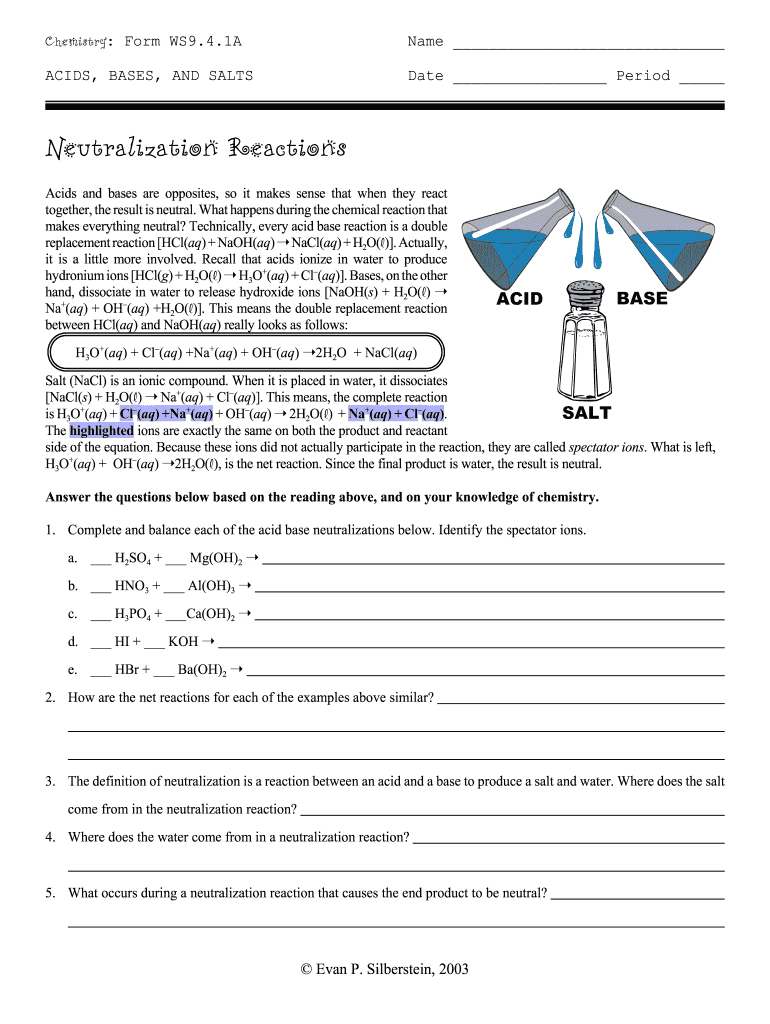
That when they react together, the result is neutral. What happens during the chemical reaction that makes everything neutral? Technically, every acid base reaction is a double replacement reaction HCl(aq) + NaOH(aq) NaCl(aq) + H2O( ) . Actually, it is a little more involved. Recall that acids ionize in water to produce hydronium ions HCl(g) + H2O( ) H3O+(aq) + Cl (aq) . Bases, on the other hand, dissociate in water to release hydroxide ions NaOH(s) + H2O( ) Na+(aq) + OH (aq) +H2O( ).
Loading

Open form follow the instructions

Easily sign the form with your finger

Send filled & signed form or save
How to fill out the Neutralization Reactions Form Ws9 4 1a online
This guide offers a clear, step-by-step approach to completing the Neutralization Reactions Form Ws9 4 1a online. Whether you are familiar with chemical concepts or new to the subject, this guide will assist you in accurately filling out the form.
Follow the steps to complete the form effectively.
- Click the ‘Get Form’ button to obtain the Neutralization Reactions Form Ws9 4 1a and open it in your online editing tool.
- Fill in your name in the designated space at the top of the form to identify yourself as the user.
- Enter the date in the provided field to record when the form is completed.
- Indicate your period in the space provided, which helps to categorize the form for your class or session.
- Read the section that explains neutralization reactions carefully. This background will be useful in answering the questions that follow.
- Proceed to the questions section. Complete and balance each acid-base neutralization reaction where indicated, and identify the spectator ions for each equation.
- Answer the following questions based on your understanding of neutralization reactions: similarities in net reactions, the origin of salt and water in reactions, and what makes the end product neutral.
- Once you have completed the form, review your answers for accuracy.
- Finally, save your changes, and choose to download, print, or share the completed form as needed.
Complete your document online to ensure all necessary information is accurately captured.
Experience a faster way to fill out and sign forms on the web. Access the most extensive library of templates available.
Related content
In clinical studies, adverse reactions in participants 16 years of age and older included...
1. Charcoal. 2. Soil amendments. 3. Environmental management. I. Lehmann ... 4. 1.3...
Get answers to your most pressing questions about US Legal Forms API.
What is formed as a result of neutralization reaction?
A neutralization reaction is when an acid and a base react to form water and a salt.
How to write balanced equations for neutralization reactions?
The balanced equation for a neutralization reaction is, NaOH + HCL → NaCl+ H2O.
What are the 4 types of neutralization reaction?
There are 4 types of neutralization reactions, depending on whether the acid and base are strong or weak. Strong Acids and Strong Bases. Strong Acids and Weak Bases. Weak Acids and Strong Bases. Weak Acids and Weak Bases.
What is neutralization reaction word formula?
Answer and Explanation: The general word equation for salt formation by neutralization is acid + base = salt + water. An example of such a reaction is that of nitric acid with calcium hydroxide.
How do you write a neutralization equation?
Neutralization reactions and net ionic equations NaOH (aq) → Na+ (aq) + HO– (aq) ... HCl (aq) → H+ (aq) + Cl– (aq) ... NaCl (aq) → Na+ (aq) + Cl– (aq) ... HCl(aq) + NaOH(aq) → H2O(l) + NaCl(aq) molecular equation. or. Na+ (aq) + HO– (aq) + H+ (aq) + Cl– (aq) → H2O(l) + Na+ (aq) + Cl– (aq) total ionic equation.
How do you write a neutralization reaction equation?
For example, when sodium hydroxide (NaOH) is treated with hydrochloric acid (HCl), then a salt, i.e., sodium chloride (NaCl) and water ( H2O) are obtained. The chemical equation for the neutralization reaction is given as: NaOH+HCl⟶NaCl+H2O.
What is a neutralization reaction example?
Neutralisation Reaction When a strong acid reacts with a strong base the resultant salt is neither acidic nor basic in nature i.e. it is neutral. For example when HCl (Hydrochloric acid), a strong acid, reacts with NaOH, a strong base, the resulting salt is sodium chloride and water.
What is an example of a neutralization reaction?
Neutralisation Reaction When a strong acid reacts with a strong base the resultant salt is neither acidic nor basic in nature i.e. it is neutral. For example when HCl (Hydrochloric acid), a strong acid, reacts with NaOH, a strong base, the resulting salt is sodium chloride and water.
Use professional pre-built templates to fill in and sign documents online faster. Get access to thousands of forms.
If you believe that this page should be taken down, please follow our DMCA take down process here.