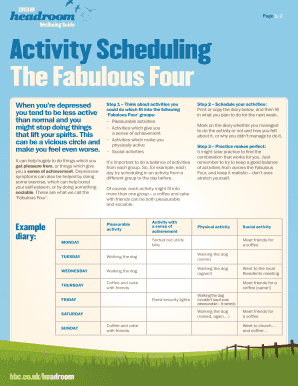
Page 1/2Activity Scheduling The Fabulous Four When youre depressed you tend to be less active than normal and you might stop doing things that lift your spirits. This can be a vicious circle and make.

How it works
  • Open form

    Open form follow the instructions

  • Easily sign form

    Easily sign the form with your finger

  • Share form

    Send filled & signed form or save

How to fill out the Depression: What You Need To Know As You Age online

Filling out the Depression: What You Need To Know As You Age form online can help you engage with effective strategies to manage depressive symptoms as you age. This guide provides detailed, step-by-step instructions to assist you in completing this important document.

Follow the steps to effectively fill out the form and improve your well-being.

  1. Click the ‘Get Form’ button to access the document, ensuring that you have the necessary tools to fill it out.
  2. Begin by reviewing the section labeled 'Activity Scheduling.' This section focuses on identifying activities to engage in from four key categories: pleasurable activities, activities that provide a sense of achievement, physical activities, and social activities. Take a moment to reflect on which activities resonate with you.
  3. In the next step, you will schedule your chosen activities. Use the provided diary format to plan your week. Write down the activities you aim to complete each day, categorizing them into the four groups mentioned. Be sure to indicate if you completed each activity and your feelings about it.
  4. Reflect on your experiences. After a week, review how well you balanced activities across the Fabulous Four. It may take time to find the right mix that works for you, so continue to adjust your schedule while keeping it realistic and achievable.
  5. Once you are satisfied with your filled-out diary, save your changes. You may then choose to download, print, or share the document as needed for your records.

Start completing your Depression: What You Need To Know As You Age form online today to take a proactive step toward managing your well-being.

Get form

Experience a faster way to fill out and sign forms on the web. Access the most extensive library of templates available.

Related content

NIMH » Depression

This brochure provides information about depression including the different types of...

Learn more
NIMH » Depression in Women: 5 Things You Should...

Most people with depression need treatment to feel better. If you think you may have...

Learn more
Brain Health As You Age Educator Guide

You should know that some conditions can mimic dementia, like hearing loss and depression...

Learn more
Questions & Answers

Get answers to your most pressing questions about US Legal Forms API.

Contact support

What is the average age of depression?

The median age of depression onset is 32.5 years old. The prevalence of adults with a major depressive episode is highest among individuals between 18 and 25. 11.3% of adults who report two or more races have experienced a major depressive episode in the past year.

The percentage of adults who experienced any symptoms of depression was highest among those aged 18 29 (21.0%), followed by those aged 45 64 (18.4%) and 65 and over (18.4%), and lastly, by those aged 30 44 (16.8%). Women were more likely than men to experience mild, moderate, or severe symptoms of depression.

The impression that the prevalence of mental disorder has been increasing during the last decades is only partially justified. The considerable increase in the demand for psychiatric and psychotherapeutic help is influenced by quite a number of factors that vary in nature and direction.

New research out of Yale University shows depression can physically change a person's brain, hastening an aging effect that might leave them more susceptible to illnesses associated with old age.

The neurobiological changes associated with getting older, prescribed medication for other conditions and genetic susceptibility (which increases with age) are also factors. There are a number of rarer mental health problems that affect older people too, including delirium, anxiety and late-onset schizophrenia.

Fifty percent of mental illness begins by age 14, and three-quarters begins by age 24.

We found interaction effects between 5 of 19 risk factors (low income, childhood abuse, and multiple aspects of poor health) and age on depression, suggesting that the relative risk these factors impose on depression is age-dependent.

Mental health issues do not get better on their own. The longer an illness persists, the more difficult it can be to treat and recover. Untreated anxiety may escalate to panic attacks, and failing to address trauma can lead to post-traumatic stress disorder. Early treatment usually leads to better outcomes.

Depression is most common in ages 18 to 25 (10.9 percent) and in individuals belonging to two or more races (10.5 percent). Women are twice as likely as men to have had a depressive episode, according to the NIMH and the World Health Organization (WHO) .

Physical conditions like stroke, hypertension, atrial fibrillation, diabetes, cancer, dementia, and chronic pain further increase the risk of depression. Additionally, these risk factors for depression are often seen in older adults: Certain medicines or combination of medicines.

Get This Form Now!

Use professional pre-built templates to fill in and sign documents online faster. Get access to thousands of forms.

If you believe that this page should be taken down, please follow our DMCA take down process here.

Get Depression: What You Need To Know As You Age