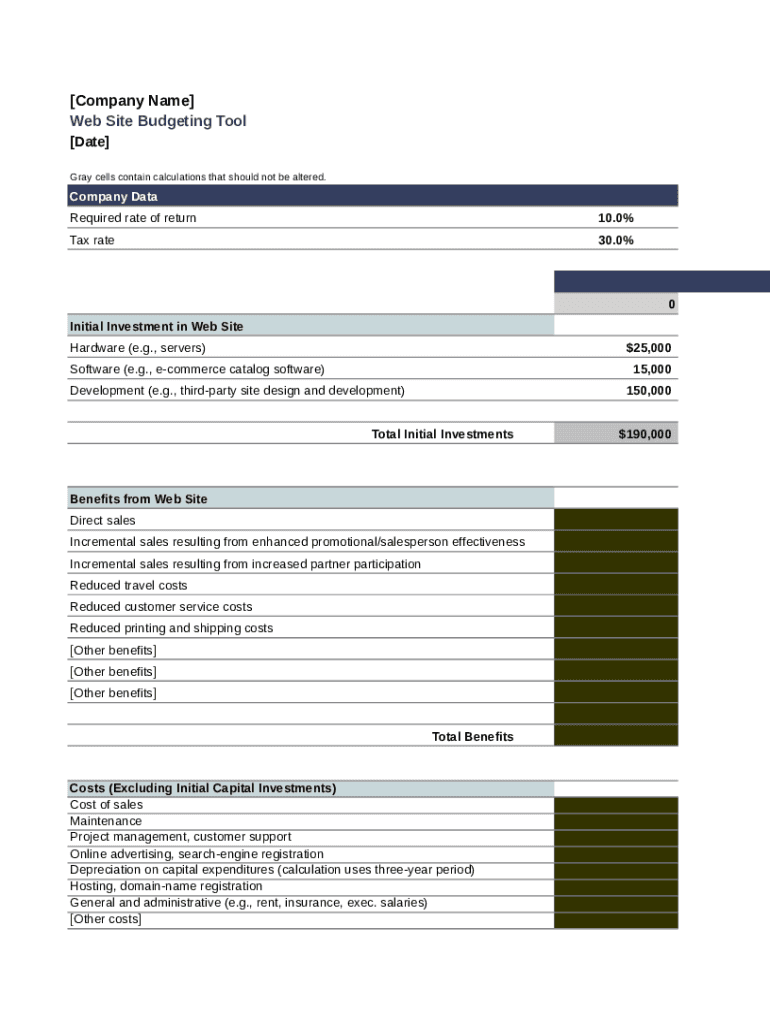
Company Name Web Site Budgeting Tool Date Gray cells contain calculations that should not be altered.Company Data Required rate of return10.0%Tax rate30.0%0 Initial Investment in Web Site Hardware.

Open form follow the instructions

Easily sign the form with your finger

Send filled & signed form or save
How to fill out the Web Site Budgeting Tool Form online
Filling out the Web Site Budgeting Tool Form is essential for understanding and planning your website's financial aspects. This guide will walk you through each section of the form to ensure a smooth and accurate completion process.
Follow the steps to successfully complete the form online.
- To begin, click the ‘Get Form’ button to access the Web Site Budgeting Tool Form and open it in your preferred online editor.
- In the 'Company Data' section, fill in the required rate of return and tax rate fields with accurate figures to reflect your company’s financial expectations.
- Input the 'Initial Investment in Web Site' by detailing costs for hardware, software, and development. Ensure these amounts are precise and straightforward.
- List the anticipated 'Benefits from Web Site' by identifying areas such as direct sales, cost reductions, and increased participation. Be thorough to capture all potential benefits.
- Document 'Costs (Excluding Initial Capital Investments)' which includes various expenses like cost of sales, maintenance, advertising, and any other overheads. Input needful estimates for a comprehensive budget.
- Review the automatically calculated fields, such as total costs, net benefits, and tax implications, to ensure that the figures align with your inputs.
- Lastly, you can save your changes, download a copy of the completed form, or print it for your records. Consider sharing it with relevant stakeholders for their insights.
Start filling out your Web Site Budgeting Tool Form online for effective financial planning!
Experience a faster way to fill out and sign forms on the web. Access the most extensive library of templates available.
Related content
Use this worksheet to see how much money you spend this month. Also, use the worksheet to...
Each individual sheet must be completed and the totals generated on each sheet are linked...
The National Science Foundation (NSF) is an independent agency of the United States...
Get answers to your most pressing questions about US Legal Forms API.
How do you create a budget for a beginner?
Step 1: List monthly income. Step 2: List fixed expenses. Step 3: List variable expenses. Step 4: Consider the model budget. Step 5: Budget for wants. Step 6: Trim your expenses. Step 7: Budget for credit card debt. Step 8: Budget for student loans.
How do you create a budget form?
Step 1: Note your net income. The first step in creating a budget is to identify the amount of money you have coming in. ... Step 2: Track your spending. ... Step 3: Set your goals. ... Step 4: Make a plan. ... Step 5: Adjust your habits if necessary. ... Step 6: Keep checking in.
What are 4 methods of budgeting?
Four Main Types of Budgets/Budgeting Methods. There are four common types of budgets that companies use: (1) incremental, (2) activity-based, (3) value proposition, and (4) zero-based. These four budgeting methods each have their own advantages and disadvantages, which will be discussed in more detail in this guide.
What are the 4 steps to preparing a budget?
Step 1: Identify Your Goals. ... Step 2: Review What You Have. ... Step 3: Define the Costs. ... Step 4: Create the Budget.
How do I make a budget template?
A budget template is a quick and easy way to budget your money every month. First, start by writing down your total take-home income. Then grab all of your monthly bills and write down where you are spending your money.
How do you create a simple budget sheet?
Step 1: Open a Google Sheet. ... Step 2: Create Income and Expense Categories. ... Step 3: Decide What Budget Period to Use. ... Step 4: Use simple formulas to minimize your time commitment. ... Step 5: Input your budget numbers. ... Step 6: Update your budget.
What are the 3 types of budgets?
Synopsis. Depending on the feasibility of these estimates, Budgets are of three types -- balanced budget, surplus budget and deficit budget.
What is budgeting and its types?
A budget is a quantitative plan for acquiring and using resources over a specified period. In an organization, the term master budget refers to a summary of a company's plans including specific targets for sales, production, and financing activities. ...
What are the four steps of creating a budget?
Determine your net income. ... Calculate your expenses. ... Set financial goals. ... Track your progress.
How do I make a monthly budget?
TOTAL YOUR MONTHLY TAKE-HOME PAY. ADD UP WHAT YOU SPEND ON FIXED EXPENSES. ADD UP WHAT YOU SPEND ON NON-MONTHLY COSTS. ADD UP CONTRIBUTIONS TO FINANCIAL GOALS. ADD UP YOUR DISCRETIONARY SPENDING. DO SOME SIMPLE MATH.
Use professional pre-built templates to fill in and sign documents online faster. Get access to thousands of forms.
If you believe that this page should be taken down, please follow our DMCA take down process here.