Loading
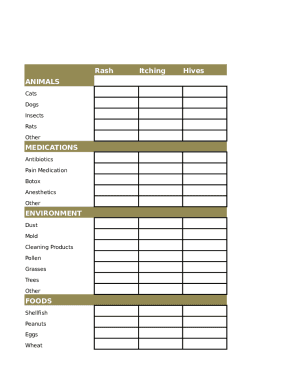
Get Et Eating Allergy Checklist
How it works
-

Open form follow the instructions
-

Easily sign the form with your finger
-

Send filled & signed form or save
How to fill out the Et Eating Allergy Checklist online
The Et Eating Allergy Checklist is an essential tool for individuals to document any allergies they may have. This guide will provide you with clear and effective instructions on how to fill out the checklist online.
Follow the steps to complete the checklist accurately.
- Press the ‘Get Form’ button to obtain the checklist and open it in your preferred online document editor.
- Begin by completing the section labeled 'Animals.' Here, indicate any allergies you have to animals such as cats, dogs, insects, and rats, by marking the relevant boxes. You may also specify any other animals by writing them in the provided space.
- Next, move to the 'Medications' section. List any allergic reactions you have experienced with medications, including antibiotics, pain medication, , anesthetics, or any other medications in the designated area.
- Proceed to the 'Environment' section. Document any environmental allergies, such as dust, mold, cleaning products, pollen, grasses, trees, or any other relevant substances.
- In the 'Foods' section, select any food allergies you may have by checking the boxes for shellfish, peanuts, eggs, wheat, soy, or others that you can specify.
- The form will also have sections regarding symptoms such as itching, hives, constipation, diarrhea, difficulty breathing, cramping, scratchy throat, runny nose, facial color changes, and swelling. Indicate any symptoms you experience by marking the corresponding boxes.
- Once you have completed all sections of the checklist, ensure that all information is accurate. You can then save your changes, download a copy of the form, print it for your records, or share it as needed.
Begin filling out your Et Eating Allergy Checklist online today to ensure your health and safety.
The 14 allergens are: celery, cereals containing gluten (such as barley and oats), crustaceans (such as prawns, crabs and lobsters), eggs, fish, lupin, milk, molluscs (such as mussels and oysters), mustard, peanuts, sesame, soybeans, sulphur dioxide and sulphites (if they are at a concentration of more than ten parts ...