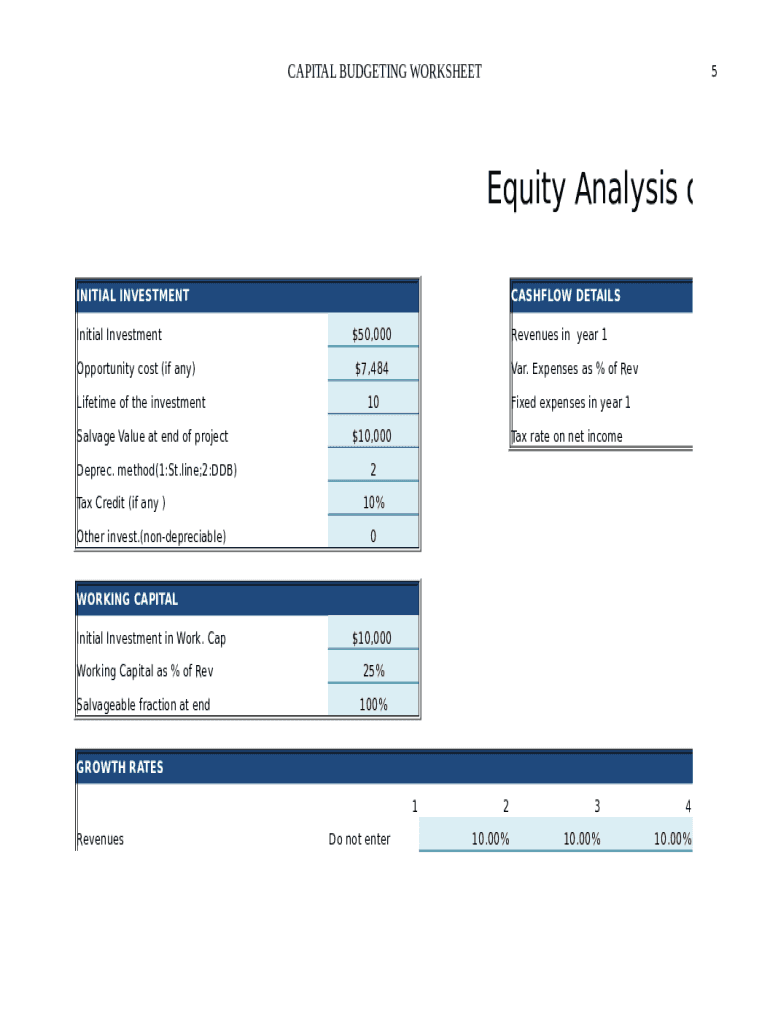
CAPITAL BUDGETING WORKSHEET5Equity Analysis of a Pro INITIAL INVESTMENT Initial Investment Opportunity cost (if any) Lifetime of the investment Salvage Value at end of project Deprec. method(1:St.line;2:DDB) Tax.

Open form follow the instructions

Easily sign the form with your finger

Send filled & signed form or save
How to fill out the Capital Budget Template online
The Capital Budget Template is a vital tool for managing financial decisions related to investments. This guide offers step-by-step instructions to help users efficiently complete the template online, ensuring accuracy and clarity in their budget planning.
Follow the steps to fill out the Capital Budget Template accurately online.
- Click ‘Get Form’ button to obtain the template and access it in the online editor.
- Fill in the initial investment section by entering the total amount planned for the investment. Include opportunity costs, the expected lifetime of the investment, salvage value at the end of the project, and choose the depreciation method applicable.
- In the Cashflow Details section, provide expected revenues for year one and specify variable and fixed expenses as percentages of revenues. Include the applicable tax rate on the net income.
- Complete the Working Capital section by inputting the initial investment in working capital and the percentage of working capital relative to revenue.
- Enter growth rates for revenues and fixed expenses as applicable, ensuring to follow the pre-set defaults for growth rates where necessary.
- Review the investment measures calculated at the end of the form, including NPV and IRR, to assess the investment's viability.
- Once all sections are filled out, save your changes. You may choose to download, print, or share the completed form for your records.
Complete your Capital Budget Template online today for effective financial planning.
Experience a faster way to fill out and sign forms on the web. Access the most extensive library of templates available.
Related content
Capital Budget Template. This budget is used where expenditures are lined out in...
A capital budget can be used to analyze the economic viability of a business project...
Gross domestic product (GDP) is a monetary measure of the market value of all the final...
Get answers to your most pressing questions about US Legal Forms API.
What is included in a capital budget?
Capital budgeting involves identifying the cash in flows and cash out flows rather than accounting revenues and expenses flowing from the investment. For example, non-expense items like debt principal payments are included in capital budgeting because they are cash flow transactions.
What are the 5 steps to capital budgeting and give an example?
The Five Stages of a Capital Budgeting Process Identification of Investment Opportunities. ... Development and Forecast of Benefits and Costs. ... Evaluation of Net Benefits. ... Authorization for Progressing and Spending Capital Expenditure. ... Control of Capital Projects.
How do I create a capital budget in Excel?
How to Create a Budget Spreadsheet in Excel Identify Your Financial Goals. ... Determine Your Budget Period. ... Calculate Your Total Income. ... Begin Creating Your Excel Budget. ... Enter All Cash, Debit and Check Transactions Into the Budget Spreadsheet. ... Enter All Credit Transactions. ... Calculate Total Expenses From All Sources.
What is an example of a capital budget?
Capital Budgeting Example The initial investment includes outlays for buildings, equipment, and working capital. $110,000 of cash revenue is projected for each of the 10 years of the project. After variable and fixed cash expenses are subtracted, $50,000 of net cash flow (before taxes) is generated.
What are the three types of capital budgeting?
3 Techniques Used In Capital Budgeting and Their Advantages Payback method. Net present value method. Internal rate of return method.
How do you create a capital budget?
Preparing a Capital Budgeting Analysis Step 1: Determine the total amount of the investment. ... Step 2: Determine the cash flows the investment will return. ... Step 3: Determine the residual/terminal value. ... Step 4: Calculate the annual cash flows of the investment. ... Step 5: Calculate the NPV of the cash flows.
What is meant by a capital budget?
A capital budget is a long-term plan that outlines the financial demands of an investment, development, or major purchase. As opposed to an operational budget that tracks revenue and expenses, a capital budget must be prepared to analyze whether or not the long-term endeavor will be profitable.
Use professional pre-built templates to fill in and sign documents online faster. Get access to thousands of forms.
If you believe that this page should be taken down, please follow our DMCA take down process here.