A skill or concept at grade level. 25. Material includes application of skills and concepts at grade level. 26. The material is focused on the major ideas/skills at that grade level. 27. Material makes it clear that student writing is a key task (argument, informative, response to audience and purpose, research). 28. Content includes 21st Century skill development such as collaboration, creative thinking, and problem solving. Other: Total Social Studies Content Criteria:.
Loading

Open form follow the instructions

Easily sign the form with your finger

Send filled & signed form or save
How to fill out the Rubrics Of Rating Instructi0nal Material online
This guide provides users with a step-by-step approach to completing the Rubrics Of Rating Instructi0nal Material form online. Properly filling out the form ensures that instructional materials meet educational standards and serve the diverse needs of students.
Follow the steps to complete the Rubrics Of Rating Instructi0nal Material form.
- Click ‘Get Form’ button to obtain the form and open it in your preferred editor.
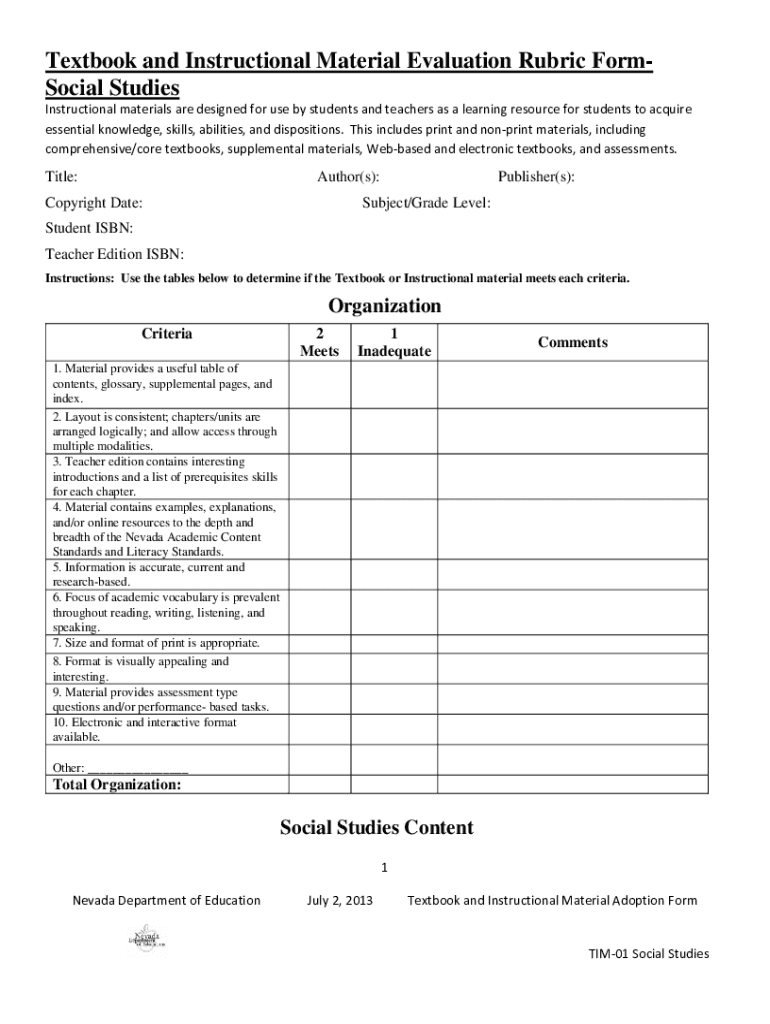
- Fill out the basic information section with relevant details including Title, Author(s), Copyright Date, Publisher(s), Subject/Grade Level, Student ISBN, and Teacher Edition ISBN.
- Review the criteria under the Organization section. For each criterion, indicate whether the material meets the standard by selecting '2' for Meets or '1' for Inadequate. Provide comments to support your assessment as necessary.
- Proceed to the Social Studies Content section and repeat the evaluation process. Assess each criterion accordingly and provide additional comments where relevant.
- Next, evaluate the Inclusion criteria using the same method. Ensure to assess accessibility, sensitivity, and inclusivity of the instructional material.
- Complete the Alignment section by evaluating the content's alignment with curriculum standards and college and career readiness skills.
- At the end of the form, calculate the total scores for Organization, Social Studies Content, Inclusion, and Alignment, then provide an overall total score for the textbook or instructional material.
- After filling out the form, review your entries for accuracy, then save your changes. You can download, print, or share the filled form as necessary.
Take the next step in educational quality by completing your document online today.
Experience a faster way to fill out and sign forms on the web. Access the most extensive library of templates available.
Related content
Rubric for Evaluating Reading/Language Arts Instructional Materials for Kindergarten to...
Rubric III Scoring Guide: 3: An object is rated superior for the utility of materials...
Instructional design (ID), also known as instructional systems design (ISD) or recently as...
Get answers to your most pressing questions about US Legal Forms API.
What are the five criteria used for acquiring instructional resources?
Five criteria were developed from data analysis. Specifically, teaching/learning resource selection should be (a) curriculum-appropriate; (2) make students interested; (3) balance students' interests and other factors when facing conflicts; (4) students-appropriate; (5) and flexible.
What are the criteria for instructional materials?
The following sections describe the four primary categories of criteria that teachers said they use when selecting instructional materials: accuracy and visual appeal, alignment to standards and depth of knowledge, ease of use and support, and engage- ment and ability to meet student needs (Figure 1).
What is an instructional rubric?
An instructional rubric is usually a one–or two–page document that describes varying levels of quality, from excellent to poor, for a specific assignment. It is usually used with a relatively complex assignment, such as a long-term project, an essay, or a research paper.
What are the six principles in selecting instructional materials?
The validity, accuracy, objectivity, timeliness, and appropriateness of materials must be considered.
What are the criteria for selection of learning resources?
Learning resources should be appropriate for the subject area and for the age, emotional development, ability level, learning styles and social development of the students for whom the materials are selected. 4. Learning resources should have aesthetic, literary, and/or social value.
What are the criteria for instructional methods?
Choosing an instructional method then requires the instructor to consider at least three main aspects: 1) the learning objectives, to make sure the method is appropriate, 2) the nature of the materials and 3) how we want students to interact with this information.
What are the 5 criteria used for acquiring instructional resources?
Specifically, teaching/learning resource selection should be (a) curriculum-appropriate; (2) make students interested; (3) balance students' interests and other factors when facing conflicts; (4) students-appropriate; (5) and flexible.
How do you evaluate instructional materials?
When evaluating instructional materials consider the extent to which each is interesting, approachable, and engaging....How well does the video align with your class? How well does the video align with your class? ... Is it at the right level for your students? ... How long is the video?
Use professional pre-built templates to fill in and sign documents online faster. Get access to thousands of forms.
If you believe that this page should be taken down, please follow our DMCA take down process here.