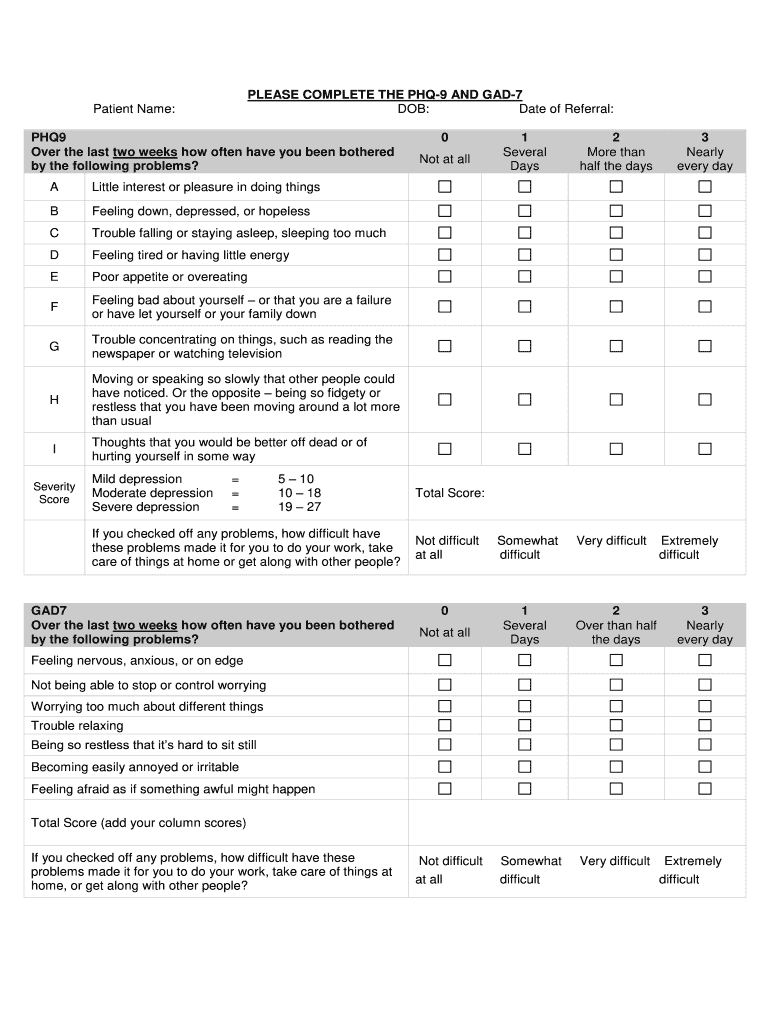
In doing things B Feeling down, depressed, or hopeless C Trouble falling or staying asleep, sleeping too much D Feeling tired or having little energy E Poor appetite or overeating F Feeling bad about yourself – or that you are a failure or have let yourself or your family down G Trouble concentrating on things, such as reading the newspaper or watching television H Moving or speaking so slowly that other people could have noticed. Or the opposite – being so fidgety or restless .

Open form follow the instructions

Easily sign the form with your finger

Send filled & signed form or save
How to fill out the UK PHQ-9 & GAD-7 online
The UK PHQ-9 and GAD-7 are essential tools for assessing mental health and anxiety levels. This guide will provide detailed, step-by-step instructions to help you complete these forms effectively and confidently.
Follow the steps to complete the forms accurately.
- Press the ‘Get Form’ button to access the form and open it in your preferred editor.
- Fill in your date of birth (DOB) and the date of referral in the designated fields.
- In the 'Patient Name' field, provide your full name to identify your responses.
- For the PHQ-9 section, read each statement carefully regarding your mood and experiences over the past two weeks. Rate how often you have been bothered by each issue, using the provided scale from 'Not at all' to 'Nearly every day'.
- Calculate your severity score based on the number of problems checked. This score will help indicate if you are experiencing mild, moderate, or severe depression.
- Next, in the GAD-7 section, similarly assess your feelings and experiences regarding anxiety over the past two weeks by rating each statement.
- Sum your scores from the GAD-7 section to determine your overall anxiety level.
- Finally, reflect on how these issues have affected your daily life and input your assessment in the provided field, indicating the level of difficulty they have caused.
- Once all fields have been completed, review your entries for accuracy, then save your changes. You may then download, print, or share the completed forms as needed.
Start filling out your documents online today to take a step towards understanding your mental health.
Experience a faster way to fill out and sign forms on the web. Access the most extensive library of templates available.
Related content
Over the last 2 weeks, how often have you been bothered by any of the following problems?...
Over the last 2 weeks, how often have you been bothered by any of the following problems?...
by JS Feinstein · 2018 · Cited by 103 — Patient Health Questionnaire (PHQ-9): The...
Get answers to your most pressing questions about US Legal Forms API.
How can you tell the difference between GAD and MDD?
Distinguishing between Generalized Anxiety Disorder (GAD) and Major Depressive Disorder (MDD) involves considering symptom patterns. GAD primarily presents with excessive worry and physical manifestations, while MDD focuses on persistent sadness and loss of interest in activities. Utilizing tools like the UK PHQ-9 & GAD-7 can aid in clarifying these differences. Comprehensive assessments can lead to more tailored treatment strategies.
What is the difference between PHQ-9 and GAD-7?
Although both the PHQ-9 and GAD-7 are vital mental health assessment tools, they differ in their focus. The PHQ-9 evaluates depressive symptoms, while the GAD-7 targets anxiety symptoms. To adequately address both issues, it’s often recommended to use them in tandem. Employing the UK PHQ-9 & GAD-7 can enhance your understanding of mental health.
What does the PHQ-9 mean NHS?
In the NHS context, the UK PHQ-9 is a widely recognized tool used for screening and diagnosing depression. It helps practitioners and patients discuss symptoms clearly. This instrument promotes early intervention strategies that can make a significant difference in treatment outcomes. Understanding your score on the PHQ-9 can facilitate more targeted mental health support.
How to get tested for anxiety in the UK?
To get tested for anxiety in the UK, consider reaching out to your primary care provider or a mental health professional. They often use tools like the GAD-7 to assess anxiety levels. If you prefer a more structured approach, platforms like USLegalForms offer resources that can guide you in finding appropriate assessments. Taking this step can lead you toward better mental health support.
What is the difference between GAD-7 and PHQ-9?
The key difference between the GAD-7 and PHQ-9 lies in what they measure. The GAD-7 assesses anxiety symptoms, while the PHQ-9 focuses on depressive symptoms. Both tools provide valuable insights but target distinct areas of mental health. Using both can offer a comprehensive view of an individual’s emotional well-being.
What is the gold standard for measuring anxiety?
The gold standard for measuring anxiety includes standardized tools like the GAD-7, which offers a reliable snapshot of anxiety levels. These instruments are psychometrically tested for validity and reliability. Utilizing such measures can empower you to have informed discussions with your healthcare provider. Implementing the UK PHQ-9 & GAD-7 in assessments ensures accurate diagnosis.
What is the clinical cut-off for PHQ-9 and GAD-7?
The clinical cut-off for the UK PHQ-9 is typically a score of 10 or higher, indicating moderate depression. For the GAD-7, a cut-off score of 8 usually suggests moderate anxiety. These thresholds aid healthcare professionals in determining the need for further evaluation. Understanding these cut-offs can help in making informed decisions about care.
When should the PHQ-9 be used?
The UK PHQ-9 should be used when you want to assess symptoms of depression in patients. It is particularly valuable for primary care settings, where quick screening can help in early intervention. Monitoring changes in scores can also inform treatment decisions. Using the PHQ-9 regularly can enhance patient care by identifying trends in mental health.
How to score PHQ and GAD?
To score the UK PHQ-9 & GAD-7, you need to add the values assigned to each response. Each question on the PHQ-9 and GAD-7 has a scoring range from 0 to 3. After calculating the total scores, you can determine the severity of symptoms. Understanding your score can guide you in seeking further evaluation or support.
What is the cut off for PHQ-9?
The cut-off for the PHQ-9 is a score of 10, which often signals moderate depressive symptoms requiring attention. Lower scores can indicate minimal or mild depression, while higher scores reflect increased severity. Regular use of the UK PHQ-9 & GAD-7 tools can greatly assist in tracking mental health changes over time and improving patient care.
Use professional pre-built templates to fill in and sign documents online faster. Get access to thousands of forms.
If you believe that this page should be taken down, please follow our DMCA take down process here.