; - divide the total wages earned for this period by 52; - the sum will be the average weekly wage. • If a full year’s wage information has not been provided covering the 52 week period prior to the date of accident: - determine the total wages earned, including yearly perquisites; - divide the total wages earned by the number of weeks wages were earned (Note: if warranted, the weeks can be converted into days and calculated on that basis); - the sum will be the average weekly wage. • .

How it works
  • Open form

    Open form follow the instructions

  • Easily sign form

    Easily sign the form with your finger

  • Share form

    Send filled & signed form or save

How to fill out the VA VWC 7A online

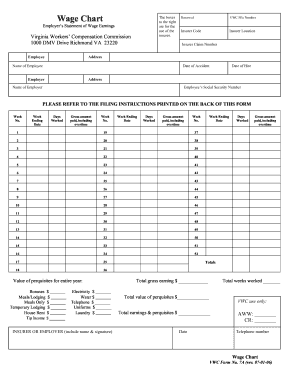
The VA VWC 7A form, also known as the Wage Chart, is essential for reporting wage earnings in relation to workers' compensation claims in Virginia. This guide provides clear, step-by-step instructions to help users complete the form accurately online.

Follow the steps to complete the VA VWC 7A form online.

  1. Click the ‘Get Form’ button to access the VA VWC 7A form and open it in your document editor.
  2. Begin by filling in the employer’s statement of wage earnings section. Include the employee's name, date of accident, and the employer's name, along with their respective addresses.
  3. Next, enter the employee’s Social Security Number and the VWC file number. These identifiers are crucial for processing the claim correctly.
  4. In the corresponding sections, indicate the insurer’s code, location, and claim number. This information is provided by the insurance company handling the claim.
  5. Now, focus on the weekly wage details. Complete the table for the 52 weeks immediately preceding the date of the accident. For each week, note the week number, ending date, days worked, and the gross amount paid, including overtime.
  6. If applicable, mark weeks in which the injured employee lost more than seven consecutive calendar days with an asterisk in the Week No. column.
  7. At the bottom of the chart, record the total gross earnings and the total value of perquisites, ensuring that the values reflect the annual amounts accurately.
  8. Lastly, have the insurer or employer complete the signature section. Include their name and sign to verify the information is correct.
  9. Review the form thoroughly for any errors or omissions before saving your changes. Once completed, you can download, print, or share the form as needed.

Complete your VA VWC 7A form online today to ensure efficient processing of your workers' compensation claim.

Get form

Experience a faster way to fill out and sign forms on the web. Access the most extensive library of templates available.

Related content

Wage Chart (Form 7A) | Virginia Workers'...

The Wage Chart should be used to determine the injured worker's pre-injury average weekly...

Learn more
Virginia Western Community College

Chapman Hall hours: Mon-Thurs 8AM – 5:30PM and Friday 8AM – 5PM. Appointments and...

Learn more
User's Guide DIGITAL StorageWorks Using Your HSZ70...

Note The HSZ70 controller has six SCSI–2 device ports. In a SCSI controller shelf, the...

Learn more
Questions & Answers

Get answers to your most pressing questions about US Legal Forms API.

Contact support

What is the waiting period for workers comp in Virginia?

The waiting period for workers' comp benefits in Virginia is typically seven days following the date of the injury. If your disability extends beyond the waiting period, you may be eligible for benefits retroactively. It is essential to keep thorough records and submit your claims promptly to minimize delays. If you have questions about your specific situation, USLegalForms can guide you through the waiting period as outlined by VA VWC 7A.

Rule 4.2 in the context of workers' comp in Virginia specifically deals with the administrative processes required for the timely filing of medical documentation. This rule is crucial for ensuring that claims proceed without unnecessary delays. It emphasizes the necessity for accurate and prompt submissions to help your claim get approved efficiently. To learn more about the implications of rule 4.2, consider checking out USLegalForms under the VA VWC 7A advisory.

The average workers' comp settlement in Virginia varies widely based on the injury severity and individual circumstances. Typically, settlements can range from a few thousand to substantial amounts depending on medical expenses and lost wages. It's important to be informed about what factors influence these settlements so you can negotiate more effectively. Resources such as USLegalForms offer insights into average settlements as they relate to VA VWC 7A.

The maximum amount of workers' compensation in Virginia is often determined by your average weekly wage and state limits. Each year, the Virginia Workers' Compensation Commission sets these limits, which can affect the overall compensation you receive. As of the most recent updates, understanding these limits is essential for anyone navigating claims. More information can be found through platforms like USLegalForms, which clarify these essential figures according to VA VWC 7A.

Rule 4.2 in Virginia Workers’ Compensation pertains to the procedures surrounding the submission of medical reports and the timeliness of these submissions. This rule ensures that all medical evidence presented aligns with the claims being filed. Familiarity with this rule can significantly enhance your ability to navigate workers' compensation claims smoothly. For comprehensive resources and guidance, USLegalForms provides helpful materials that address these nuances under VA VWC 7A.

To calculate Temporary Partial Disability (TPD) in Virginia, you need to determine the difference between your pre-injury average weekly wage and your current weekly wages after the injury. The TPD benefit is typically two-thirds of the difference, subject to maximum compensation caps. It’s vital to have accurate documentation of wages to ensure correct calculations are made according to VA VWC 7A standards. Resources like USLegalForms can assist you in managing these calculations effortlessly.

The coming and going rule in Virginia essentially means that if you are injured while commuting to or from work, those injuries may not be covered under workers' compensation. This rule aims to clarify that the injury must occur during the course of employment. Therefore, if you suffer an injury while running errands during work hours, that may qualify. Understanding this rule is important for filing a successful claim under the VA VWC 7A guidelines.

While 1099 employees typically do not require workers' compensation insurance under VA VWC 7A, there are exceptions based on the nature of the work. If your business carries inherent risks, consider the implications of not providing coverage. Evaluating your business model can help guide whether to obtain workers' comp, providing additional protection for both you and your workers. Consulting legal resources can simplify this decision.

In Virginia, most businesses with three or more employees are required to provide workers' compensation. This requirement includes both full-time and part-time workers as governed by VA VWC 7A. Certain professions, such as construction trades, may have additional regulations. Keeping abreast of these requirements is essential for business owners to maintain compliance.

Businesses in Virginia with more than three employees are generally required to carry workers' compensation insurance. This requirement extends to part-time, temporary, and seasonal workers under the VA VWC 7A guidelines. Additionally, specific industries, such as construction, have more stringent obligations. Ensuring compliance protects your business and your employees.

Get This Form Now!

Use professional pre-built templates to fill in and sign documents online faster. Get access to thousands of forms.

If you believe that this page should be taken down, please follow our DMCA take down process here.

Get VA VWC 7A