Loading
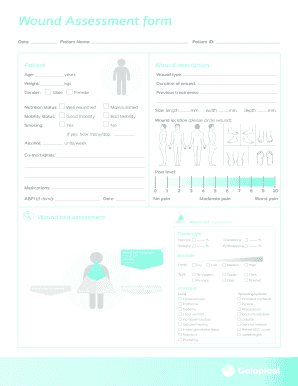
Get Wound Description
How it works
-

Open form follow the instructions
-

Easily sign the form with your finger
-

Send filled & signed form or save
How to fill out the Wound Description online
Filling out the Wound Description form online is essential for effective wound management and documentation. This guide provides a clear, step-by-step process to help users accurately complete the form, ensuring all necessary information is captured.
Follow the steps to accurately complete the Wound Description form.
- Click ‘Get Form’ button to access the Wound Description form and open it in an appropriate online editor.
- Begin by entering the patient’s name and identification details in the designated fields, ensuring accuracy for proper patient recognition.
- Provide information about the age and weight of the patient, selecting appropriate units (years and kgs) to maintain clarity.
- Specify the wound type by selecting from the provided options. This aids in categorizing the wound correctly for treatment purposes.
- Document the duration of the wound by indicating how long it has been present.
- Indicate the gender of the patient by selecting the appropriate option, ensuring accurate demographic categorization.
- Describe any previous treatments received for the wound, providing context for ongoing management.
- Assess and document the nutrition status of the patient, marking whether they are well-nourished or malnourished.
- Note the mobility status of the patient, indicating whether they have good or bad mobility, as this can affect wound care strategies.
- Address smoking status by selecting 'Yes' or 'No', as smoking can influence wound healing.
- Measure and enter the wound's size, including length, width, and depth in millimeters to ensure precise documentation.
- Circle the wound location on the provided diagram, which helps to clarify the specific area impacted.
- If applicable, indicate the average number of alcohol units consumed weekly by the patient.
- List any co-morbidities that the patient may have, as these can affect treatment decisions.
- Assess and document the pain level the patient is experiencing, using a defined scale that corresponds to zero to three levels of pain.
- If medications are being taken by the patient, provide a list under the medications section.
- Record the Ankle-Brachial Pressure Index (ABPI) if applicable, detailing the result using the provided scale.
- Detail the tissue type and level of exudate by choosing from the given options to guide treatment.
- Assess the wound edge and periwound skin for specific conditions like necrosis or maceration, marking these appropriately on the form.
- Conclude by outlining management goals and treatment plans based on the evaluations made, ensuring to include objectives for the next visit.
- Finally, save any changes made to the form, and utilize options to download, print, or share the completed document as necessary.
Complete your Wound Description form online today for effective wound management.
Definition/Introduction Class 1 wounds are considered to be clean. They are uninfected, no inflammation is present, and are primarily closed. ... Class 2 wounds are considered to be clean-contaminated. ... Class 3 wounds are considered to be contaminated. ... Class 4 wounds are considered to be dirty-infected.