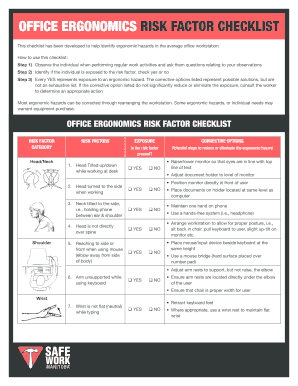
OFFICE ERGONOMICS RISK FACTOR CHECKLIST This checklist has been developed to help identify ergonomic hazards in the average office workstation. How to use this checklist: Step 1)Observe the individual.
Open form follow the instructions
Easily sign the form with your finger
Send filled & signed form or save
How to fill out the Office Ergonomics Checklist online
The Office Ergonomics Checklist is a valuable tool designed to help identify ergonomic hazards within a workstation. Properly filling out this checklist can contribute significantly to enhancing workplace comfort and safety.
Follow the steps to complete the checklist efficiently.
- Press the ‘Get Form’ button to access the Office Ergonomics Checklist and open it in your preferred editor.
- Begin by observing the individual performing their regular work activities while asking them relevant questions based on your observations.
- For each ergonomic risk factor presented in the form, check 'yes' or 'no' to indicate whether exposure to that risk factor is present.
- For every 'yes' response, review the corrective options provided and consider implementing them to address the identified ergonomic hazards.
- If the suggested corrective options do not sufficiently mitigate the issues, consult with the individual to explore further actions that might be necessary.
- Once all sections of the checklist have been completed and any necessary adjustments made, save changes to the document.
- Download, print, or share the completed checklist as required for future reference or submission.
Begin filling out the Office Ergonomics Checklist online to enhance your workplace ergonomics.
Experience a faster way to fill out and sign forms on the web. Access the most extensive library of templates available.
Related content
Computer Workstation Ergonomics: Self-Assessment Checklist ... information, refer to the...
HP created the Safety and Comfort Guide to describe the proper workstation setup, posture...
Get answers to your most pressing questions about US Legal Forms API.
What are the 5 ergonomic guidelines?
Always Work in the Neutral Posture Good upper body posture (shoulders back but relaxed—not slumping forward over the keyboard) Back supported by chair. Chair seat should not compress behind the knees. Feet firmly on a surface for support (floor/footrest) Head balanced on neck (not tilted back or too far forwards)
What are the 5 work ergonomic guidelines that each person should follow while working?
Ergonomic Tips for Computer Users Maintain good posture when working at the keyboard. ... Keep your feet supported on the floor or on a footrest when you work to reduce pressure on your lower back. Avoid twisting or bending your trunk or neck. ... Keep your shoulders relaxed with your elbows close to your sides.
What is ergonomics checklist?
A good ergonomic environment allows for maximum adjustability of the office equipment including desk height, chair height, backrest, seat pan, armrests, footrests, computer screens, keyboard position, document holders, and lighting.
What are 5 ergonomic requirements that you need to think about when you are setting up your work station?
7 Things You Need for an Ergonomically Correct Workstation A comfortable chair that supports your spine. ... A desk set at the proper height for using your keyboard. ... An external, ergonomic keyboard. ... A mouse that fits your hand. ... A display set at a comfortable height, within arm's reach. ... Good lighting.
What are the ergonomic standards for workstation?
push you bottom and hips as far back as they can go in the chair. adjust the seat height so you feet are flat on the floor or alternatively use a footrest. adjust the chair back to a 100-110 degree recline. adjust the armrest so that your shoulders are relaxed, or if in the way remove the rest.
What are the ergonomic requirements for working in an office?
Protect Your Office Workers With Good Ergonomics Ensuring the top of your monitor is at or just below eye level. Keeping your head and neck balanced and in-line with torso when seated at your computer. Keeping shoulders relaxed. Elbows should be close to body and supported. The lower back should be supported.
What are some ergonomic requirements?
Maintain proper posture, paying careful attention to positioning of head, neck/spine, arms/wrists, hips/thighs and feet. Basically, ensure the small of your back is supported, your shoulders relaxed (not slumped, not elevated), and that there is no pressure under your thighs.
Use professional pre-built templates to fill in and sign documents online faster. Get access to thousands of forms.
If you believe that this page should be taken down, please follow our DMCA take down process here.