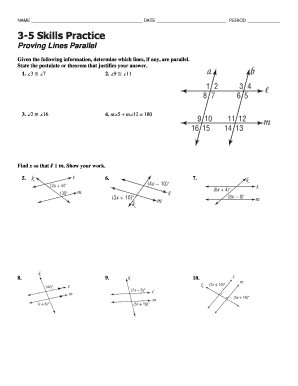
NAME DATE PERIOD 35 Skills Practice Proving Lines Parallel Given the following information, determine which lines, if any, are parallel. State the postulate or theorem that justifies your answer.

How it works
  • Open form

    Open form follow the instructions

  • Easily sign form

    Easily sign the form with your finger

  • Share form

    Send filled & signed form or save

How to fill out the Proving Lines Parallel Practice online

This guide provides step-by-step instructions for effectively completing the Proving Lines Parallel Practice online. Whether you are new to document management or seeking to refresh your skills, this guide will support you through each section of the form.

Follow the steps to complete the Proving Lines Parallel Practice

  1. Click ‘Get Form’ button to access the Proving Lines Parallel Practice. This action will allow you to view and edit the document in an online format.
  2. Begin by filling in your name in the designated NAME field at the top of the form. This will help identify your submission once completed.
  3. Next, enter the current DATE in the appropriate section to indicate when you are completing the practice.
  4. In the PERIOD field, specify your class period. This information can help your instructor track submissions more efficiently.
  5. Read the instructions carefully for each problem regarding the relationships between angles. For example, state which lines are parallel, referencing the appropriate postulate or theorem.
  6. Work through the provided angle relationships, such as ∠3 ≅ ∠7 and ∠9 ≅ ∠11, and justify your answers based on the properties of parallel lines.
  7. Solve for any unknown variables, such as x. Make sure to show all your work in the spaces provided to demonstrate your reasoning.
  8. Review all your entries to ensure accuracy and completeness before finalizing the document.
  9. Once you are satisfied with your responses, you can choose to save your changes, download the completed form, print it, or share it as needed.

Complete your Proving Lines Parallel Practice online today for an efficient and organized approach to document management.

Get form

Experience a faster way to fill out and sign forms on the web. Access the most extensive library of templates available.

Related content

Suggested Practice for SOL G.7 M N O S T V Given...

Suggested Practice for SOL G.2. For what value of. x. will line. c. be parallel to line. d...

Learn more
Parallel Lines Cut by a Transversal

to apply the angle theorems to prove lines parallel, to practice geometric proof and...

Learn more
Grafika_eloadasdia_2019-tavasz_4.pdf - VIK Wiki

coordinates map lines to lines and also preserve parallel lines. This theorem can ... In...

Learn more
Questions & Answers

Get answers to your most pressing questions about US Legal Forms API.

Contact support

What is the 3 parallel lines theorem?

Three Parallel Lines Theorem If three parallel lines intersect two transversals, then they divide the transversals proportionally.

If two lines and a transversal form corresponding angles that are congruent, then the lines are parallel. Converse of the Alternate Interior Angles Theorem: If two lines and a transversal form alternate interior angles that are congruent, then the two lines are parallel.

Ways to Prove Lines Are Parallel the converse of the alternate interior angles theorem. the converse of the corresponding angles theorem. the converse of the same-side interior angles postulate. the converse of the alternate exterior angles theorem.

Properties of Parallel Lines Corresponding angles are equal. Vertical angles/ Vertically opposite angles are equal. Alternate interior angles are equal. Alternate exterior angles are equal. Pair of interior angles on the same side of the transversal are supplementary.

If two lines and a transversal form same-side interior angles that are supplementary, then the two lines are parallel. If two lines and a transversal form alternate exterior angles that are congruent, then the two lines are parallel.

The definition of parallel lines, in Euclid's wording, is that of “straight lines which, being in the same plane and being produced indefinitely in both directions, do not meet one another in either direction”.

Get This Form Now!

Use professional pre-built templates to fill in and sign documents online faster. Get access to thousands of forms.

If you believe that this page should be taken down, please follow our DMCA take down process here.

Get Proving Lines Parallel Practice