May 16, 2011 ... The Breast Cancer Risk Assessment Tool is an interactive tool designed by scientists at the National Cancer Institute (NCI) and the National .
Loading
Open form follow the instructions
Easily sign the form with your finger
Send filled & signed form or save
How to fill out the Breast Cancer Risk Survey (Gail Model) online
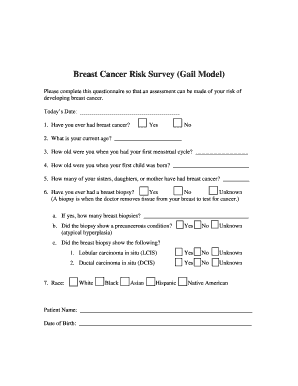
The Breast Cancer Risk Survey, commonly known as the Gail Model, is an important tool for assessing breast cancer risk. This guide provides a step-by-step process to help users accurately complete the survey online.
Follow the steps to fill out the Breast Cancer Risk Survey effectively.
- Press the ‘Get Form’ button to access the questionnaire and open it for completion.
- Enter today’s date in the designated field to provide context for your responses.
- Indicate whether you have ever been diagnosed with breast cancer by selecting 'Yes' or 'No'.
- Input your current age in the specified area.
- Provide the age at which you experienced your first menstrual cycle.
- State the age you were when your first child was born in the appropriate field.
- Indicate how many of your sisters, daughters, or mother have been diagnosed with breast cancer.
- Respond to whether you have ever had a breast biopsy by selecting 'Yes', 'No', or 'Unknown'.
- Select 'Yes', 'No', or 'Unknown' regarding whether the biopsy showed a precancerous condition such as atypical hyperplasia.
- Indicate if the biopsy showed lobular carcinoma in situ (LCIS) by selecting 'Yes', 'No', or 'Unknown'.
- Select if the biopsy indicated ductal carcinoma in situ (DCIS) with options 'Yes', 'No', or 'Unknown'.
- Choose your race from the options provided: White, Black, Asian, Hispanic, or Native American.
- Fill in your name and date of birth in the designated fields.
- Review your responses for accuracy, then save your changes, download, print, or share the completed form as needed.
Complete the Breast Cancer Risk Survey online to better understand your personal risk factors.
Experience a faster way to fill out and sign forms on the web. Access the most extensive library of templates available.
Related content
An interactive tool, also known as The Gail Model, designed by scientists at the National...
The Breast Cancer Risk Assessment tool (http://www.cancer.gov/bcrisktool/) was developed...
Outcome and Assessment Information Set (OASIS)/Outcome- Based Quality Improvement (OBQI)...
Get answers to your most pressing questions about US Legal Forms API.
What is the Gail model for breast cancer risk?
The Gail model incorporates six breast cancer risk factors, namely: age, age at menarche, age at first live birth, number of breast biopsies, history of atypical hyperplasia, and number of first-degree relatives with breast cancer (Gail et al., 1989; Claus et al., 1994; Costantino at al., 1999).
What is a normal Gail score?
A woman's risk is considered low if her five-year risk of developing breast cancer is less than 1.6%; it is considered high if she scores above 1.66%. (All women who are over 60 have a score of at least 1.66 and are considered high risk, based on the Gail Model.)
What is the Gail score risk assessment?
This assessment is based on your family and personal history. You may be at higher risk for breast cancer. This score is called a Gail score. The Gail score can estimate your risk of getting invasive breast cancer in the next 5 years.
What is the Gail index for breast cancer?
The Gail Model for Breast Cancer risk estimates the absolute 5 year risk and lifetime risk of developing breast cancer. Family history includes only first degree relatives with breast cancer, which is not enough information to estimate the risk of a patient having BRCA mutation.
Which is better Gail model or Tyrer Cuzick?
Differences in the Models In instances of predicting risk in women who have a higher familial cancer history, the Tyrer-Cuzick is likely the most appropriate choice. This is because the Gail model has a tendency to underestimate risk of developing breast cancer in women with familial history of cancer.
What Gail score is high risk?
A score of greater than 1.7% is high. Women age 35-79 with a Gail score greater than 1.7% may reduce the risk of developing breast cancer by taking cancer preventing medicines.
What does a Gail score of 1.66 percent indicates?
This number, which corresponds to the Gail original score of 1.66, was used as a cutoff point to categorize patients as high risk.
Use professional pre-built templates to fill in and sign documents online faster. Get access to thousands of forms.
If you believe that this page should be taken down, please follow our DMCA take down process here.