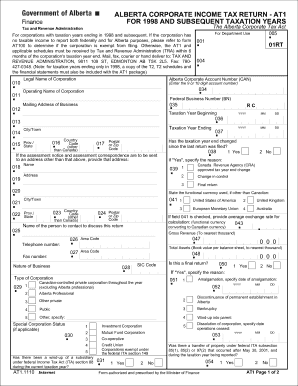
On years ending in 1998 and subsequent. If the corporation has no taxable income to report both federally and for Alberta purposes, please refer to form AT100 to determine if the corporation is exempt from filing. Otherwise, the AT1 and applicable schedules must be received by Tax and Revenue Administration (TRA) within 6 months of the corporation's taxation year end. Mail, fax, courier or hand deliver to: TAX AND REVENUE ADMINISTRATION, 9811 109 ST, EDMONTON AB T5K 2L5. Fax: 780427-0348. (Note:.
Loading
Open form follow the instructions
Easily sign the form with your finger
Send filled & signed form or save
How to fill out the Canada AT1 online
The Canada AT1 form is essential for corporations operating within Alberta, enabling them to report their income tax for taxation years ending in 1998 and subsequent years. This guide will provide step-by-step instructions to help users complete the form accurately and effectively online.
Follow the steps to fill out the form correctly.
- Press the ‘Get Form’ button to access the Canada AT1 form online.
- Fill in the legal name of the corporation in the designated field. Ensure that the name is consistent with the entity's registration documents.
- Enter the federal business number (BN) in the specified area. If your corporation does not have a BN, you should seek guidance on obtaining one.
- Provide the mailing address for the business, including the street address, city, province or state, and postal or zip code.
- Indicate the taxation year start and end dates. This is critical for determining the period for which you are reporting.
- Answer whether there has been a change in the taxation year end since the last return. If yes, provide the reason for this change.
- Specify the nature of your business by entering the SIC code, if applicable, ensuring you select the most accurate description.
- If this is a final return, indicate this in the corresponding section and provide a reason if necessary.
- Report the gross revenue and total assets, rounding to the nearest thousand. Ensure that you report all monetary amounts in dollars without cents.
- Complete the sections related to Alberta taxable income and other deductions, cross-referencing the appropriate schedules as required.
- After filling all sections, ensure you review your entries for accuracy and completeness. It is vital for efficient processing.
- Finally, save your changes and options will be presented to download, print, or share the form as needed.
Start completing your AT1 form online today to ensure timely submission.
Experience a faster way to fill out and sign forms on the web. Access the most extensive library of templates available.
Related content
Jan 23, 2025 — The Notes and the AT1 Notes will constitute subordinated indebtedness for...
As a result of that forced merger, approximately US$17 billion of Additional Tier 1 (AT1)...
Mar 4, 2019 — This monitor contains radio transmitters and has been designed...
Get answers to your most pressing questions about US Legal Forms API.
How far back can a corporation amend a tax return?
A corporation can typically amend a tax return up to three years from the original filing date. This timeframe allows you to correct any mistakes, ensuring your financial records are accurate and compliant. Be proactive in addressing issues to avoid complications with the Canada Revenue Agency. For detailed guidance, consider the resources provided by uslegalforms.
How to amend Alberta corporate tax return?
To amend an Alberta corporate tax return, submit an amended return to the Alberta's taxation authority specifying the changes you want to make. Fill out the required forms accurately, detailing the corrections needed. This process is crucial to ensure your corporate taxes reflect your true financial position. Uslegalforms provides helpful templates to make amending as simple as possible.
Can I amend my tax return if I already filed?
Yes, you can amend your tax return even after filing. You'll need to use a designated form, such as the T1 Adjustment Request, to make the changes. It’s essential to address any discrepancies promptly to maintain accurate records with the Canada Revenue Agency. For assistance, consider exploring resources available at uslegalforms.
How do I correct a mistake on my tax return in Canada?
To correct a mistake on your tax return in Canada, you need to request a change from the Canada Revenue Agency. This typically involves submitting a T1 Adjustment Request and providing the correct information. Prompt corrections can help avoid interest charges or penalties, ensuring your compliance with regulations. USLegalForms also has resources that simplify this process.
How to fill out a W8BEN form in Canada?
Filling out a W8BEN form in Canada is straightforward if you follow the steps carefully. Start by providing your name, country of citizenship, and address. Then, declare the type of income you receive and claim any applicable tax treaty benefits. For a clearer understanding, you might want to consult uslegalforms, which offers guided templates and support.
Do I have to file an Alberta corporate tax return?
Yes, if your corporation operates in Alberta, you must file an Alberta corporate tax return. Filing is essential for reporting your corporation's income, expenses, and taxes owed. Additionally, compliance helps you avoid penalties and ensures a smooth operation. You can find resources and assistance, including useful templates, on platforms like uslegalforms.
What is the Osfi ruling for LRCNs?
The Office of the Superintendent of Financial Institutions (OSFI) regulates LRCNs in Canada to ensure compliance with financial stability requirements. Their ruling outlines how these notes fit into capital adequacy frameworks and helps protect investors. Familiarity with the OSFI's guidelines is crucial for individuals involved in Canada AT1 investments to maintain compliance and security.
What is an LRCN?
An LRCN, or Limited Recourse Capital Note, is specifically designed to raise capital while also reducing risk exposure for investors. These notes allow issuers to manage their capital structure efficiently. Investors interested in Canada AT1 can benefit from the unique features of LRCNs, enabling diversified investment strategies.
What is an LCRn?
An LCRn, or Liquidity Coverage Ratio Note, relates to regulations established to ensure banks maintain sufficient short-term liquidity. These instruments help institutions meet capital needs during financial difficulties. Understanding LCRns is advantageous for those exploring investment options in Canada AT1 offerings, as liquidity is a critical aspect of financial security.
How to get into Canadian investment banking?
Breaking into Canadian investment banking typically requires a strong educational background, often in finance or economics. Networking is crucial; attending industry events and connecting with professionals can open doors to opportunities. Additionally, aspiring candidates should consider internships in leading firms to gain relevant experience, especially in relation to Canada AT1 financial products.
Use professional pre-built templates to fill in and sign documents online faster. Get access to thousands of forms.
If you believe that this page should be taken down, please follow our DMCA take down process here.
This form is available in several versions. Select the version you need from the drop-down list below.