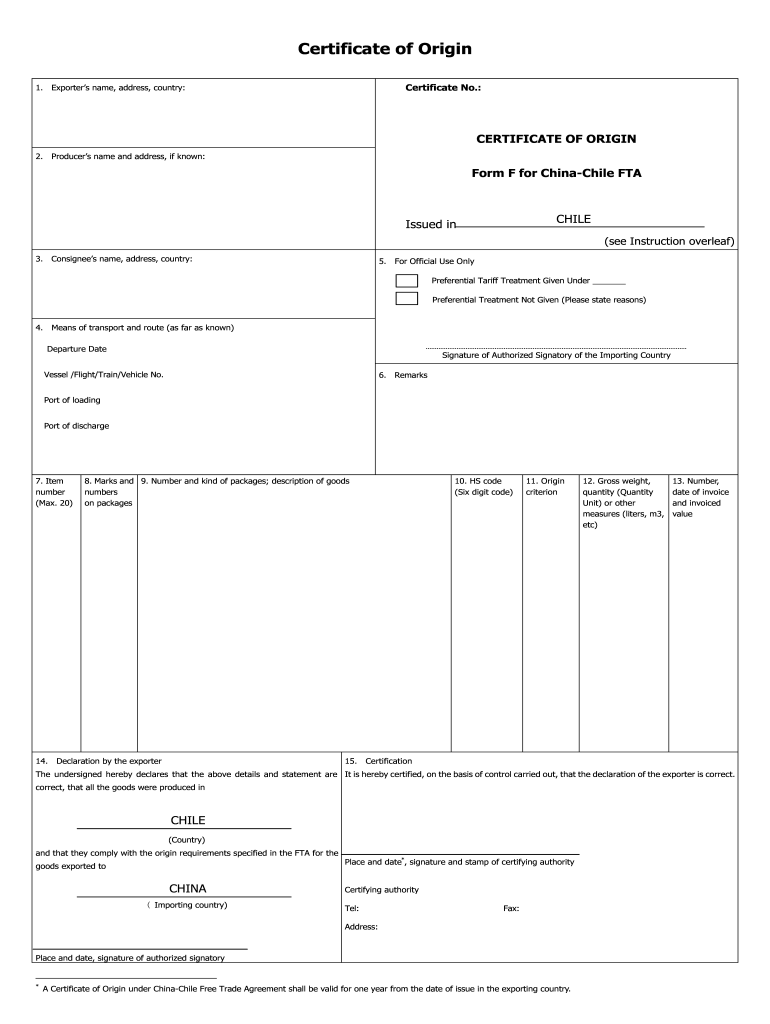
Instruction overleaf) 3. Consignee’s name, address, country: 5. For Official Use Only Preferential Tariff Treatment Given Under _______ Preferential Treatment Not Given (Please state reasons) 4. Means of transport and route (as far as known) Departure Date Signature of Authorized Signatory of the Importing Country Vessel /Flight/Train/Vehicle No. 6. Remarks Port of loading Port of discharge 7. Item number (Max. 20) 8. Marks and 9. Number and kind of packages; description of goods numb.
Loading

Open form follow the instructions

Easily sign the form with your finger

Send filled & signed form or save
How to fill out the Certificate of Origin Form F online
The Certificate of Origin Form F is a crucial document used in international trade. This guide will help you understand the form and provide a clear, step-by-step process for completing it online.
Follow the steps to expertly complete the Certificate of Origin Form F online.
- Click ‘Get Form’ button to obtain the form and open it for editing.
- Enter the full legal name, address, and country of the exporter in the designated field.
- If known, input the producer’s full legal name and address in the next section. If there are multiple producers, list them appropriately, or indicate 'SAME' if the exporter is also the producer.
- Provide the consignee’s name, address, and country in the following field.
- Fill in mean of transport details, including the departure date, transport vehicle number, port of loading, and discharge.
- Indicate whether preferential tariff treatment is accorded by checking the relevant box.
- Enter the item number, ensuring it does not exceed twenty entries.
- Fill in the marks and numbers found on the packages.
- Specify the number and kind of packages and offer a detailed description of each good.
- Identify the HS tariff classification for each item described.
- Describe the origin criteria for the goods, selecting from options like ‘P’, ‘RVC’, or ‘PSR’ as applicable.
- Document the gross weight, quantity, or other measures of the goods.
- Record the invoice number, date, and invoiced value accurately.
- Complete the declaration by the exporter, ensuring it is signed and dated.
- The certifying authority must sign, date, and stamp the document, providing their contact details.
- Finally, review the completed document, and save or download it as needed.
Complete your Certificate of Origin Form F online today.
Experience a faster way to fill out and sign forms on the web. Access the most extensive library of templates available.
Related content
Jun 21, 2023 — The PDF provided on this page is a fillable template that demonstrates...
An importer who claims preferential tariff treatment on a good must submit, at the request...
Charges. Indicate which charges (Freight, Origin Cost, Duty, Tax and Customs) are to be...
Get answers to your most pressing questions about US Legal Forms API.
Who provides a certificate of origin?
Typically, a Certificate of Origin Form F is issued by the exporter or their agent. Various organizations, such as chambers of commerce, may also provide certification services. It’s important to choose a reliable source to ensure that the certificate is accepted by customs authorities and meets all regulatory requirements.
Can I make my own certificate of origin?
Yes, you can create your own Certificate of Origin Form F. However, it’s crucial to ensure that all required details are included and that it meets the specific regulations of your destination country. Using a trusted platform like US Legal Forms can simplify this task by providing templates and guidance to ensure compliance and accuracy.
What is the purpose of a certificate of origin?
The primary purpose of the Certificate of Origin Form F is to confirm the geographical origin of products being exported. This document helps facilitate customs clearance, supports compliance with trade agreements, and can affect tariff rates. By providing accurate origin information, you can avoid delays in the shipping process.
Is the certificate of origin the same as a title?
No, a Certificate of Origin Form F is not the same as a title. A title indicates ownership of a vehicle or property, while the Certificate of Origin serves as proof of where goods originate. Understanding this distinction is essential for proper documentation in shipping and customs processes.
What is a Certificate of Origin with an example?
A Certificate of Origin Form F is a document that certifies the origin of goods being exported. For example, if a company in the United States exports electronics manufactured in Texas to a buyer in Canada, the certificate will state that the items are made in the U.S. This document is crucial for complying with international trade regulations and tariffs.
How to fill out a Certificate of Origin form?
Filling out the Certificate of Origin Form F involves a few straightforward steps. Start by entering the exporter and consignee details, then describe the goods clearly. Carefully review each section to include all required information, ensuring everything is accurate before signing and dating the form. Using our US Legal Forms platform can streamline this process with pre-filled templates.
What information is needed for Certificate of Origin?
To complete a Certificate of Origin Form F, you need essential details such as the name and address of the exporter, the name and address of the consignee, a description of the goods, and their origin. Additionally, it’s vital to include shipment details and any tariffs or export regulations that apply. This information ensures that the certificate accurately reflects the product and its journey.
Who generates the certificate of origin?
The generation of a Certificate of Origin often involves collaboration between the manufacturer, exporter, and authorized agencies. In many cases, a trusted platform like USLegalForms can assist in creating and filling out the Certificate of Origin Form F accurately. Utilizing such services ensures you comply with international trade requirements seamlessly. This can significantly reduce the burden of paperwork and enhance trade efficiency.
Who fills out USMCA certificate of origin?
The USMCA Certificate of Origin must be filled out by the exporter or producer of the goods. They are responsible for providing accurate details regarding product origin and compliance with USMCA rules. This certification can also involve input from the buyer or other parties in the supply chain. Ensuring the correct completion of the Certificate of Origin Form F can help streamline the trade process and avoid potential penalties.
What is a form of a certificate of origin?
A Certificate of Origin comes in various forms depending on the specific trade agreement or country involved. The most common types include the standard Certificate of Origin and the Form F used under USMCA regulations. Each form serves the same purpose: to certify the origin of goods. Choosing the correct Certificate of Origin Form F for your products will minimize customs issues and enhance trade compliance.
Use professional pre-built templates to fill in and sign documents online faster. Get access to thousands of forms.
If you believe that this page should be taken down, please follow our DMCA take down process here.