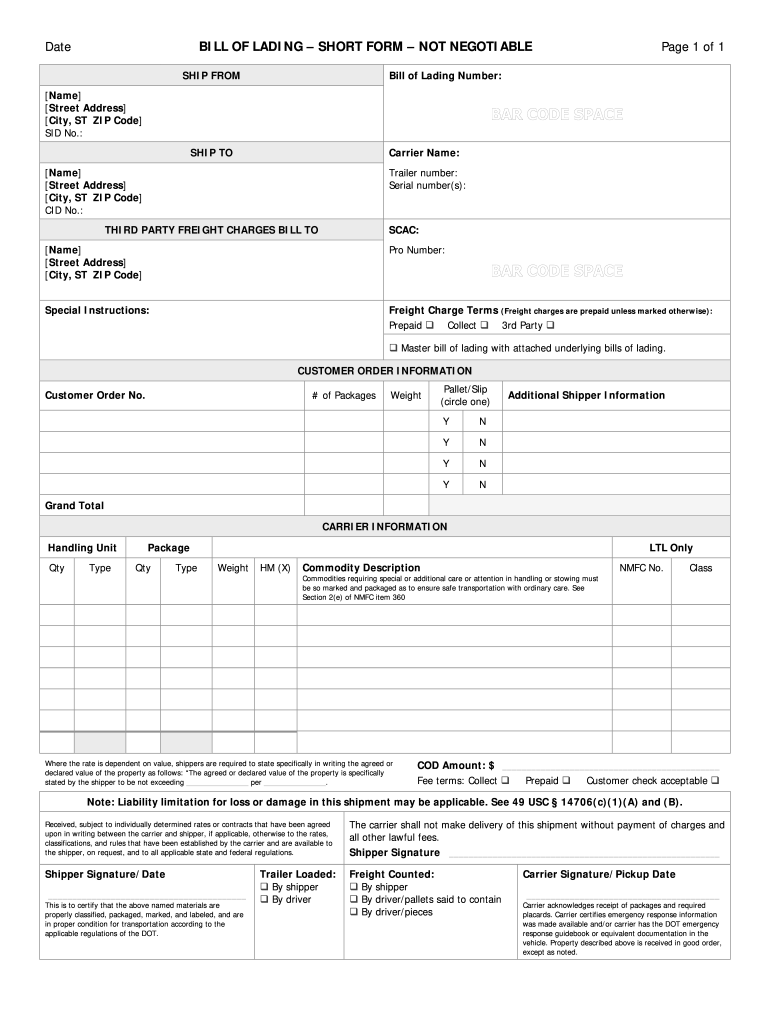
Date BILL OF LADING SHORT FORM NOT NEGOTIABLE SHIP FROM Page 1 of 1 Bill of Lading Number Name Street Address City ST ZIP Code SID No. SHIP TO Carrier Name Trailer number Serial number s THIRD PARTY FREIGHT CHARGES BILL TO SCAC Pro Number Special Instructions Freight Charge Terms Freight charges are prepaid unless marked otherwise Prepaid Collect 3rd Party Master bill of lading with attached underlying bills of lading. CUSTOMER ORDER INFORMATION Customer Order No* of Packages Weight Pallet/Slip circle one Y N Additional Shipper Information Grand Total CARRIER INFORMATION Handling Unit Qty Type LTL Only HM X Commodity Description Commodities requiring special or additional care or attention in handling or stowing must be so marked and packaged as to ensure safe transportation with ordinary care. See Section 2 e of NMFC item 360 Where the rate is dependent on value shippers are required to state specifically in writing the agreed or declared value of the property as follows The agreed....
Loading

Open form follow the instructions

Easily sign the form with your finger

Send filled & signed form or save
How to fill out the Bill of Lading Short Form online
Filling out the Bill of Lading Short Form online is a straightforward process that helps ensure the safe and effective transport of goods. This guide provides clear, step-by-step instructions for completing each section of the form accurately.
Follow the steps to fill out the Bill of Lading Short Form online.
- Press the ‘Get Form’ button to obtain the Bill of Lading Short Form and open it in your preferred editor.
- Begin with the 'Ship From' section. Enter the name, street address, city, state, and ZIP code of the sender. Include the SID number if applicable.
- In the 'Ship To' section, input the recipient's name and address details, alongside the CID number.
- Fill out the 'Carrier Information' by providing the carrier name, trailer number, and serial numbers.
- If applicable, complete the 'Third Party Freight Charges Bill To' section by entering the name and address of the third party responsible for freight charges.
- Indicate the freight charge terms. Select one from 'Prepaid', 'Collect', or '3rd Party'.
- Complete the 'Customer Order Information' section. Enter the customer order number, the number of packages, and weight. You may also indicate if pallets or slips are used.
- For 'Carrier Information', input the handling unit, quantity, and package type, making sure to specify any units such as LTL and hazardous materials if necessary.
- Provide a detailed description of the commodity being shipped in the 'Commodity Description' section.
- State any declared value of the property as required if the rate is value-dependent.
- Complete the 'COD Amount' if applicable and note any fees.
- Sign and date the form in the 'Shipper Signature' section. Include any freight count and signatures by the driver if necessary.
- Review all information for accuracy. Once everything is complete, save your changes. You can then download, print, or share the form as needed.
Start filling out your Bill of Lading Short Form online today for a streamlined shipping process.
Experience a faster way to fill out and sign forms on the web. Access the most extensive library of templates available.
Related content
BILL OF LADING – SHORT FORM – NOT NEGOTIABLE. Page 1 of 1. SHIP FROM. Bill of Lading...
Short form Bill of Lading. Date of Original: 18 August 1966. Format of Original: ["Project...
Oct 1, 2018 — (19) BILL TO: A person or entity designated as "Bill To" (BT) on the Bill...
Get answers to your most pressing questions about US Legal Forms API.
What is the difference between BL and SWB?
The key difference between a Bill of Lading (BL) and a Sea Waybill (SWB) lies in their legal implications. A BL serves as a document of title, which means it can be transferred to others, while an SWB is typically non-negotiable. Understanding these distinctions can enhance your shipping operations and help you choose the right documentation, such as the Bill of Lading Short Form, for your needs.
How to fill out a bill of lading form?
To fill out a bill of lading form properly, start with the sender's and receiver's details at the top of the document. Next, describe the goods being shipped, specifying quantity, weight, and nature. Employing a Bill of Lading Short Form from a reliable source like USLegalForms can make this process easier and ensure accuracy.
What is the bill of lading in short?
In short, a bill of lading serves as a document issued by a carrier to acknowledge receipt of cargo for shipment. It also acts as a contract for the transport of goods and can confer title. The Bill of Lading Short Form simplifies this by condensing essential information into a more manageable document.
Is CMR a bill of lading?
The CMR, or Convention on the Contract for the International Carriage of Goods by Road, serves a similar function to a bill of lading but is specifically tailored for road transport. While both documents facilitate the shipment process, the CMR is used in international road transport while the Bill of Lading Short Form can be used for various means, including air and sea.
What should be entered on the bill of lading?
On the bill of lading, you should enter crucial details such as the consignor and consignee's names, addresses, and contact information. Additionally, include a detailed description of the cargo, its weight, and any special handling instructions. Utilizing a Bill of Lading Short Form can help streamline this information, making it easier to fill out.
How do you write a bill of lading?
Writing a bill of lading involves formulating a clear and concise document. Begin by including essential details such as sender and receiver information, a description of the cargo, and shipping instructions. By using a Bill of Lading Short Form template, you can ensure that all necessary components are included without unnecessary complications.
What is another name for a BoL?
Another common name for a BoL is the shipping receipt. This terminology emphasizes its role in acknowledging the receipt of goods for transport. Understanding the various names, including the Bill of Lading Short Form, can help you navigate shipping and logistics more effectively.
How to fill a bill of lading form?
Filling out a bill of lading form involves several key steps. First, accurately entering the sender's and receiver's information is crucial. Next, detail the goods being shipped, including descriptions and quantities, to ensure clarity. Consider utilizing platforms like USLegalForms to access templates that guide you through the process seamlessly.
What is the short form of bill of lading?
The short form of bill of lading is commonly referred to as a BoL. It serves as a receipt for goods, a contract of carriage, and a document of title. By using the Bill of Lading Short Form, businesses can simplify shipping documentation while ensuring compliance with legal requirements.
What is the difference between through bill of lading and bill of lading?
A through bill of lading covers multiple modes of transportation from the shipper to the final destination without requiring separate documents for each transport leg. In contrast, a standard bill of lading may only detail one specific leg of the shipment. Understanding the differences between the two is essential for effective logistics management.
Use professional pre-built templates to fill in and sign documents online faster. Get access to thousands of forms.
If you believe that this page should be taken down, please follow our DMCA take down process here.