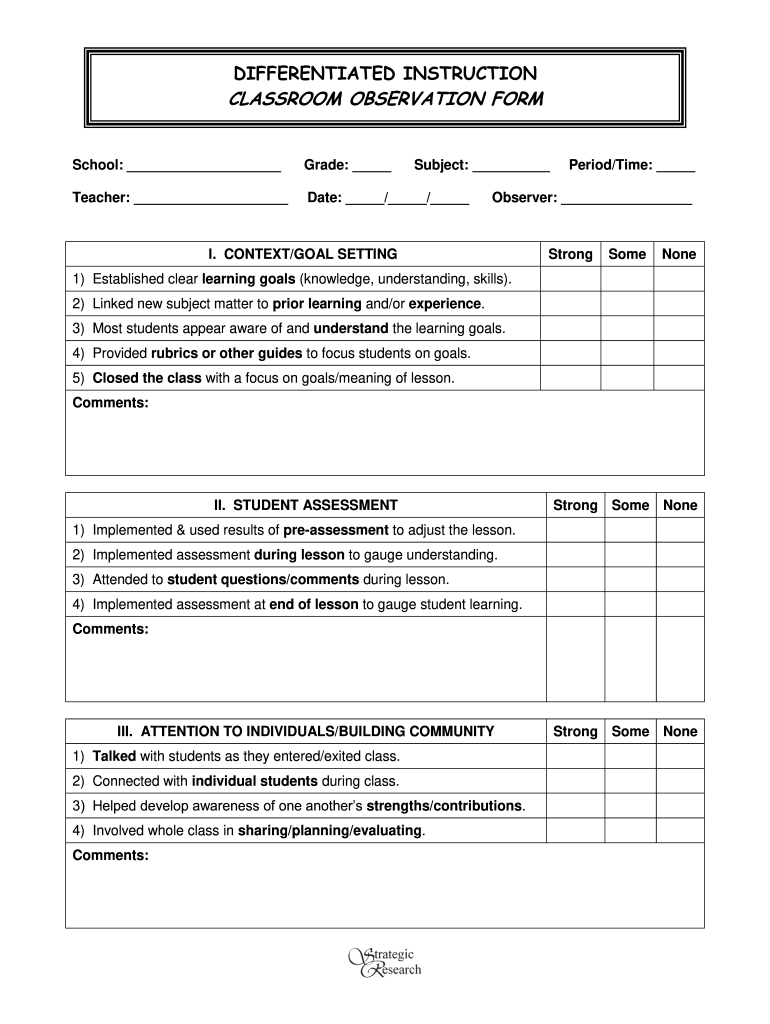
Observer: _________________ I. CONTEXT/GOAL SETTING Strong Some None 1) Established clear learning goals (knowledge, understanding, skills). 2) Linked new subject matter to prior learning and/or experience. 3) Most students appear aware of and understand the learning goals. 4) Provided rubrics or other guides to focus students on goals. 5) Closed the class with a focus on goals/meaning of lesson. Comments: II. STUDENT ASSESSMENT Strong Some None 1) Implemented & used results of pre-asse.
Loading

Open form follow the instructions

Easily sign the form with your finger

Send filled & signed form or save
How to fill out the Strategic Research Differentiated Instruction Classroom Observation Form online
The Strategic Research Differentiated Instruction Classroom Observation Form is designed to evaluate various aspects of classroom instruction and student engagement. This guide provides step-by-step instructions to help users complete the form efficiently and accurately in an online format.
Follow the steps to complete the form online:
- Click ‘Get Form’ button to access the form and open it in the online editor.
- Fill in the header section, including the school name, grade, subject, teacher's name, date, period/time, and observer's name.
- In the context/goal setting section, evaluate and mark how well the instructional goals were established and understood by students, using the provided scale (Strong, Some, None) for each question.
- Proceed to the student assessment section, assessing how the teacher implemented and used assessments during the lesson, again using the same scale.
- In the attention to individuals/building community section, assess the interactions between the teacher and students, marking your observations.
- Continue to the instructional practices and classroom routines section, noting the effectiveness of varied teaching approaches and classroom management.
- Evaluate the positive, supportive learning environment by assessing the teacher's behavior toward students and how well the classroom atmosphere fosters participation.
- In the quality curriculum section, ensure that the lesson aligns with state learning standards and focuses on significant educational issues.
- For preparation for & response to learner needs, assess the teacher's readiness to accommodate diverse student needs.
- In the evidence of differentiation section, evaluate how different forms of content, process, and products are used to meet varied learners' needs.
- Finally, review all sections, add any comments throughout the form, and ensure all data is accurately represented.
- Once completed, save your changes, and choose to download, print, or share the form as needed.
Complete your Strategic Research Differentiated Instruction Classroom Observation Form online today for effective classroom evaluation.
Experience a faster way to fill out and sign forms on the web. Access the most extensive library of templates available.
Related content
by P Subban · 2015 · Cited by 101 — The checklist is intended to prompt discussion...
The paper presents the Differentiated Classroom Observation Scale, a tool developed to...
Educators are invited to join FastBridge Learning and challenge us to innovate and deliver...
Get answers to your most pressing questions about US Legal Forms API.
What are the types of classroom observations?
Classroom observations can be classified into several types, including peer observation, administrative observation, and reflective observation. Peer observation involves colleagues observing each other’s teaching practices to share feedback and support. Administrative observation typically focuses on formal evaluations conducted by school administrators. Reflective observation encourages teachers to self-evaluate their methods. Each type benefits significantly from insights gathered through the Strategic Research Differentiated Instruction Classroom Observation Form.
What is standard 4 differentiated instruction?
Standard 4 of differentiated instruction emphasizes the importance of tailoring teaching methods to meet the diverse needs of all students. This includes understanding each student's unique learning profile and adapting instruction accordingly. By implementing strategies aligned with this standard, educators can enhance engagement and achievement. The Strategic Research Differentiated Instruction Classroom Observation Form can aid teachers in evaluating their adherence to this standard.
What are the three phases of classroom observation?
Classroom observation typically unfolds in three phases: pre-observation, observation, and post-observation. During pre-observation, educators discuss goals and focus areas with the observer. The observation phase captures real-time teaching dynamics and student interactions. Finally, the post-observation phase encourages reflection and discussion about the insights gained, especially when utilizing the Strategic Research Differentiated Instruction Classroom Observation Form for structured feedback.
What are the 4 ways to differentiate instruction?
To differentiate instruction effectively, teachers can modify content, alter learning activities, adjust the learning environment, and provide varied assessments. Modifying content involves offering diverse resources that match students' readiness levels. Altering activities allows for tailored challenges and engagement methods. Adjusting the learning environment creates a positive atmosphere, while varied assessments enable teachers to gauge understanding accurately, all of which can be tracked using the Strategic Research Differentiated Instruction Classroom Observation Form.
What are the three types of participant observation?
The three types of participant observation are complete participation, participation as an observer, and observation without participation. In complete participation, the observer immerses themselves fully in the group being studied. Participation as an observer involves engaging with the group while maintaining an observational role. Observing without participation allows for unbiased, objective data collection. Each method can benefit from the insights provided by the Strategic Research Differentiated Instruction Classroom Observation Form.
What are the 4 elements of differentiated instruction?
The four essential elements of differentiated instruction include content, process, product, and learning environment. Content refers to what students learn, while process relates to how they engage with that content. The product represents what students create to demonstrate their understanding. Lastly, learning environment encompasses the atmosphere in which learning takes place, all of which can be effectively analyzed using the Strategic Research Differentiated Instruction Classroom Observation Form.
What are the three types of classroom observation?
Classroom observation can be categorized into three types: formal observation, informal observation, and self-observation. Formal observation involves structured assessments, often tied to specific goals. Informal observation may be spontaneous, allowing for natural learning moments to be captured. Self-observation encourages teachers to reflect on their practices, further benefiting from tools like the Strategic Research Differentiated Instruction Classroom Observation Form.
What are the three parts of observation?
Observation typically involves three key parts: the planning phase, the actual observation, and the reflection phase. During planning, educators identify specific goals and criteria for observation. The observation phase focuses on documenting behaviors and interactions in real-time. Finally, the reflection phase allows for analysis and feedback, enhancing the effectiveness of the Strategic Research Differentiated Instruction Classroom Observation Form.
What are examples of differentiation strategies applied in the classroom?
Teachers can use various differentiation strategies to enhance learning. For instance, they may provide tiered assignments that cater to different skill levels. Additionally, flexible grouping allows students to work in varied teams based on their strengths. Utilizing a Strategic Research Differentiated Instruction Classroom Observation Form can help educators assess the effectiveness of these strategies.
What is differentiated instruction assessment examples?
Differentiated instruction assessment examples include project-based assessments, portfolios, and verbal assessments tailored to student strengths. These assessments allow educators to evaluate student understanding in various ways, fostering a more comprehensive view of student performance. Utilizing the Strategic Research Differentiated Instruction Classroom Observation Form can aid teachers in choosing the most appropriate assessment methods for each student.
Use professional pre-built templates to fill in and sign documents online faster. Get access to thousands of forms.
If you believe that this page should be taken down, please follow our DMCA take down process here.