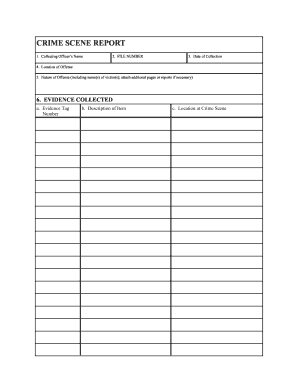
Ports if necessary) 6. EVIDENCE COLLECTED a. Evidence Tag Number b. Description of Item c. Location at Crime Scene .

How it works
  • Open form

    Open form follow the instructions

  • Easily sign form

    Easily sign the form with your finger

  • Share form

    Send filled & signed form or save

How to fill out the Crime Scene Report online

Completing a Crime Scene Report is essential for documenting the details of an incident. This guide will provide you with clear instructions on how to accurately fill out the report online, ensuring that all necessary information is captured.

Follow the steps to complete your Crime Scene Report with ease.

  1. Click the ‘Get Form’ button to access the Crime Scene Report form and open it in your preferred editor.
  2. Begin by entering the collecting officer’s name in the designated field. This is important for identifying who gathered the evidence and completed the report.
  3. Fill in the file number associated with the case. This helps to link the report to the specific incident record for easy reference.
  4. Enter the date of collection. Ensure this is accurate as it reflects when the evidence was documented.
  5. Provide the exact location where the offense took place. This information is crucial for understanding the context of the crime.
  6. Describe the nature of the offense. Include the names of any victims involved and ensure to attach additional pages or reports if further details are necessary.
  7. For evidence collected, fill in the sub-fields: first, enter the evidence tag number assigned to the item, then provide a detailed description of the item itself.
  8. Finally, indicate the specific location at the crime scene where the evidence was found. This adds to the accuracy of the report.
  9. Once all fields are completed, you can save changes, download a copy of the report, print it directly, or share it as needed.

Start filling out your Crime Scene Report online today for efficient and accurate documentation.

Get form

Experience a faster way to fill out and sign forms on the web. Access the most extensive library of templates available.

Related content

Crime Scene Investigations

The Crime Scene Investigation Unit is responsible for complex crime scene investigations;...

Learn more
A Simplified Guide To Crime Scene Investigation

A crime scene report is often referred to as a crime scene supplement because it...

Learn more
Main Story 12-11

Jul 17, 2024 — Overview. A tabloid reporter somehow found a way into the building and...

Learn more
Questions & Answers

Get answers to your most pressing questions about US Legal Forms API.

Contact support

What are the 7 steps of CSI in order?

The 7 steps of Crime Scene Investigation (CSI) are recognition, preservation, collection, documentation, analysis, presentation, and action. Each step contributes to a thorough investigation, ensuring that no aspect is overlooked. When compiled, these findings should be documented in a clear and structured Crime Scene Report to support future proceedings.

Documenting a crime scene involves capturing detailed photographs, creating sketches, and taking comprehensive notes. Use specific measurements and descriptions to ensure the report is accurate. Collectively, this documentation forms the foundation of a solid Crime Scene Report that can be crucial for legal investigations and proceedings.

The seven steps of investigation include defining the problem, developing a plan, collecting data, analyzing information, reporting results, taking action, and evaluating the impact. Each step builds upon the previous one, ensuring a comprehensive overview of the situation. A precise Crime Scene Report is the culmination of this process, summarizing all findings effectively.

Processing a crime scene involves securing the scene, conducting a preliminary survey, and documenting everything with photographs or sketches. Following these steps, collect and preserve evidence, record detailed notes, and conduct a detailed search. Finally, craft a Crime Scene Report that encapsulates all findings in a coherent format, making it easier for further legal proceedings.

The 7's of crime scene investigation include securing the scene, separating witnesses, scanning the scene, seeing the scene, sketching the scene, searching for evidence, and safeguarding the evidence. Each step is critical in maintaining the integrity of the information collected. A well-documented Crime Scene Report captures all these facets to support the investigative process.

In forensic investigations, start by identifying the crime scene, followed by securing it to prevent contamination. The next step is to collect and document evidence meticulously, then analyze it for patterns or important details. After thorough analysis, present your findings along with a detailed Crime Scene Report to summarize the investigation process.

Creating a crime scene report involves first documenting all observations and evidence collected at the scene. Use clear language and structure your report logically, detailing the location, time, and nature of the incident. A well-crafted Crime Scene Report not only includes factual information but also any eyewitness accounts, which can add depth to the investigation.

To effectively conduct an investigation, you should start by securing the crime scene, ensuring it remains intact. Next, gather preliminary information and make observations, followed by documenting the scene and collecting evidence. After securing and evaluating the evidence, be sure to analyze it thoroughly. Finally, deliver a comprehensive Crime Scene Report that outlines all findings and conclusions.

To write a crime scene report, start by summarizing the facts, including who, what, where, when, and how. Detail any evidence found and note the actions taken at the scene. Including photographs and diagrams can enhance the clarity of your Crime Scene Report. Finally, ensure that you review your report for accuracy, as this document will be essential for any legal proceedings.

To start a crime report, begin with the basic information where the crime took place, the time, and the type of crime committed. Including your observations and any immediate evidence you noticed is critical for clarity in the Crime Scene Report. Next, make sure to document potential witnesses and their contact information. This initial step lays the groundwork for a detailed and effective report.

Get This Form Now!

Use professional pre-built templates to fill in and sign documents online faster. Get access to thousands of forms.

If you believe that this page should be taken down, please follow our DMCA take down process here.

Get Crime Scene Report