Loading
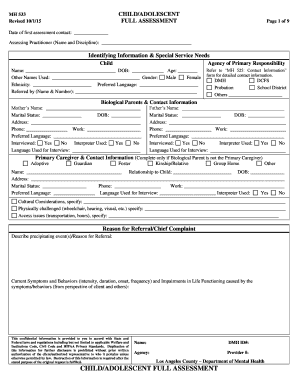
Get Child Adolescent Full Assessment
How it works
-

Open form follow the instructions
-

Easily sign the form with your finger
-

Send filled & signed form or save
How to fill out the Child Adolescent Full Assessment online
Completing the Child Adolescent Full Assessment online is a crucial step in ensuring that the needs of the child or adolescent are accurately assessed and addressed. This guide provides a clear and supportive approach to navigate each section of the form efficiently.
Follow the steps to fill out the assessment form correctly.
- Press the ‘Get Form’ button to access the Child Adolescent Full Assessment and open it in your preferred online editor.
- Begin with the date of first assessment contact, entering the date in the designated field. Next, fill in the assessing practitioner's name and professional discipline clearly.
- In the Identifying Information & Special Service Needs section, provide the child's basic details: their name, date of birth, age, and any other names they have used. Choose the appropriate gender option and fill in ethnicity and preferred language.
- Record the name and contact information of the referring individual or agency in the relevant fields. Use the given checklist to select from agencies like DMH, DCFS, probation, or school district.
- For Biological Parents & Contact Information, complete the sections for both the mother and father, including names, marital statuses, dates of birth, addresses, and contact numbers. Ensure to indicate if an interpreter was used during the interview.
- If the biological parent is not the primary caregiver, complete the Primary Caregiver section by providing their information and relationship to the child.
- In the Reason for Referral/Chief Complaint section, carefully describe the precipitating events that lead to the referral and detail the current symptoms and their impact on daily functioning.
- Continue to the Mental Health History section, indicating past psychiatric hospitalizations or outpatient treatment experiences if applicable. Provide details like dates and reasons.
- Fill out the medications section by listing all current and previous psychotropic medications, including dosage and effectiveness.
- In the Substance Risks, Use & Attitudes section, assess or provide remarks on the client’s current substance use and any relevant family or peer influences.
- Complete the Medical History section by providing comprehensive details about physical health, including any chronic illnesses or significant medical concerns.
- In the Developmental History section, summarize prenatal care and early development milestones, mentioning any environmental stressors.
- Outline the psychosocial history, including school status, vocational information, and any history with juvenile court or child protective services.
- Explain the current living situation, family composition, and any relevant family history that impacts the child’s current needs.
- Provide a thorough assessment of the Mental Status, addressing observations in appearance, behavior, thought content, cognition, and mood/affect.
- Conclude with a clear Summary and Diagnosis, providing necessary codes, recommendations, and signatures if required.
- Once all sections are filled out, ensure to save your changes. You can also download, print, or share the completed assessment form as needed.
Start filling out the Child Adolescent Full Assessment online today to ensure comprehensive care for the youth.
Adult Mental Health Assessment Evaluations typically consist of a written questionnaire, interview questions, lab tests and physical examination. Commonly used tools of diagnosis for mental disorders we use include: Patient Health Questionnaire (PHQ-9) - the most common screening tool to identify depression.