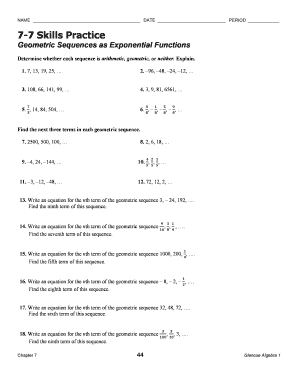
NAME DATE PERIOD 77 Skills Practice Geometric Sequences as Exponential Functions Determine whether each sequence is arithmetic, geometric, or neither. Explain. 1. 7, 13, 19, 25, 2. 96, 48, 24, 12,.

How it works
  • Open form

    Open form follow the instructions

  • Easily sign form

    Easily sign the form with your finger

  • Share form

    Send filled & signed form or save

How to fill out the 7 7 Skills Practice Geometric Sequences as Exponential Functions online

This guide provides a comprehensive overview of how to effectively complete the 7 7 Skills Practice Geometric Sequences as Exponential Functions document. Step through each section to ensure accurate and thorough submissions.

Follow the steps to successfully fill out the form online.

  1. Click the ‘Get Form’ button to access the document and open it in the editor.
  2. Begin by entering your name in the designated field at the top of the form. This ensures your work is easily identifiable.
  3. Next, fill in the date in the specified area. Make sure to use the current date to keep track of when the document was completed.
  4. Indicate your class period in the corresponding section, providing context for your submission.
  5. Proceed to the main section of the form. Here, you will analyze several sequences to determine if they are arithmetic, geometric, or neither. Be sure to provide a brief explanation for each answer.
  6. For the geometric sequences listed, find the next three terms as instructed. Carefully follow the pattern established in each sequence.
  7. When instructed to write an equation for the nth term, ensure your expression accurately reflects the pattern of the sequence provided.
  8. Once you have completed all sections, review your answers for accuracy. Make any necessary revisions.
  9. Finally, save your changes, and you have the option to download, print, or share the form as needed.

Complete your document online today and ensure your understanding of geometric sequences as exponential functions!

Get form

Experience a faster way to fill out and sign forms on the web. Access the most extensive library of templates available.

Related content

Algebra II Unit 3: Modeling with Functions - MDK12

Enduring understandings go beyond discrete facts or skills. ... linear and quadratic...

Learn more
Name Date Period 7 Chapter 7 Mid Chapter Test...

Intervention Answers (Anticipation Guide and Lesson 7-1) Geometry Chapter 7 Test ... NAME...

Learn more
Addition - Wikipedia

Addition is one of the four basic operations of arithmetic, the other three being...

Learn more
Questions & Answers

Get answers to your most pressing questions about US Legal Forms API.

Contact support

What is exponential function in sequences?

A sequence of numbers has an exponential pattern when each successive number increases (or decreases) by the same percent.

1:25 3:49 Geometric Sequences as Exponential Functions - YouTube YouTube Start of suggested clip End of suggested clip Sequence. Well F of 1 is 5 f of 2 is going to be 5 to the two which is 25 f of 3 is going to be 5 toMoreSequence. Well F of 1 is 5 f of 2 is going to be 5 to the two which is 25 f of 3 is going to be 5 to the three which is 125 f of 4 is going to be 5 to the four which is 625.

An exponential function is defined as a function with a positive constant other than 1 raised to a variable exponent. A function is evaluated by solving at a specific input value. An exponential model can be found when the growth rate and initial value are known.

An arithmetic sequence has a constant difference between each consecutive pair of terms. This is similar to the linear functions that have the form y=mx+b. A geometric sequence has a constant ratio between each pair of consecutive terms.

Both have variables that are exponents, an initial value, and a constant ratio which is the base.

A geometric sequence is an exponential function. Instead of y=ax, we write an=crn where r is the common ratio and c is a constant (not the first term of the sequence, however). A recursive definition, since each term is found by multiplying the previous term by the common ratio, ak+1=ak * r.

Geometric sequence: The difference between geometric growth and exponential growth is, geometric growth is discrete (due to the fixed ratio) whereas exponential growth is continuous. With geometric growth, a fixed number is multiplied to x whereas with exponential growth, a fixed number is raised to the x.

Get This Form Now!

Use professional pre-built templates to fill in and sign documents online faster. Get access to thousands of forms.

If you believe that this page should be taken down, please follow our DMCA take down process here.

Get 7 7 Skills Practice Geometric Sequences As Exponential Functions