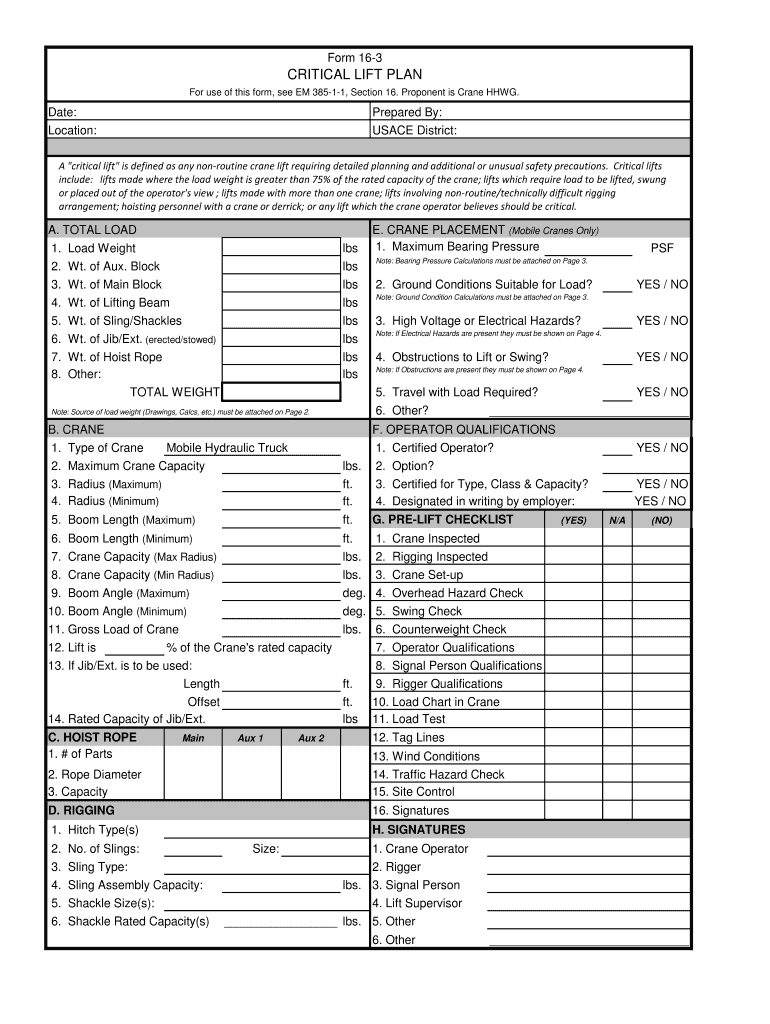
Ane lift requiring detailed planning and additional or unusual safety precautions. Critical lifts include: lifts made where the load weight is greater than 75% of the rated capacity of the crane; lifts which require load to be lifted, swung or placed out of the operator's view ; lifts made with more than one crane; lifts involving non-routine/technically difficult rigging arrangement; hoisting personnel with a crane or derrick; or any lift which the crane operator believes should be critical. A.

Open form follow the instructions

Easily sign the form with your finger

Send filled & signed form or save
How to fill out the USACE 16-3 online
Filling out the USACE 16-3 form is crucial for planning and executing a critical lift safely and effectively. This guide will provide you with a comprehensive step-by-step process to complete the form online, ensuring that all necessary information is accurately recorded.
Follow the steps to complete the USACE 16-3 form online:
- Click ‘Get Form’ button to obtain the form and open it in the editor.
- Begin by entering the date and location for the critical lift at the top of the form.
- In section A, titled 'Total Load', input the weight of each component, including the load weight, auxiliary block, main block, lifting beam, slings/shackles, jib/ext, hoist rope, and any other relevant items. Sum these values to calculate the total weight.
- Proceed to section E for 'Crane Placement'. Answer the questions regarding ground conditions, bearing pressure, electrical hazards, and obstructions by marking 'Yes' or 'No' as appropriate. If there are obstructions, indicate them on the designated page.
- In section F, 'Operator Qualifications', detail the operator’s certification status, maximum and minimum boom lengths, as well as the crane’s capacity specifications. Ensure to confirm the operator is designated in writing by the employer.
- Section G features the 'Pre-lift Checklist'. Verify and check off each item related to crane inspections, rigging inspections, operator qualifications, and overhead hazards. Maintain an accurate record of all checks made.
- In section D, 'Rigging', provide information regarding hitch types, number of slings, sling types, shackle sizes, and other relevant details regarding rigging preparations.
- Finalize the form by ensuring all sections are completed accurately. Review the entire document for any omitted information before saving.
- Once you have reviewed and confirmed all entries are correct, you can save your changes, download, print, or share the completed form as required.
Complete your USACE 16-3 form online today for effective critical lift planning.
Experience a faster way to fill out and sign forms on the web. Access the most extensive library of templates available.
Related content
This chapter provides general guidance regarding commissioning of building systems and...
Jan 6, 2006 — The test data are summarized in Tables 16-1, 16-2, and 16-3. Material...
Jun 1, 1999 — Purpose. This Engineer Manual (EM) is intended to provide detailed...
Get answers to your most pressing questions about US Legal Forms API.
How to make a critical lift plan?
Creating a critical lift plan requires a detailed analysis of the lift, including load information and site conditions. You need to identify potential risks and outline mitigation strategies, ensuring compliance with USACE 16-3. Additionally, keeping lines of communication open among team members will foster a collaborative and safe working environment.
How to calculate a lifting plan?
Calculating a lifting plan involves determining the load's weight, center of gravity, and required lifting equipment. You should also assess the lifting path and any environmental factors that may impact the operation. Utilizing the USACE 16-3 framework can streamline these calculations and improve overall safety.
What should be included in a lift plan?
A comprehensive lift plan should include load details, rigging methods, equipment specifications, and safety protocols. You should also outline the roles of each team member involved in the lift. By integrating requirements from USACE 16-3, you can enhance safety and efficiency during the operation.
How to write a lift plan?
Writing a lift plan starts with defining the scope of the lift, including load specifications and environmental conditions. It's crucial to document safety measures, equipment requirements, and personnel assignments. Following USACE 16-3 standards guarantees that your lift plan encompasses all essential elements for a successful operation.
What is LHE in rigging?
LHE, or Lift Heavy Equipment, refers to lifting operations involving substantial loads. Understanding LHE is essential as it dictates the rigging methods and equipment used. Adhering to USACE 16-3 guidelines helps ensure that heavy lifts are carried out safely and effectively.
What are the requirements for a critical lift?
For a lift to be classified as critical, it must meet specific criteria outlined in USACE 16-3. This includes considering the weight and type of load, potential risks, and the environment where the lift occurs. During this process, ensure all personnel involved are trained and knowledgeable about safety protocols.
What is the first step in planning a lift?
The initial step in planning a lift is to conduct a thorough site assessment. You should evaluate the location, identify potential hazards, and gather necessary equipment information. This foundational understanding aligns with USACE 16-3 guidelines and sets the stage for a safe lift operation.
What are the three basics of lifting OSHA?
The three basics of lifting according to OSHA include assessing the load before lifting, ensuring the load is stable, and positioning your body correctly during the lift. These foundational principles aim to prevent injuries and ensure safe lifting practices. By implementing the USACE 16-3 guidelines, companies can strengthen their compliance with OSHA while promoting a safer work environment.
What are the three criteria for critical lifting operations?
The three criteria for critical lifting operations are the weight of the load, the lifting environment, and the experience level of the team involved. Each of these factors plays a vital role in determining the lift's safety and success. By adhering to the USACE 16-3 standards, teams can better evaluate these criteria and conduct lifts with confidence.
What are the criteria for critical lifting?
The criteria for critical lifting involve load weight, the complexity of the lift, and environmental factors. A critical lift often includes loads that require coordination with multiple workers or specialized equipment. Following USACE 16-3 can help in establishing these criteria clearly and ensuring all safety measures are in place.
Use professional pre-built templates to fill in and sign documents online faster. Get access to thousands of forms.
If you believe that this page should be taken down, please follow our DMCA take down process here.