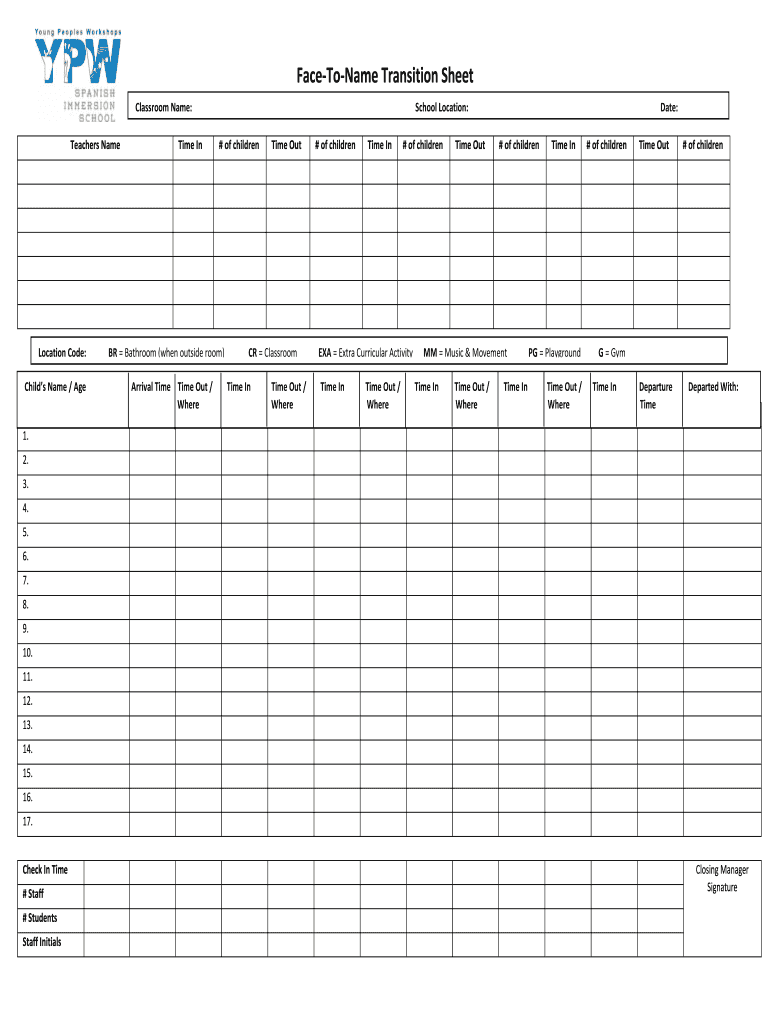
Where Time Out CR = Classroom Time In Time Out / Where # of children Time In # of children EXA = Extra Curricular Activity Time In Time Out / Where Time Out Date: # of children MM = Music & Movement Time In Time Out / Where Time In Time In PG = Playground Time Out / Where # of children Time Out # of children G = Gym Time In Departure Time Departed With: 1. 2. Where 3. 4. 5. 6. 7. 8. 9. 10. 11. 12. 13. 14. 15. 16. 17. Check In Time # Staff # Students Staff Initials Closi.

Open form follow the instructions

Easily sign the form with your finger

Send filled & signed form or save
How to fill out the YPW Face-To-Name Transition Sheet online
The YPW Face-To-Name Transition Sheet is an essential document for recording important transition information for children. This guide provides clear instructions on how to successfully complete this form online, ensuring you capture all necessary details accurately.
Follow the steps to complete the transition sheet effectively.
- Press the ‘Get Form’ button to access the YPW Face-To-Name Transition Sheet and open it in your preferred editor.
- Begin by filling in the 'Classroom Name' and 'Teachers Name' fields at the top of the form. This helps identify the specific classroom and the educator responsible for the children.
- Enter the 'Location Code' to provide context for the whereabouts of the children during transitions.
- In the 'Child’s Name / Age' section, list each child with their respective age to ensure proper identification.
- For each transition, record the 'Time In' and 'Time Out' in the dedicated fields, including the location for each activity (e.g., Classroom, Bathroom, Playground).
- Indicate the number of children involved in each activity under the '# of children' column.
- Mark the 'Departure Time' and list who each child departed with in the 'Departed With:' section to ensure all children are accounted for.
- Fill in 'Check In Time', '# Staff', and '# Students' to provide a comprehensive overview of the staff-to-child ratio during transitions.
- Add the closing manager's signature at the end of the form to authenticate the information collected.
- Upon completing the form, be sure to save your changes, and you can choose to download, print, or share the document as required.
Start completing the YPW Face-To-Name Transition Sheet online today for efficient record-keeping!
Experience a faster way to fill out and sign forms on the web. Access the most extensive library of templates available.
Related content
by MJ Correia · 1966 · Cited by 1 — Entei last name, first name, middle initial. If...
by X Liang · 2024 · Cited by 26 — The transition period from childhood to adolescence...
The governor also says he will name the board members within the 90-day window, as...
Get answers to your most pressing questions about US Legal Forms API.
Does your name change how you look?
While your name does not physically alter your appearance, it can affect how others view and interact with you. The YPW Face-To-Name Transition Sheet highlights this dynamic, illustrating the importance of names in shaping social impressions. By using this tool, you can enhance your understanding of these interpersonal relationships.
Does your face change to your name?
Your face does not literally change to your name; however, your name can influence how others perceive your personality. The YPW Face-To-Name Transition Sheet helps to visualize this concept, allowing you to see how a name can shape identity in social settings. By understanding this, you can navigate interactions more effectively.
Is there a correlation between name and face?
The correlation between name and face can be subtle yet significant. Studies suggest names can shape perceptions and social interactions. The YPW Face-To-Name Transition Sheet provides a valuable insight into this relationship, fostering better understanding and connections among individuals.
What is the name to face on Procare?
The Procare system supports the YPW Face-To-Name Transition Sheet, which connects names with visual identifiers. This ensures that individuals using the platform can accurately recognize and associate names with their corresponding faces. Utilizing this feature enhances interaction within the system and improves overall user experience.
Does your face change based on your name?
The YPW Face-To-Name Transition Sheet does not imply that your face physically changes with your name. However, names can influence how people perceive you. This tool helps clarify the connection between identity and naming, showing how names might impact first impressions.
How do you put a name to a face in a sentence?
To put a name to a face in a sentence, you must emphasize the recognition of a person's identity in relation to their appearance. You could say, 'When I saw Emily, I immediately remembered her from school.' The YPW Face-To-Name Transition Sheet can facilitate this practice, allowing individuals to strengthen their recall of names and faces.
How do you mention a name in a sentence?
Mentioning a name in a sentence involves placing it in a context where it adds meaning or importance. For example, you might say, 'Mark is joining us for dinner tonight.' To help improve this skill, consider the YPW Face-To-Name Transition Sheet, which guides users in effectively incorporating names into their conversations.
Do you use a comma before a name in a sentence?
Yes, you typically use a comma before a name in a direct address to show clarity in your communication. For instance, you might say, 'Could you help me, Sarah?' This practice is important for effective communication, and resources like the YPW Face-To-Name Transition Sheet can provide further guidance on proper punctuation and structure.
Why can't I put names to faces?
Struggling to match names with faces is a common challenge that many people experience. Factors such as memory retention and social anxiety can contribute to this difficulty. Utilizing tools like the YPW Face-To-Name Transition Sheet can enhance your ability to remember names, making social interactions smoother and more enjoyable.
How do you put someone's name in a sentence?
To include someone's name in a sentence, simply integrate it with the rest of your words. For example, you could say, 'I met Jane at the park yesterday.' The YPW Face-To-Name Transition Sheet can help individuals practice this skill, promoting clarity and connection in conversation.
Use professional pre-built templates to fill in and sign documents online faster. Get access to thousands of forms.
If you believe that this page should be taken down, please follow our DMCA take down process here.