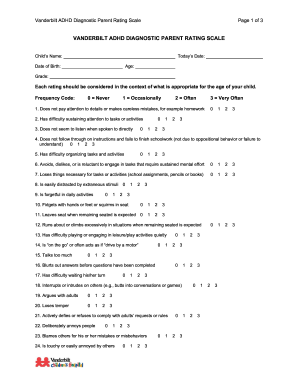
Dered in the context of what is appropriate for the age of your child. Frequency Code: 0 = Never 1 = Occasionally 2 = Often 3 = Very Often 1. Does not pay attention to details or makes careless mistakes, for example homework 2. Has difficulty sustaining attention to tasks or activities 3. Does not seem to listen when spoken to directly 0 0 1 2 1 2 0 1 2 3 3 3 4. Does not follow through on instructions and fails to finish schoolwork (not due to oppositional behavior or failure t.
Open form follow the instructions
Easily sign the form with your finger
Send filled & signed form or save
How to fill out the Vanderbilt ADHD Diagnostic Parent Rating Scale online
The Vanderbilt ADHD Diagnostic Parent Rating Scale is a vital tool used to evaluate a child's behavior and symptoms related to attention-deficit/hyperactivity disorder (ADHD). This guide provides clear instructions on how to complete the form online, ensuring that you can provide accurate and helpful information regarding your child's behaviors.
Follow the steps to successfully complete the form online.
- Press the ‘Get Form’ button to access the Vanderbilt ADHD Diagnostic Parent Rating Scale and open it for completion.
- Start by entering your child's name and relevant personal information, including today's date, their date of birth, age, and grade level. This information is crucial for accurate assessment.
- Review the frequency code definitions that accompany the rating items. Make sure to understand the ratings, where '0' means never, '1' means occasionally, '2' means often, and '3' means very often.
- Go through each item listed in the scale carefully. For each behavior listed, select the appropriate rating from the frequency code. It is important to consider how often each behavior is exhibited in the context of your child's age.
- Continue rating all items until you reach the performance section of the form. This section evaluates your child's overall academic performance and classroom behavior.
- For the performance section, indicate whether your child's performance and behavior fall into problematic, average, or above-average categories across each subject area and behavior metric.
- Once you have filled out all sections, review your responses to ensure accuracy and completeness. Take the time to reflect on each behavior and its frequency.
- Finally, you can save your changes, download, print, or share the completed Vanderbilt ADHD Diagnostic Parent Rating Scale. Ensure that you retain a copy for your records.
Complete the Vanderbilt ADHD Diagnostic Parent Rating Scale online today to support your child's evaluation.
Experience a faster way to fill out and sign forms on the web. Access the most extensive library of templates available.
Related content
Problematic. Average. Above Average. 2. Overall Classroom Behavior. 1. 2. 3. 4. 5 a...
Requires 6 or more counted behaviors on items 10 through 18 and a performance problem...
Sep 18, 2024 — ... Parent Rating Scale for Children (BASC-3-PRS-C), No, No, Reynolds &...
Get answers to your most pressing questions about US Legal Forms API.
How accurate is the Vanderbilt ADHD test?
The Vanderbilt ADHD Diagnostic Parent Rating Scale is considered an accurate measure for identifying ADHD symptoms in children. Multiple studies support its validity and ability to differentiate ADHD from other behavioral issues. While no assessment is perfect, the Vanderbilt scale provides a strong foundation for understanding a child's behavior. Utilizing this tool, along with professional interpretation, can significantly enhance the accuracy of ADHD diagnoses.
Is the Vanderbilt ADHD assessment reliable?
The Vanderbilt ADHD Diagnostic Parent Rating Scale has been proven to be a reliable instrument for assessing ADHD symptoms. Its design allows for consistent and accurate reporting of behaviors from multiple informants, including parents and teachers. Reliability is vital as it ensures that results lead to effective diagnosis and intervention strategies. Parents can trust this assessment tool to guide their understanding and management of ADHD.
What score on Vanderbilt indicates ADHD?
A score on the Vanderbilt ADHD Diagnostic Parent Rating Scale that meets or exceeds certain thresholds can suggest the presence of ADHD. Generally, higher scores indicate more severe symptoms and warrant further evaluation by a healthcare professional. Clinicians use these scores to determine the likelihood of ADHD and to explore potential treatment options. It's crucial for parents to discuss these scores with their child's healthcare provider for tailored guidance.
What is the rating scale for ADHD assessment?
The rating scale for ADHD assessment, such as the Vanderbilt ADHD Diagnostic Parent Rating Scale, includes specific questions that measure ADHD symptoms. These scales help in identifying behaviors that match ADHD diagnostic criteria. By gathering responses from parents, clinicians can evaluate the frequency and intensity of these behaviors. Effective assessment relies on these ratings for accurate diagnosis and intervention planning.
What is the Vanderbilt ADHD rating scale for parents?
The Vanderbilt ADHD Diagnostic Parent Rating Scale is a tool designed for parents to assess their child's behavior and symptoms related to ADHD. It consists of various questions that focus on different aspects of attention and hyperactivity. By completing this scale, parents provide valuable insights for healthcare providers, helping to form a comprehensive evaluation of ADHD. This involvement fosters a collaborative approach to understanding and treating the child's challenges.
How is the ADHD 5 rating scale scored?
The Vanderbilt ADHD Diagnostic Parent Rating Scale is scored by adding the points assigned to each response on the scale. Typically, each item receives a score based on its level of severity. The total score helps clinicians determine the presence and severity of ADHD symptoms. This scoring process is essential for effectively identifying and addressing the needs of the child.
How do you score the ADHD rating scale?
Scoring the ADHD rating scale, including the Vanderbilt ADHD Diagnostic Parent Rating Scale, involves totaling responses to evaluate symptom frequency and severity. Each question usually has a designated point value, with higher totals indicating more significant concerns. After scoring, reviewing the results with a qualified clinician provides clarity and direction.
What is a high score for ADHD?
A high score for ADHD generally falls above the average range on the Vanderbilt ADHD Diagnostic Parent Rating Scale, indicating notable symptoms. Scores can be context-dependent, with variations based on age and specific behaviors assessed. It is essential to discuss these scores with a healthcare professional for a thorough understanding.
What is high level ADHD?
High level ADHD refers to the severity of symptoms that significantly impact daily functioning. On the Vanderbilt ADHD Diagnostic Parent Rating Scale, high levels typically show elevated scores across multiple areas. Understanding the level of ADHD helps in tailoring appropriate interventions and supports for the child.
What is the scoring scale for ADHD?
The scoring scale for ADHD varies based on the specific assessment tool being used, such as the Vanderbilt ADHD Diagnostic Parent Rating Scale. Generally, higher scores indicate more severe symptoms, while lower scores suggest fewer issues. Knowing how to interpret these scores can be crucial, so seeking guidance from a professional is beneficial.
Use professional pre-built templates to fill in and sign documents online faster. Get access to thousands of forms.
If you believe that this page should be taken down, please follow our DMCA take down process here.