Origin Confined to building of origin Beyond building of origin Main Floor Size (Complete One) Total square feet BY Width in Feet Length in Feet Number of Stories Damaged by Flame Story of origin Material Contributing Most to Flame Spread Insurance Company Information Number of stories w/ minor damage Insurance Company Name (1 to 24% Flame Damage) Item contributing most to flame spread Number of stories w/ significant damage (25 to 49% Flame Damage) Policy Number Number of stories w.
Loading

Open form follow the instructions

Easily sign the form with your finger

Send filled & signed form or save
How to fill out the NFIRS Incident Field Notes online
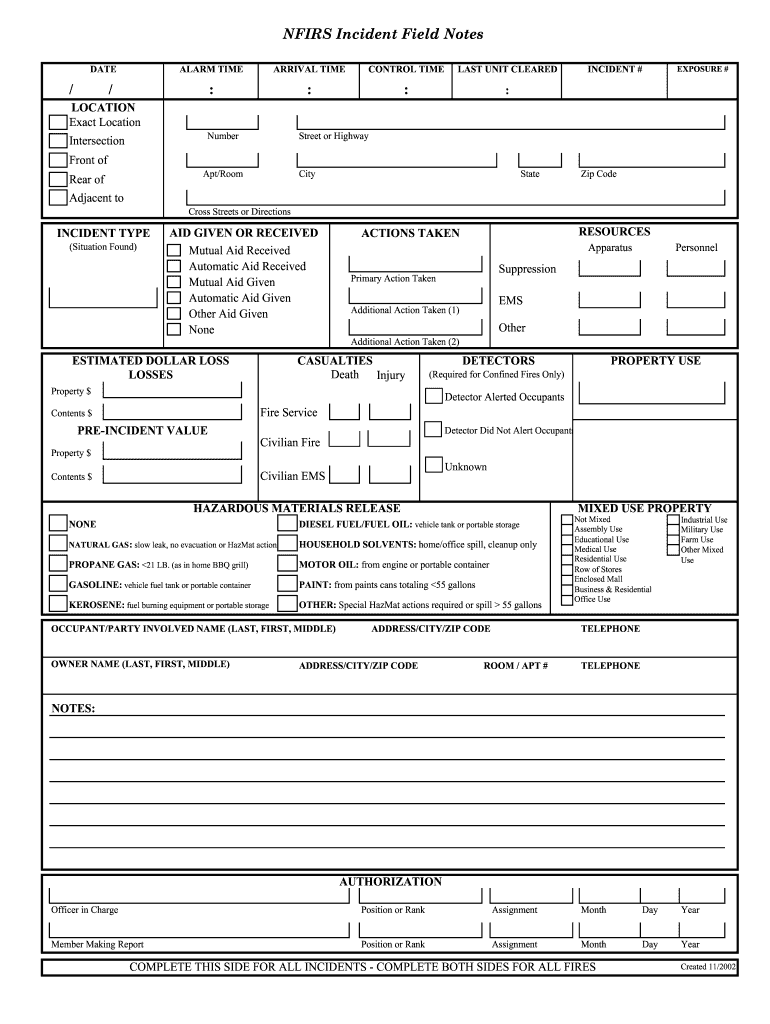
Filling out the NFIRS Incident Field Notes form is essential for documenting incidents and ensuring comprehensive reporting. This guide provides clear instructions on completing each section of the form online, making the process straightforward and user-friendly.
Follow the steps to accurately complete the NFIRS Incident Field Notes form.
- Click the ‘Get Form’ button to obtain the NFIRS Incident Field Notes form. This will allow you to access the form and begin filling it out online.
- Start by entering the alarm time, arrival time, control time, and last unit cleared, along with the date and incident number. These details are crucial for accurate incident tracking.
- Provide the exact location of the incident, including any relevant intersection, street or highway, city, state, and zip code. If applicable, include cross streets or directions to further define the location.
- Select the type of incident from the available categories. This section helps categorize the nature of the situation you encountered.
- Indicate any aid given or received during the incident, specifying if mutual or automatic aid was involved. Choose from the provided options to accurately reflect assistance during the incident.
- Detail the resources utilized during the incident, including personnel and equipment. Specify actions taken, primary actions, and any additional actions you performed.
- Estimate the dollar loss incurred due to the incident. Include all relevant costs associated with property and contents.
- Record any casualties resulting from the incident, including deaths and injuries. Accurate reporting in this section is vital for data collection.
- If applicable, indicate the presence and functionality of detectors in the property involved. Mark whether they alerted occupants and note if the detectors were effective.
- Complete the property use section by indicating the type of use for the property involved in the incident.
- Provide details about any hazardous materials released, if applicable. Choose from the given categories to accurately reflect the situation.
- Fill in the occupant or party involved information, as well as owner details. This information may include names and contact details necessary for follow-up.
- Complete the authorization section with the officer in charge's information and the member making the report, including their position or rank and date.
- Once all sections are completed, review the information for accuracy. Save your changes, and you can opt to download, print, or share the form as needed.
Complete your NFIRS Incident Field Notes form online today for accurate incident documentation.
Experience a faster way to fill out and sign forms on the web. Access the most extensive library of templates available.
Related content
This reference guide provides step-by-step instructions for submitting fire incident...
Non-Fire Incidents: - 200: Overpressure. Page 2. 2. Rupture, Explosion, Overheat (no fire)...
by JD Flynn · 2009 · Cited by 59 — Remember to limit analysis to incident type 300-399...
Get answers to your most pressing questions about US Legal Forms API.
Is NFIRS required?
Whether NFIRS is required often depends on state regulations and funding requirements. Many states mandate participation in NFIRS to ensure accurate data collection for federal grants and assistance. By understanding the importance of NFIRS Incident Field Notes in your state, you can better prepare your department for compliance and funding opportunities.
How do I report to NFIRS?
Reporting to NFIRS involves using a designated software platform or web application to input incident data. Fire departments must adhere to the guidelines provided by their state and the NFIRS manual to ensure accurate reporting. By utilizing NFIRS Incident Field Notes, you can streamline your reporting process and ensure compliance with federal requirements.
What is replacing NFIRS?
Currently, there is no direct replacement for NFIRS. However, new technologies and systems are being developed to enhance fire reporting and data analytics. While NFIRS Incident Field Notes will continue to play a vital role in fire reporting, it's essential to keep an eye on emerging solutions that could complement or improve the existing framework.
Are NFIRS reports public record?
Yes, NFIRS reports are generally considered public records. This means that they can be accessed by the public unless restricted by local laws or regulations. Utilizing NFIRS Incident Field Notes allows firefighters and departments to maintain transparency and accountability while providing valuable information for community awareness.
What is the current version of NFIRS?
As of now, the latest version of NFIRS is NFIRS 5.0. This version introduced various enhancements aimed at improving data accuracy and ease of reporting. Staying updated with NFIRS Incident Field Notes ensures that fire departments can utilize the latest features for effective incident tracking and reporting.
Is NFIRS going away?
Currently, NFIRS is not going away and remains a critical tool for fire reporting in the United States. While there are discussions about modernizing reporting systems, NFIRS continues to serve as an essential resource for gathering fire incident data. You can rely on NFIRS Incident Field Notes for maintaining comprehensive records and fulfilling reporting requirements.
What is the difference between Neris and NFIRS?
Neris and NFIRS serve different purposes in incident reporting. Neris focuses on real-time data collection and situational awareness, while NFIRS captures detailed incident reports for fire departments. Essentially, NFIRS Incident Field Notes provide crucial data for fire analysis, allowing departments to improve their response strategies based on historical incidents.
What is code 161 for NFIRS?
Code 161 in NFIRS refers to the specific incident type of 'Explosion (no fire).' Understanding these codes is crucial for accurate reporting and analysis. By using NFIRS Incident Field Notes, fire departments can log incidents like code 161 more effectively, ensuring essential data is captured consistently.
What is the incident number in NFIRS?
The incident number in NFIRS serves as a unique identifier for each fire incident, aiding in organization and retrieval of records. It links all relevant NFIRS Incident Field Notes under a specific case, ensuring that reports are easily traceable. When filing your report, make sure to input the incident number accurately to maintain the integrity of your data history. This identification is crucial for subsequent investigations and analyses.
How to write an incident report about fire?
When writing an incident report about a fire, clarity is key. Start with the date, time, and location of the incident, followed by detailed descriptions of what occurred, including responses by fire departments. Ensure your NFIRS Incident Field Notes include witness statements, equipment used, and any injuries or damages reported. This methodical approach fosters an accurate record for future analysis and improvement.
Use professional pre-built templates to fill in and sign documents online faster. Get access to thousands of forms.
If you believe that this page should be taken down, please follow our DMCA take down process here.