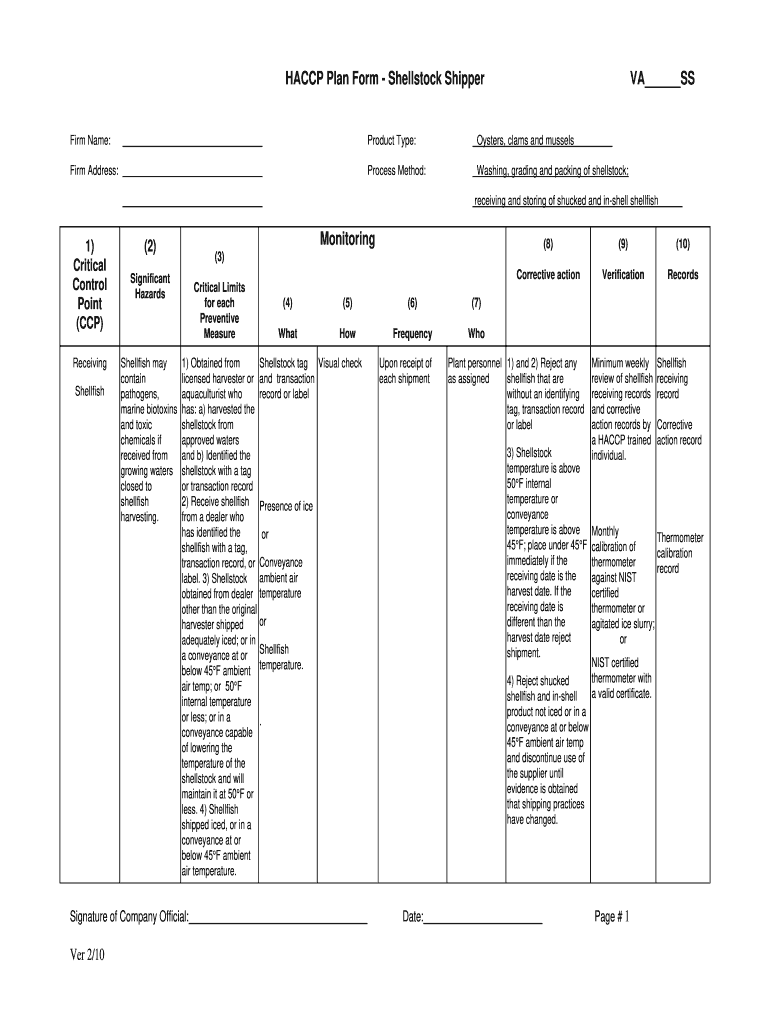
G of shucked and in-shell shellfish 1) Critical Control Point (CCP) Receiving Shellfish Monitoring Critical Limits for each Preventive Measure 1) Obtained from licensed harvester or aquaculturist who has: a) harvested the shellstock from approved waters and b) Identified the shellstock with a tag or transaction record 2) Receive shellfish from a dealer who has identified the shellfish with a tag, transaction record, or label. 3) Shellstock obtained from dealer other than the original harvester.

Open form follow the instructions

Easily sign the form with your finger

Send filled & signed form or save
How to fill out the HACCP Plan Form online
Completing the HACCP Plan Form online is essential for ensuring the safety and compliance of shellfish processing operations. This guide will provide you with a clear and supportive approach to fill out each section of the form accurately.
Follow the steps to complete the HACCP Plan Form effectively.
- Click ‘Get Form’ button to access the HACCP Plan Form and open it in your preferred online editor.
- Enter your firm's name in the designated field. Make sure it matches the name registered with relevant authorities for consistency.
- Specify the product type, which, in this case, includes oysters, clams, and mussels. Accuracy here is crucial for compliance.
- Fill in your firm’s address. Ensure it is exact to facilitate accurate communications and inspections if necessary.
- Describe the process method. This involves detailing the steps like washing, grading, packing shellstock, as well as receiving and storing shucked and in-shell shellfish.
- Identify the Critical Control Points (CCPs). Items such as Receiving Shellfish and Shellstock Points of Transfer should be listed with their respective monitoring protocols.
- List the monitoring critical limits for each CCP. Ensure all preventive measures are documented - for instance, maintaining specific temperatures and checking for proper identification tags.
- Address significant hazards associated with shellfish, such as pathogens and biotoxins. This is vital for risk management in your operations.
- Document corrective actions that will be taken if monitoring indicates a deviation from critical limits. This demonstrates preparedness and accountability.
- Finalize your form by reviewing all entries for accuracy. You can then save changes, download, print, or share the completed form as required.
Start filling out the HACCP Plan Form online to ensure compliance and food safety today.
Experience a faster way to fill out and sign forms on the web. Access the most extensive library of templates available.
Related content
Instructions: Record product name, time, the two temperatures/times, and any corrective...
HACCP Plan Form (continued). (1). Critical Control Point. (2). Significant Hazards. (3)...
We recommend that you use forms such as these for documenting your food safety plan for...
Get answers to your most pressing questions about US Legal Forms API.
How to obtain HACCP?
To obtain HACCP certification, you first need to develop a comprehensive HACCP plan that meets industry standards. Once you have your plan in place, seek a recognized certification body that specializes in food safety. They will review your plan and operations, followed by an inspection to ensure compliance. Products like the HACCP Plan Form available on US Legal Forms can help you establish a strong foundation for your certification journey.
Can I write my own HACCP plan?
Yes, you can write your own HACCP plan, but it requires a clear understanding of food safety hazards and the principles of HACCP. Start by thoroughly researching your specific industry standards and regulatory requirements. If you feel uncertain, consider using a structured resource like a HACCP Plan Form from US Legal Forms to guide you in creating a compliant and effective plan.
Who is responsible for writing the HACCP plan?
The responsibility of writing the HACCP plan typically falls on a team that includes food safety managers and product specialists. This team should be knowledgeable about your specific operations and hazards. It is crucial to involve individuals who understand the processes involved in food preparation and distribution. Using resources like US Legal Forms can also simplify the creation of an effective HACCP Plan Form.
How to apply for a HACCP plan?
To apply for a HACCP plan, first determine the specific requirements for your business type and industry. You can usually find guidance through your local health department or regulatory agency. Additionally, consider using platforms like US Legal Forms, which provide customizable HACCP Plan Forms to streamline the process. Be sure to gather all necessary documentation and any required food safety history to complete your application.
Why are the 7 principles of HACCP important?
The seven principles of HACCP are crucial because they establish a systematic approach to identifying and managing food safety hazards. By following these principles, businesses can effectively prevent foodborne illnesses, ensuring consumer safety and compliance with regulations. Utilizing a HACCP Plan Form allows for structured documentation of the process, which enhances accountability and clarity in food safety management.
What are the 7 steps of food safety?
The seven steps of food safety include cleaning, separating raw and cooked foods, cooking food to safe temperatures, chilling foods properly, monitoring time and temperature, preventing cross-contamination, and educating staff about proper food handling techniques. Each step plays a significant role in reducing foodborne illness risks. Using a HACCP Plan Form can help solidify these practices, ensuring they're consistently followed.
What is an example of a HACCP plan?
An example of a HACCP plan might include a detailed outline for preparing a specific dish in a restaurant. It would detail each step from sourcing ingredients, cooking processes, cooling, and storage. Each element would highlight potential hazards and associated control measures, documented using a HACCP Plan Form to track compliance and necessary adjustments.
What are the 7 steps to creating a HACCP plan?
Creating a HACCP plan involves seven essential steps starting with assembling a team and describing the product or service. Next, you conduct a hazard analysis, identify critical control points, and set critical limits for each point. Then, you develop monitoring procedures, outline corrective actions, and ensure verification processes are in place. Completing this with a comprehensive HACCP Plan Form helps maintain compliance and fosters a culture of safety.
How to fill out a HACCP plan?
To fill out a HACCP Plan, start by clearly defining the scope and the food products involved. Next, identify and evaluate potential hazards associated with each ingredient or process. Record control measures and establish monitoring procedures within the form. Ensure you outline corrective actions and verification processes, documenting every step to maintain a thorough record.
What is an example of documentation in HACCP?
An example of documentation in HACCP is the HACCP Plan Form itself, which includes details such as the scope, hazard analysis, and control measures. This document serves as a living record that captures every aspect of your food safety management system. It also provides evidence of compliance during audits and can assist in training staff on food safety protocols.
Use professional pre-built templates to fill in and sign documents online faster. Get access to thousands of forms.
If you believe that this page should be taken down, please follow our DMCA take down process here.