Loading
Form preview
  • US Legal Forms
  • Other Templates
  • Industry Forms
  • Industry Contractor Forms
  • Aws B2.1/b2.1m 2009

Get Aws B2.1/b2.1m 2009

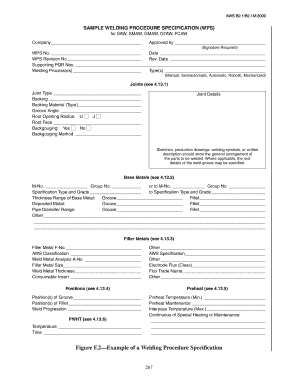
__________________________ Figure F.2—Example of a Welding Procedure Specification 267 AWS B2.1/B2.1M:2009 Shielding (see 4.13.7) Torch Shielding Root Shielding Trailing Environmental Shielding Gas(es) Composition Flow Rate Electrical Characteristics (see 4.13.8) Other Variables (see 4.13.9) Current Type/Polarity____________________________ Pulsing: Yes No Current (Range) _______________________________ Voltage (Range) _______________________________ Wire Feed Speed (Range) ________.

How it works

  1. Open form

    Open form follow the instructions

  2. Easily sign form

    Easily sign the form with your finger

  3. Share form

    Send filled & signed form or save

How to fill out the AWS B2.1/B2.1M online

The AWS B2.1/B2.1M is a vital document for creating welding procedure specifications. This guide provides clear instructions on how to complete the form online, ensuring a thorough understanding of each section and field.

Follow the steps to fill out your AWS B2.1/B2.1M form online

  1. Click the ‘Get Form’ button to obtain the form and open it for editing.
  2. Begin by entering the company name in the designated space.
  3. Fill in the name of the approver in the approved by section, including a signature.
  4. Complete the WPS number and the date fields accurately.
  5. Specify the revision number and revision date for the document.
  6. List all relevant supporting PQR numbers for reference.
  7. Fill in the welding process details, including types such as manual, semiautomatic, automatic, robotic, or mechanized.
  8. Provide specifics on the joints, including joint type, backing details, backing material type, groove angle, root opening radius, and root face.
  9. Indicate whether backgouging is required and detail the backgouging method if applicable.
  10. Include any sketches, production drawings, or a written description that demonstrates the joint details.
  11. Enter the specifications for base metals, including M-No., group numbers, specification type, grade, and thickness ranges.
  12. Complete the filler metals section by providing details such as filler metal F-No., AWS classification, and weld metal analysis.
  13. Specify the positions for welding, preheat requirements including temperatures, and maintenance needs.
  14. Fill out the shielding section to indicate torch shielding and gas composition.
  15. Include electrical characteristics, current type/polarity, and additional welding parameters.
  16. At the conclusion of your form, review all sections for accuracy, then save changes, and choose to download, print, or share the completed form.

Start completing your AWS B2.1/B2.1M online today for successful welding specifications!

Get form

Experience a faster way to fill out and sign forms on the web. Access the most extensive library of templates available.
Get form

Related content

SAIA A92.2 “Vehicle Mounted Elevating and...
AWS B2.1/B2.1M “Specification for Welding Procedure and Performance ... AWS D10.9...
Learn more
(PDF) AWS B2 1
This document serves as a normative annex for AWS B2.1/B2.1M-BMG:2014, detailing base...
Learn more
PRODUCT CATALOG
Designed for use with 98% Ar/2% O2 or 75%. Ar/25% CO2 shielding gas, Metalloy 80B2 is used...
Learn more

Related links form

Canada FLR 10A 2005 Canada FLR 34F - Ontario 2006 Canada FLR-13-E 2005 Canada FLR-25G-E 2009

Questions & Answers

Get answers to your most pressing questions about US Legal Forms API.

Contact support

AWS B2.1 focuses on welding procedure specifications, while AWS D1.1 addresses the requirements for welding steel structures. Both certifications are essential but serve different purposes in the welding industry. Understanding the distinctions can help welders choose the appropriate certification for their career goals. Moreover, mastering these certifications can significantly enhance your qualification and job opportunities.

Many consider the AWS welding test to be quite rigorous, particularly the AWS B2.1/B2.1M exam. This test involves practical assessments and theoretical knowledge that requires comprehensive preparation. Welders need to be proficient in multiple techniques and understand industry standards thoroughly. Therefore, adequate preparation is essential to pass this test and demonstrate skill.

AWS B2.1 certification focuses on the development of welding procedures and qualification standards. This certification outlines the essential criteria for producing quality welds consistently. By mastering AWS B2.1/B2.1M, welders can advance their careers and increase their job prospects. Additionally, this certification is respected across various industries, ensuring that certified professionals can meet stringent project demands.

Welders qualified under AWS D1.1 maintain their certification for up to six months before needing to requalify. This qualification is based on specific welding processes and positions determined during their testing. It is crucial to stay current with skills and knowledge, as practices and standards can evolve. Regular practice and recertification can help maintain proficiency.

The AWS welding certification, including the AWS B2.1/B2.1M certification, can be challenging. It requires welders to have a deep understanding of welding procedures and quality standards. The difficulty level often depends on the individual's experience and preparation. Many candidates find that thorough study and hands-on practice enhance their chances of success.

The hardest welding test often refers to tests that require extensive skill and precision, such as the AWS B2.1/B2.1M certification process. These tests challenge welders to demonstrate their abilities in a range of critical welding techniques and materials. Successfully passing this test proves a welder's competence and readiness for complex projects. Each test can vary based on the specific requirements of the job or industry.

AWS B2.1 focuses on the specifications for welding procedures, while AWS D1.1 provides specific requirements for structural welding. Essentially, B2.1 outlines how to perform welding across multiple materials and techniques, whereas D1.1 targets welding in structural applications. Understanding these distinctions can enhance your expertise and help you make informed choices in your professional development.

Welders qualified under AWS D1.1 are certified for a specific period, typically up to six months for certain processes. However, the duration may vary based on the type of welding and the specific conditions of the certification. Staying informed about AWS B2.1/B2.1M can support your ongoing qualifications and ensure your skills remain relevant in the industry.

SWPs, or Safe Work Practices, are essential guidelines focused on ensuring safety and efficiency in welding operations. They outline the necessary steps and precautions that should be taken when performing welding tasks, helping prevent accidents and ensuring compliance with regulations. Incorporating SWPs alongside AWS B2.1/B2.1M practices can significantly improve workplace safety.

AWS B2.1 certification pertains to the specifications for welding procedures for various materials. It serves as a benchmark for welders, ensuring they adhere to industry standards in their work. By achieving AWS B2.1 certification, you demonstrate your commitment to quality and proficiency in welding, which can enhance your employment opportunities.

Get This Form Now!

Use professional pre-built templates to fill in and sign documents online faster. Get access to thousands of forms.
Get form
If you believe that this page should be taken down, please follow our DMCA take down processhere.
Get AWS B2.1/B2.1M
Get form
  • Adoption
  • Bankruptcy
  • Contractors
  • Divorce
  • Home Sales
  • Employment
  • Identity Theft
  • Incorporation
  • Landlord Tenant
  • Living Trust
  • Name Change
  • Personal Planning
  • Small Business
  • Wills & Estates
  • Packages A-Z
  • Affidavits
  • Bankruptcy
  • Bill of Sale
  • Corporate - LLC
  • Divorce
  • Employment
  • Identity Theft
  • Internet Technology
  • Landlord Tenant
  • Living Wills
  • Name Change
  • Power of Attorney
  • Real Estate
  • Small Estates
  • Wills
  • All Forms
  • Forms A-Z
  • Other Templates
  • Legal Hub
  • About Us
  • Help Portal
  • Legal Resources
  • Blog
  • Affiliates
  • Contact Us
  • Delete My Account
  • Site Map
  • Industries
  • Forms in Spanish
  • Localized Forms
  • State-specific Forms
  • Forms Kit
  • Real Estate Handbook
  • All Guides
  • Notarize
  • Incorporation services
  • For Consumers
  • For Small Business
  • For Attorneys
  • USLegal
  • FormsPass
  • pdfFiller
  • signNow
  • altaFlow
  • DocHub
  • Instapage
Form Packages
  • Adoption
  • Bankruptcy
  • Contractors
  • Divorce
  • Home Sales
  • Employment
  • Identity Theft
  • Incorporation
  • Landlord Tenant
  • Living Trust
  • Name Change
  • Personal Planning
  • Small Business
  • Wills & Estates
  • Packages A-Z
Form Categories
  • Affidavits
  • Bankruptcy
  • Bill of Sale
  • Corporate - LLC
  • Divorce
  • Employment
  • Identity Theft
  • Internet Technology
  • Landlord Tenant
  • Living Wills
  • Name Change
  • Power of Attorney
  • Real Estate
  • Small Estates
  • Wills
  • All Forms
  • Forms A-Z
  • Other Templates
Customer Service
  • Legal Hub
  • About Us
  • Help Portal
  • Legal Resources
  • Blog
  • Affiliates
  • Contact Us
  • Delete My Account
  • Site Map
  • Industries
  • Forms in Spanish
  • Localized Forms
  • State-specific Forms
  • Forms Kit
Legal Guides
  • Real Estate Handbook
  • All Guides
Prepared for you
  • Notarize
  • Incorporation services
Our Customers
  • For Consumers
  • For Small Business
  • For Attorneys
Our Sites
  • USLegal
  • FormsPass
  • pdfFiller
  • signNow
  • altaFlow
  • DocHub
  • Instapage
Social Media
Call us now toll free:
+1 833 426 79 33
As seen in:
© Copyright 1999-2026 airSlate Legal Forms, Inc. 17 Station Street, Suite 303, Brookline, MA 02445
  • Your Privacy Choices
  • Terms of Service
  • Privacy Notice
  • Content Takedown Policy
  • Bug Bounty Program