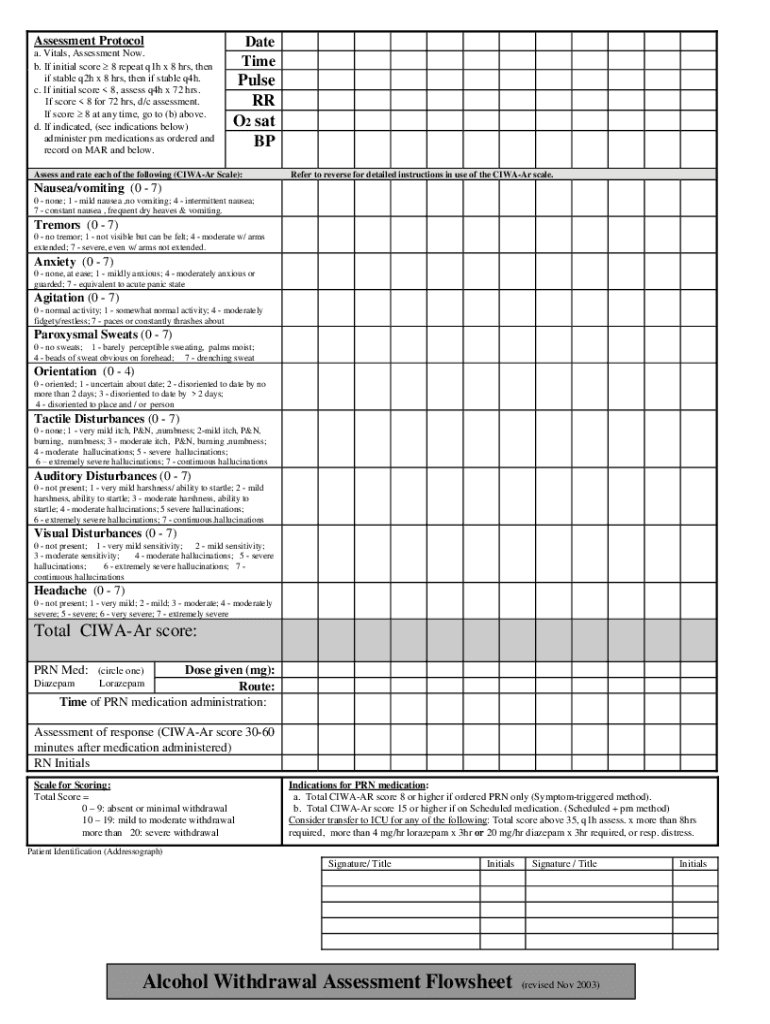
Ial score 8 repeat q1h x 8 hrs, then if stable q2h x 8 hrs, then if stable q4h. c. If initial score < 8, assess q4h x 72 hrs. If score < 8 for 72 hrs, d/c assessment. If score 8 at any time, go to (b) above. d. If indicated, (see indications below) administer prn medications as ordered and record on MAR and below. Date Time Pulse RR O2 sat BP Assess and rate each of the following (CIWA-Ar Scale): Refer to reverse for detailed instructions in use of the CIWA-Ar scale. Nausea/vomiting.
Loading

Open form follow the instructions

Easily sign the form with your finger

Send filled & signed form or save
How to use or fill out the Alcohol Withdrawal Assessment Scoring Guidelines (CIWA - Ar) online
This guide provides clear and comprehensive instructions on how to effectively fill out the Alcohol Withdrawal Assessment Scoring Guidelines (CIWA - Ar) form online. The CIWA - Ar is essential for assessing individuals experiencing alcohol withdrawal, and accurately completing it is vital for their care.
Follow the steps to complete the CIWA - Ar form online.
- Press the 'Get Form' button to obtain the Alcohol Withdrawal Assessment Scoring Guidelines (CIWA - Ar) form and open it to begin filling it out.
- Begin with the first criterion: Nausea/Vomiting. Rate on a scale from 0 to 7 based on the patient's reported symptoms. Ensure to ask specific questions regarding their experience.
- Proceed to the second criterion: Tremors. Have the patient extend their arms and spread their fingers. Rate the tremors from 0 to 7 based on your observations and patient feedback.
- Continue to assess Anxiety, rating from 0 to 7 based on the patient's demeanor throughout the assessment.
- Next, evaluate Agitation, using the same scale of 0 to 7 to document the patient's restlessness or activity level.
- For Paroxysmal Sweats, rate on a scale from 0 to 7 based on the presence and severity of perspiration observed.
- Assess Orientation and clouding of sensorium, asking the prescribed questions. This criterion is rated from 0 to 4.
- Check for Tactile disturbances, asking about sensations like itching or numbness. Rate accordingly from 0 to 7.
- Evaluate Auditory disturbances by asking about the patient's sensitivity to sounds. Rate this criterion from 0 to 7.
- Assess Visual disturbances, inquiring about any visual sensitivities or hallucinations. Rate from 0 to 7.
- Finally, ask about Headache and rate its severity on a scale from 0 to 7.
- Once all criteria have been assessed and rated, add up the scores to obtain the total CIWA-Ar score for the patient.
- If the total CIWA-Ar score is 8 or greater, ensure to initiate prophylactic medication as required for the patient's safety.
- Document all findings, including vital signs on the relevant assessment sheets as per the protocol.
- At the end of the process, ensure to save changes, download, print, or share the CIWA - Ar form as necessary.
Start completing the Alcohol Withdrawal Assessment Scoring Guidelines (CIWA - Ar) online to ensure effective patient care.
Experience a faster way to fill out and sign forms on the web. Access the most extensive library of templates available.
Related content
What is clear is that there are significant clinical advantages to quantifying the alcohol...
Update Training on CIWA and COWS. Clinical Institute Withdrawal Assessment of Alcohol...
The information contained within this Provider Manual is proprietary. The information is...
Get answers to your most pressing questions about US Legal Forms API.
What is the score on the alcohol use disorder identification test?
The score on the alcohol use disorder identification test varies based on responses to screening questions. This test measures the impact of drinking on an individual's life, rather than withdrawal symptoms specifically. For a comprehensive understanding of alcohol-related issues, integrating results from the Alcohol Withdrawal Assessment Scoring Guidelines (CIWA - Ar) with the identification test can provide valuable insights.
What is the alcohol scoring scale?
The alcohol scoring scale, particularly represented by the CIWA-Ar, consists of various symptoms important for evaluating alcohol withdrawal. This scale ranges from 0 to 67, where higher scores reflect more severe symptoms. Using this scale, healthcare providers can promptly address withdrawal symptoms in alignment with the Alcohol Withdrawal Assessment Scoring Guidelines (CIWA - Ar).
What is the score for alcoholism?
The score for alcoholism varies based on the assessment tool used; however, the CIWA-Ar focuses specifically on withdrawal symptoms. The Alcohol Withdrawal Assessment Scoring Guidelines (CIWA - Ar) do not diagnose alcoholism directly but help gauge the withdrawal phase severity. This scoring assists professionals in managing alcohol-related health issues effectively.
At what CIWA score do you give medication?
Medication is generally considered when a CIWA score reaches 8 or higher, signifying increased withdrawal severity. Following the Alcohol Withdrawal Assessment Scoring Guidelines (CIWA - Ar), treatment plans may include medications such as benzodiazepines to alleviate symptoms. This proactive approach helps ensure the safety and comfort of individuals undergoing withdrawal.
What is a CIWA score of 19?
A CIWA score of 19 indicates significant withdrawal symptoms that may require medical intervention. According to the Alcohol Withdrawal Assessment Scoring Guidelines (CIWA - Ar), a score in this range suggests that the individual is experiencing moderate to severe symptoms. Healthcare providers typically initiate treatment to manage these symptoms and prevent complications.
How to score the CIWA-Ar?
To score the CIWA-Ar, a clinician evaluates ten specific symptoms related to alcohol withdrawal. Each symptom receives a score ranging from 0 to 7, depending on severity. The total score helps guide treatment decisions and monitor progress during the withdrawal process, ensuring individuals receive appropriate care.
What is the scoring system for alcohol dependence?
The scoring system for alcohol dependence helps identify the severity of alcohol use disorder in individuals. The Alcohol Withdrawal Assessment Scoring Guidelines (CIWA - Ar) incorporates various criteria to gauge the impact of alcohol on daily functioning and health. This allows healthcare professionals to tailor treatment plans that address the specific needs of the individual.
What is the scoring system for alcohol?
The scoring system for alcohol assesses the severity of withdrawal symptoms experienced by individuals who are decreasing or stopping alcohol consumption. The Alcohol Withdrawal Assessment Scoring Guidelines (CIWA - Ar) provides a standardized method to evaluate signs such as tremors, anxiety, and sweating. By using this scoring system, healthcare providers can determine the appropriate level of care and intervention needed.
What is a score of 21 on the Clinical Institute Withdrawal Assessment of alcohol scale?
A score of 21 on the Clinical Institute Withdrawal Assessment of alcohol scale indicates a moderate to severe level of withdrawal symptoms. This score suggests that a patient may require more intensive medical intervention and monitoring. By utilizing the Alcohol Withdrawal Assessment Scoring Guidelines (CIWA - Ar), healthcare providers can ensure a comprehensive treatment approach.
When should you reassess CIWA?
You should reassess the CIWA score every few hours or as needed based on the patient's condition. Regular reassessment is crucial for monitoring changes in withdrawal symptoms. This practice allows healthcare providers to adjust treatment strategies effectively, ensuring the best care for patients experiencing alcohol withdrawal.
Use professional pre-built templates to fill in and sign documents online faster. Get access to thousands of forms.
If you believe that this page should be taken down, please follow our DMCA take down process here.