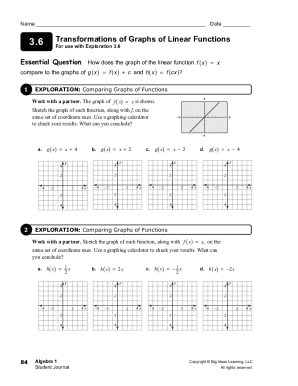
Name Date Transformations of Graphs of Linear Functions 3.6 For use with Exploration 3.6 Essential Question How does the graph of the linear function f ( x ) x compare to the graphs of g ( x ) f (.
Loading
Open form follow the instructions
Easily sign the form with your finger
Send filled & signed form or save
How to use or fill out the Transformations Of Graphs Of Linear Functions - Big Ideas Math online
This guide provides a thorough walkthrough for users looking to fill out the Transformations Of Graphs Of Linear Functions form online. With clear instructions and supportive guidance, you will navigate the form with ease, ensuring all necessary components are completed accurately.
Follow the steps to successfully complete the form online
- Click ‘Get Form’ button to access the form and open it in the editor.
- Begin with filling in your name in the designated field, ensuring that you write clearly and legibly.
- Next, enter the date when you are filling out the form, using the provided space.
- Address the exploration questions by sketching the corresponding graphs. Utilize a graphing calculator as specified to verify your results.
- Proceed to the section on matching functions with their graphs. Carefully read each function and draw lines to connect them with their corresponding graphs, checking for accuracy.
- In the notetaking section, write definitions for each vocabulary term provided, using your own words to ensure understanding.
- Conclude by reviewing all entries for completeness and accuracy before saving your changes, downloading the form, printing it, or sharing it as needed.
Start filling out the Transformations Of Graphs Of Linear Functions form online today!
Experience a faster way to fill out and sign forms on the web. Access the most extensive library of templates available.
Related content
Text/Instructional Material Title: _ Big Ideas Math Course 3 (Grade 8): Virginia Edition__...
Vertical and Horizontal Translations for Linear Functions Reflecting Linear Functions over...
In mathematics, topology is concerned with the properties of a geometric object that are...
Get answers to your most pressing questions about US Legal Forms API.
What is the domain and range in big ideas math?
A function is a relationship that pairs each input with exactly one output. The domain is the set of all possible input values. The range is the set of all possible output values.
What is the transformation of graphs and functions?
Transformation of functions means that the curve representing the graph either "moves to left/right/up/down" or "it expands or compresses" or "it reflects". For example, the graph of the function f(x) = x2 + 3 is obtained by just moving the graph of g(x) = x2 by 3 units up.
What are the transformations of graphs and linear functions?
There are three transformations possible in a linear function. One is a translation, or left or right or up or down shift. Another is reflection or flip of the graph. Lastly is scaling or stretch of the graph.
What are the three graphing linear functions?
There are three basic methods of graphing linear functions. The first is by plotting points and then drawing a line through the points. The second is by using the y-intercept and slope. The third is applying transformations to the identity function f(x)=x f ( x ) = x .
What is a horizontal translation of a linear function?
Topic Notes. Horizontal translations refer to movements of a graph of a function horizontally along the x-axis by changing the x values. So, if y = f(x), then y = (x –h) results in a horizontal shift. If h > 0, then the graph shifts h units to the right; while If h < 0, then the graph shifts h units to the left.
What are the different types of transformations on a graph?
Types of Transformations TransformationFunction Rotation Rotates or turns the pre-image around an axis Reflection Flips the pre-image and produces the mirror-image Translation Slides or moves the pre-image Dilation Stretches or shrinks the pre-image
What are the transformations of a linear system?
Definition: Linear Transformation A transformation T:Rn→Rm is a linear transformation if it satisfies the following two properties: T(→x+→y)=T(→x)+T(→y) for all vectors →x and →y, and. T(k→x)=kT(→x) for all vectors →x and all scalars k.
What is a linear transformation of a function?
A linear transformation is a function from one vector space to another that respects the underlying (linear) structure of each vector space. A linear transformation is also known as a linear operator or map.
Use professional pre-built templates to fill in and sign documents online faster. Get access to thousands of forms.
If you believe that this page should be taken down, please follow our DMCA take down process here.