Thing that already happened, does your child use words that end in “-ed,” such as “walked,” “jumped,” or “played”? Ask your child questions, such as “How did you get to the store?” (“We walked.”) “What did you do at your friend’s house?” (“We played.”) Please write an example: COMMUNICATION TOTAL page 2 of 7 E101540200 Ages & Stages Questionnaires®, Third Edition (ASQ-3™), Squires & Bricker © 2009 Paul H. Brookes Publishing Co. All rights reserved. 54 M.

Open form follow the instructions

Easily sign the form with your finger

Send filled & signed form or save
How to fill out the ASQ-3 P101540100 online
The ASQ-3 P101540100 is a crucial tool for assessing the developmental milestones of children aged 51 months to 56 months. This guide will provide a clear, step-by-step process for completing this questionnaire online, ensuring a smooth and efficient experience.
Follow the steps to accurately complete the ASQ-3 P101540100 questionnaire.
- Press the ‘Get Form’ button to retrieve the ASQ-3 P101540100 form and open it in your preferred document editor.
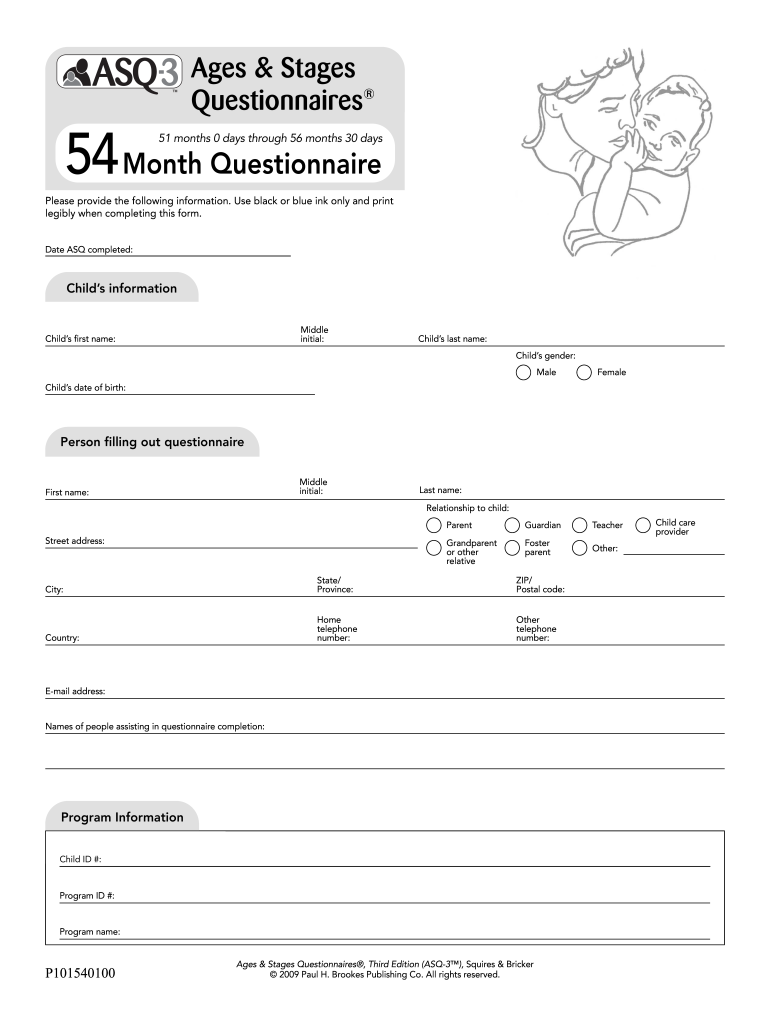
- Fill in the date when the ASQ was completed, starting with the child’s information. Provide the child's middle initial, first name, last name, gender, and date of birth. Ensure that all entered data is legible and accurate.
- Next, provide your information as the person filling out the questionnaire. Include your middle initial, first name, last name, relationship to the child, and contact information such as street address, city, state/province, ZIP/postal code, country, and telephone numbers.
- Specify the names of individuals assisting you in completing the questionnaire along with any relevant program information, including child ID number, program ID number, and program name.
- Proceed to the main section of the questionnaire that contains various questions regarding your child's activities and skills. For each statement, indicate whether your child performs the activity consistently, sometimes, or not yet by marking the appropriate circle.
- As you complete the sections, refer to the important points provided in the questionnaire, ensuring that your child is engaged and relaxed during this process to obtain the best results.
- Upon finishing the questionnaire, it’s crucial to review your responses for accuracy. Once satisfied, save your changes to the document.
- Finally, you can download, print, or share the completed form as needed, ensuring it is submitted to the appropriate program or service as indicated in the instructions.
Complete your ASQ-3 P101540100 questionnaire online today for accurate developmental assessment.
Experience a faster way to fill out and sign forms on the web. Access the most extensive library of templates available.
Related content
legibly when completing this form. Date ASQ ... Program name: P101540100. Ages & Stages...
Get answers to your most pressing questions about US Legal Forms API.
What does ASQ-3 screen for?
The ASQ-3 P101540100 screens for a variety of developmental areas, including communication, gross motor, fine motor, problem-solving, and personal-social skills. By focusing on these domains, the ASQ-3 helps identify children who may need further evaluation or support. This comprehensive approach ensures that all aspects of development are considered. Utilizing the ASQ-3 can greatly enhance a child's developmental journey.
Is ASQ-3 for autism?
The ASQ-3 P101540100 is primarily a developmental screening tool, not specifically designed exclusively for autism. However, it effectively highlights developmental delays that may be associated with autism spectrum disorder. This means that it plays a significant role in early detection, making it a useful resource for families and professionals alike. Regular use of the ASQ-3 can facilitate proactive measures to support child development.
Does ASQ detect autism?
While the ASQ-3 P101540100 is not a diagnostic tool for autism, it can help identify developmental concerns that may warrant further investigation. By highlighting areas where a child may need additional support, it serves as a valuable first step. Early identification can lead to timely interventions, improving outcomes for children. Consider using the ASQ-3 to regularly monitor developmental progress.
Who can use the ASQ-3?
The ASQ-3 P101540100 can be used by a wide range of users, including parents, healthcare providers, and educators. This tool is adaptable, allowing anyone involved in a child's development to facilitate screenings. It is designed to empower caregivers with insights into a child's growth and development. Using the ASQ-3 can foster collaborative efforts to support children's needs.
What is a normal ASQ score?
A normal ASQ-3 P101540100 score typically falls within the expected developmental range for a child’s age. Scores are usually categorized into different ranges that indicate areas needing attention or further evaluation. Understanding these scores can help you identify if your child is developing on track. Regular assessments with the ASQ-3 can provide reassurance for parents and caregivers.
What is the best assessment tool for autism?
The ASQ-3 P101540100 is considered one of the best assessment tools for autism. It provides a comprehensive evaluation of developmental milestones in young children. Parents and professionals appreciate its user-friendly format, which helps identify potential delays. By utilizing the ASQ-3, users can ensure children get timely support.
How do I print an ASQ questionnaire?
To print an ASQ questionnaire, first locate the ASQ-3 P101540100 form on your device. Make sure you have your printer set up and ready to go. Select the print option from your document viewer, and ensure the settings are correct for the best print quality. Once you confirm all settings, hit print to receive your ASQ-3 P101540100 questionnaire.
How to fill out ASQ3?
Filling out the ASQ-3 P101540100 is straightforward and user-friendly. Parents or caregivers respond to questions by observing the child's behaviors and skills in daily situations. It's important to answer each question honestly to gain accurate insights into your child's development. If you need guidance, platforms like uslegalforms offer resources to ensure you complete the ASQ-3 effectively.
How is the ASQ SE questionnaire scored?
The scoring for the ASQ-3 P101540100 involves adding the scores from each item in the questionnaire. This total helps determine if a child's development is on track or if further evaluation is necessary. Each area of development has specific cut-off scores to guide you. Understanding the results can help you make informed decisions for your child's growth.
Who can complete an ASQ?
An ASQ can be completed by parents, caregivers, healthcare providers, or early childhood professionals who understand the child's behaviors and development. It's important that the individual knows the child well to provide accurate insights. When using ASQ-3 P101540100, you gain access to a reliable way to assess your child's growth. US Legal Forms offers supportive tools to guide you through this essential process.
Use professional pre-built templates to fill in and sign documents online faster. Get access to thousands of forms.
If you believe that this page should be taken down, please follow our DMCA take down process here.