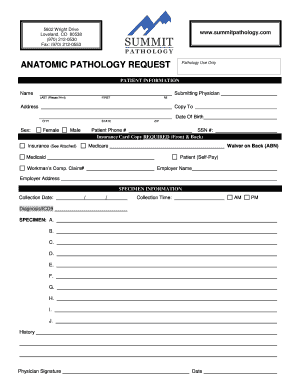
5802 Wright Drive Loveland, CO 80538 (970) 2120530 Fax: (970) 2120553 www.summitpathology.com Pathology Use Only ANATOMIC PATHOLOGY REQUEST PATIENT INFORMATION Name Submitting Physician LAST (Please.
Open form follow the instructions
Easily sign the form with your finger
Send filled & signed form or save
How to fill out the Summit Pathology online
Filling out the Summit Pathology form online is a straightforward process designed to facilitate the submission of important pathology requests. This guide provides step-by-step instructions to ensure that all necessary information is accurately completed.
Follow the steps to successfully complete the Summit Pathology form.
- Click ‘Get Form’ button to obtain the form and open it in your editor.
- Begin by filling out the patient information section. Enter the patient's full name in the provided fields, including last name, first name, and middle initial. Provide the patient's address, city, state, and zip code. Also, include their date of birth and a contact phone number.
- In the submitting physician section, record the name of the physician submitting the request. Ensure that the information is printed clearly.
- Indicate the patient's sex by selecting either 'Female' or 'Male.'
- Provide the patient's Social Security Number (SSN) and ensure a copy of the patient's insurance card (front and back) is attached as required.
- Select the appropriate insurance type by marking the relevant checkbox, such as Medicare, Medicaid, or Self-Pay. If applicable, include any Workman’s Comp claim number and details about the employer.
- Fill out the specimen information and collection details. Record the collection date and time (AM/PM) accurately. Describe the specific specimen type and diagnosis using the provided diagnosis/ICD9 field.
- In the specimen section, complete all relevant fields labeled A through J as needed, providing any history pertinent to the specimen.
- Ensure that the physician's signature is included, along with the date to validate the request.
- After completing all sections, review the filled form for accuracy. You can then save changes, download, print, or share the form.
Complete your Summit Pathology form online today for efficient processing.
Experience a faster way to fill out and sign forms on the web. Access the most extensive library of templates available.
Related content
Jan 9, 2018 — Forensic Pathologists: Arnall, Michael, MD, Adams/Boulder County...
Dr. Ulysses Balis, Director of Pathology Informatics at UM is the Conference Director of...
Food Toxicology; Toxicology; Genetic Toxicology and Toxicity Testing; Human & Health...
Get answers to your most pressing questions about US Legal Forms API.
What is pathology department?
A Pathology Department is a unit which is managed as a separate entity by a CONSULTANT or non-medical scientist of equivalent standing which deals with DIAGNOSTIC TEST REQUESTS for pathology. The Pathology Department may consist of one or more Pathology Laboratories that may be located on one or more sites.
What is the pathology process?
It involves the examination of tissues, organs, bodily fluids, and autopsies in order to study and diagnose disease. Currently, pathology can be divided into eight main areas, depending on the types of methods used or the types of diseases examined. These different disciplines are described below.
What is pathology answer?
Pathology is the study of the cause of a disease. This is done by testing the body fluids for the presence of microorganisms or chemicals indicative of the disease. Treating diseases with drugs or chemicals comes under the purview of medicine.
What are the 7 pathological processes?
From the viewpoint of the general pathology, most of the human diseases are associated with a limited number of pathogenic processes such as inflammation, tumor growth, thrombosis, necrosis, fibrosis, atrophy, pathological hypertrophy, dysplasia and metaplasia.
What is NHS pathology?
What is pathology? Pathology is the study of disease and is central to diagnoses made in the NHS. The work of pathologists and scientists is vital for efficient and effective healthcare.
What are the 4 parts of pathology?
Other branches of pathology include: Anatomic pathology. The study of tissues, organs, and tumors. Cytopathology. The study of cellular changes and everything related to cells. Forensic pathology. Doing autopsies and legal pathology tests. Molecular pathology. The study of DNA and RNA sequencing, genes, and genetics.
What is the role of a pathologist?
What is a pathologist? A pathologist is a medical healthcare provider who examines bodies and body tissues. He or she is also responsible for performing lab tests. A pathologist helps other healthcare providers reach diagnoses and is an important member of the treatment team.
What is the basic of pathology?
Pathology is divided into general & systemic pathology for pedagogical reasons. General pathology covers the basic mechanisms of diseases whereas systemic pathology covers diseases as they occur in each organ system.
Use professional pre-built templates to fill in and sign documents online faster. Get access to thousands of forms.
If you believe that this page should be taken down, please follow our DMCA take down process here.