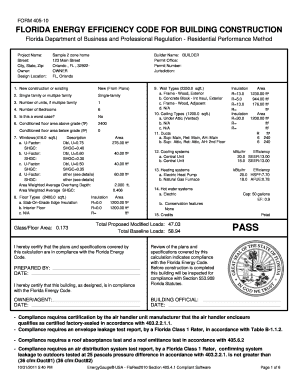
R, confirming system leakage to outdoors tested at 25 pascals pressure difference in accordance with 403.2.2.1. is not greater than (36 cfm:Duct#1) (36 cfm:Duct#2) 10/31/2011 5:40 PM EnergyGauge® USA - FlaRes2010 Section 405.4.1 Compliant Software Page 1 of 6 PROJECT Title: Building Type: Owner: # of Units: Builder Name: Permit Office: Jurisdiction: Family Type: New/Existing: Comment: Sample 2 zone home FLProp2010 OWNER 1 BUILDER Bedrooms: Conditioned Area: Total Stories: Worst Case: Rota.

How it works
  • Open form

    Open form follow the instructions

  • Easily sign form

    Easily sign the form with your finger

  • Share form

    Send filled & signed form or save

How to fill out the FL DBPR 405-10 online

The FL DBPR 405-10 is an essential document for compliance with the Florida Energy Efficiency Code for building construction. This guide offers step-by-step instructions to assist users in accurately completing the form online, ensuring alignment with energy standards and regulations.

Follow the steps to complete the FL DBPR 405-10 online.

  1. Click the 'Get Form' button to access the FL DBPR 405-10 and open it in your preferred online document editor.
  2. Begin by filling out the 'Project Name' section at the top of the form. Ensure that the address fields are accurately filled out, including the street, city, state, and zip code.
  3. Provide the name of the owner in the 'Owner' field and the name of the builder in the 'Builder Name' section. Make sure to include the permit office and permit number if applicable.
  4. Indicate whether the project involves new construction or an existing building by selecting the appropriate option in the relevant section of the form.
  5. Specify whether the building is single-family or multi-family. If it is multi-family, include the number of units in the provided field.
  6. Complete the section regarding the number of bedrooms and the conditioned floor area above and below grade. Fill in these details accurately to reflect the building's specifications.
  7. Detail the window specifications, including U-Factor and SHGC values for each type of window used in the building, and provide the area and other associated metrics.
  8. Continue with floor, wall, ceiling, and duct types, providing required data for insulation types, areas, and R-value wherever applicable.
  9. Document the specifics of heating, cooling, and hot water systems, including efficiency ratings and capacities as outlined in the form.
  10. Upon completing all sections, review the form thoroughly. Save your changes, and proceed to download, print, or share the completed document as needed.

Start filling out your FL DBPR 405-10 online today to ensure compliance with Florida's Energy Efficiency Code.

Get form

Experience a faster way to fill out and sign forms on the web. Access the most extensive library of templates available.

Related content

SF-Permit-Checklist.pdf

Florida Energy Form 405-10 and Equipment Sizing Calculations. ______6 ... 487-1395, or...

Learn more
Questions & Answers

Get answers to your most pressing questions about US Legal Forms API.

Contact support

Does Florida have a personal property tax?

Yes, Florida does have a personal property tax system that applies to various assets owned by individuals and businesses. Unlike some states, Florida's personal property tax primarily targets tangible personal property rather than residential real estate. Filing the FL DBPR 405-10 helps you understand your liabilities and allows the tax assessor to evaluate your property accordingly. Utilizing platforms like uslegalforms can simplify this process and ensure that your filings are properly managed.

In Florida, personal property includes any assets that are not permanently fixed to a location, such as furniture, machinery, equipment, and inventory. This classification generally covers tangible items used for business operations, and it also includes rental properties. Understanding what constitutes personal property is critical when completing your FL DBPR 405-10 form. Proper identification ensures that you report accurately, allowing you to maintain compliance with state laws.

Filing a DR 405 in Florida is necessary if you own tangible personal property and your property's value exceeds a certain threshold. This form, commonly referred to as FL DBPR 405-10, is essential for accurate tax reporting each year. By filing this form, you help property appraisers assess the value of your assets. Without this filing, you may face penalties or fines, so it's wise to stay compliant.

Yes, Florida does impose personal property taxes on vehicles, including cars, boats, and aircraft. However, it is essential to recognize that personal vehicles are typically not subject to this tax at the same level as business-related assets. When dealing with personal property tax and your vehicles, the FL DBPR 405-10 form becomes vital for indicating any business use accurately. This way, you can ensure you meet your tax obligations without overspending.

In Florida, the requirement to file a tangible personal property tax return is outlined in Section 193.015 of the Florida Statutes. This section emphasizes the importance of filing the DR-405 form, also known as FL DBPR 405-10, to report your tangible assets. By completing this return, you ensure compliance with state tax requirements and avoid potential penalties. Thus, understanding this section helps you navigate your tax obligations effectively.

Who must file a TPP tax return? Anyone owning tangible personal property on January 1 must file a tax return by April 1 each year unless you were notified by our office that the filing requirement has been waived.

$25,000 TPP Exemption If you file your TPP return by April 1, you will be eligible for a property tax exemption of up to $25,000 of assessed value. (see s. 196.183, F.S.)

“Tangible personal property” exists physically (i.e., you can touch it) and can be used or consumed. Clothing, vehicles, jewelry, and business equipment are examples of tangible personal property.

As a business owner, you have to file a Florida tangible personal property tax return (DR-405), or TPP for short. However, it doesn't work like your income tax return. You have to pay a tax that's determined by your county's tax collector on certain fixed assets you own.

Tangible personal property includes equipment, supplies, and any other property (including information technology systems) other than that is defined as an intangible property. It does not include copyrights, patents, and other intellectual property that is generated or developed (rather than acquired) under an award.

Get This Form Now!

Use professional pre-built templates to fill in and sign documents online faster. Get access to thousands of forms.

If you believe that this page should be taken down, please follow our DMCA take down process here.

Get FL DBPR 405-10