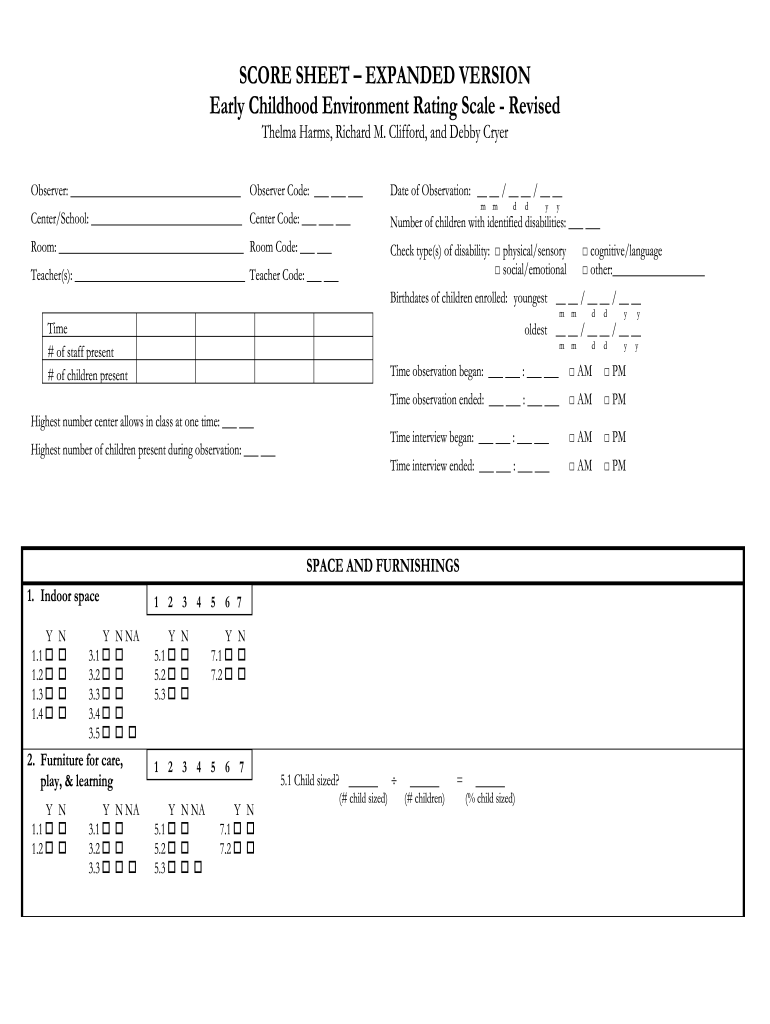
__ ___ ___ Date of Observation: __ __ / __ __ / __ __ Center/School: _______________________________ Center Code: ___ ___ ___ Number of children with identified disabilities: ___ ___ Room: ______________________________________ Room Code: ___ ___ Check type(s) of disability: ɷ physical/sensory ɷ social/emotional Teacher(s): ___________________________________ Teacher Code: ___ ___ m m d d y y ɷ cognitive/language ɷ other:___________________ Birthdates of children enrolled: young.
Loading

Open form follow the instructions

Easily sign the form with your finger

Send filled & signed form or save
How to fill out the ECERS Score Sheet online
The ECERS Score Sheet is an essential tool for assessing the quality of early childhood environments. Filling it out online allows for efficient data entry and analysis, ensuring that observations are accurately documented to improve educational outcomes.
Follow the steps to complete your ECERS Score Sheet online.
- Click ‘Get Form’ button to obtain the form and open it in the editor.
- Begin by filling in the observer's information, including their name and observer code, followed by the date of the observation.
- Provide details of the center or school, such as the name and code, and specify the room and the number of children present, along with those identified with disabilities.
- In the designated sections, check the types of disabilities of the children present. Use the provided options to indicate if they are physical/sensory, social/emotional, cognitive/language, or other.
- Record children's birthdates and the number of staff present for the observation. Note the maximum allowable number of children in the class and highest observed attendance.
- Proceed through the various sections of the form, providing yes/no responses as applicable, and fill in any necessary notes or observations in the provided spaces.
- For specific scoring sections, make sure to calculate and input subscale averages in their designated areas based on your observations.
- Review all entries for accuracy. Save your changes, and once finalized, you can download, print, or share the filled form as needed.
Begin filling out your ECERS Score Sheet online today to ensure thorough documentation of your assessment.
Experience a faster way to fill out and sign forms on the web. Access the most extensive library of templates available.
Related content
Mar 9, 2015 — These subscale scores are found in the Total and Average Score section at...
by T Harms — SCORE SHEET – EXPANDED VERSION. Early Childhood Environment Rating Scale...
Get answers to your most pressing questions about US Legal Forms API.
What is a good score on the ECERS?
A good score on the ECERS typically falls within the range that indicates a program meeting or exceeding basic quality standards. Generally, a score of 5 or higher suggests that a program provides excellent early learning experiences. However, scores may vary based on program types and objectives. To better understand how these scores apply to your program, the ECERS Score Sheet can provide clarity and insight.
What is the ECERS-3 rating scale?
The ECERS-3 rating scale is an updated version of the original ECERS scale, designed to enhance the assessment of preschool and kindergarten classrooms. It reflects the latest research in early childhood education, focusing on effective practices and outcomes for children. This tool not only measures quality but also provides specific guidance for ongoing improvement. The ECERS Score Sheet is an excellent resource for utilizing the ECERS-3 effectively.
What is the ECERS early childhood Environmental rating scale?
The ECERS Early Childhood Environmental Rating Scale focuses on evaluating aspects of the physical and emotional environment in early childhood programs. It examines crucial areas like safety, interaction, and educational materials. By utilizing this scale, educators can effectively identify the strengths and areas for growth in their programs. With the ECERS Score Sheet, tracking these evaluations becomes more manageable.
What is the ECERS Early Childhood Environment Rating Scale?
The ECERS Early Childhood Environment Rating Scale is a comprehensive tool specifically designed to assess the quality of early childhood programs. It covers essential caregiving practices, materials, and interactions within the learning environment. This scale provides educators with the insights they need to improve their offerings. Employing the ECERS Score Sheet helps simplify this assessment process and provides structured feedback.
What is the rating scale for ECE?
The rating scale for early childhood education typically categorizes performance and quality indicators from low to high. It provides benchmarks that help assess how well a program meets set standards. Educators can use these ratings to develop targeted improvement plans. The ECERS Score Sheet offers a user-friendly format to track ratings easily and analyze strengths and weaknesses.
What is a rating scale in ECE?
A rating scale in early childhood education (ECE) measures the quality of educational programs by evaluating various aspects such as classroom environment, teaching strategies, and interactions. This tool helps educators and administrators pinpoint specific areas needing attention. By applying a rating scale, educators can enhance their programs, benefiting both children and parents. Utilizing the ECERS Score Sheet can streamline this evaluation process.
What is the 5 performance rating scale?
The 5 performance rating scale is a method used to evaluate early childhood programs using clear categories that range from inadequate to excellent. Each level provides detailed descriptions, helping educators understand specific areas of strength and opportunities for improvement. This scale is essential for assessing quality and ensuring that children receive the best possible environments. You can use the ECERS Score Sheet for a structured evaluation.
Is ECERS still used?
Yes, ECERS is still widely used as a reliable tool for assessing early childhood educational quality. Many programs and educators continue to utilize the ECERS Score Sheet to enhance their educational environments. Its ongoing relevance highlights its effectiveness in supporting quality improvement initiatives in early education.
What is the ECE rating scale?
The ECE rating scale measures various aspects of early childhood education, including the overall environment and caregiver interactions. This scale provides a comprehensive understanding of a program’s effectiveness. By using the ECERS Score Sheet, you can receive valuable insights for continuous improvement.
What is the difference between ECERS-3 and ECERS-R?
The main difference between ECERS-3 and ECERS-R is that ECERS-3 has updated items and a clearer scoring system. While both frameworks aim to assess environmental quality, ECERS-3 reflects current research and best practices more accurately. Understanding these differences can help you choose the correct assessment for your needs.
Use professional pre-built templates to fill in and sign documents online faster. Get access to thousands of forms.
If you believe that this page should be taken down, please follow our DMCA take down process here.