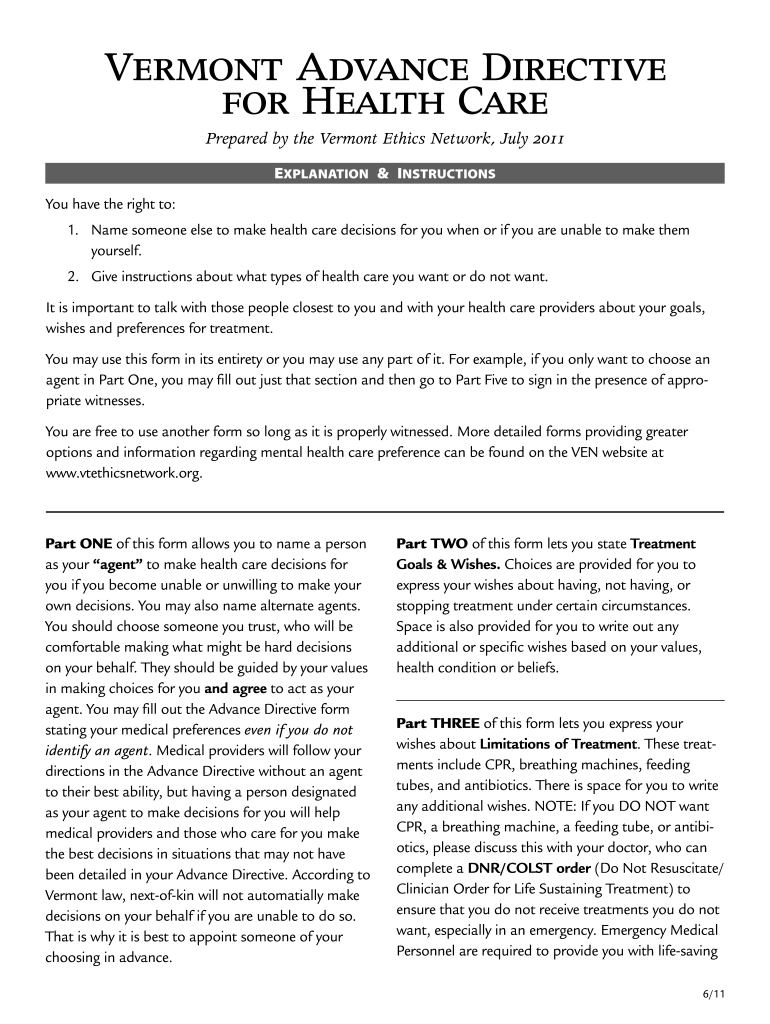
Nt. If there is no DNR/COLST order the emergency medical team will perform CPR as they will not have time to consult an Advance Directive, your family, agent, or physician. Part FOUR of this form allows you to express your wishes related to organ/tissue donation & preferences for funeral, burial and disposition of your remains. Part FIVE is for signatures. You must sign and date the form in the presence of two adult witnesses. The following persons may not be witnesses: your agent and alternat.
Loading

Open form follow the instructions

Easily sign the form with your finger

Send filled & signed form or save
How to fill out the VT Advance Directive for Health Care online
Filling out the VT Advance Directive for Health Care is a crucial step in ensuring your health care preferences are honored. This guide provides clear, step-by-step instructions to help you complete the form online, ensuring your wishes are communicated effectively.
Follow the steps to fill out your Advance Directive online.
- Click ‘Get Form’ button to obtain the form and open it in the editor.
- Begin with your personal information. Fill in your name, date of birth, address, city, state, and zip code as required in the designated sections.
- In Part One, appoint a health care agent by providing their name, address, and contact details. Consider choosing someone you trust to make decisions on your behalf.
- If necessary, designate an alternate agent by filling in their information. This person will step in if your primary agent is unavailable.
- List your primary care providers who can be consulted about your medical decisions and specify any individuals who should not be consulted.
- In Part Two, express your health care goals and spiritual wishes. Choose from the options provided and include any specific beliefs or additional goals.
- Proceed to Part Three, where you can outline any limitations of treatment. Clearly indicate your preferences regarding resuscitation, breathing assistance, feeding methods, and antibiotics.
- In Part Four, decide on organ and tissue donation preferences. Specify your wishes regarding burial or disposition of remains.
- Finally, in Part Five, sign and date the form in the presence of two adult witnesses who are not your agents or close relatives.
- After completing the form, save your changes and make copies for your agent, health care providers, and family members.
Ensure your health care wishes are respected; complete your Advance Directive online today.
Experience a faster way to fill out and sign forms on the web. Access the most extensive library of templates available.
Related content
May 7, 2025 — It is a written document that outlines your wishes for medical treatment...
An advance directive is a written statement of a person's wishes regarding medical...
This compilation includes state, District of Columbia, and territory statutes as of...
Get answers to your most pressing questions about US Legal Forms API.
Why would a physician not honor an advance directive?
A physician may not honor a VT Advance Directive for Health Care if they believe it conflicts with current medical standards or if the wishes expressed are unclear. Additionally, changes in your health condition may prompt them to recommend different treatment options than stated. It's crucial to ensure your directive is updated and accurately reflects your current wishes. Regularly reviewing it with your healthcare provider can help prevent misunderstandings.
When can you get an advance directive?
You can obtain a VT Advance Directive for Health Care at any time, as long as you are an adult capable of making informed decisions. Many people choose to create one during routine medical checkups or life transitions, such as moving or starting a family. Accessing resources, like uslegalforms, can simplify this process and guide you through the necessary steps. Don't wait for a future emergency to prepare your directive.
When should you get an advance directive?
You should consider getting a VT Advance Directive for Health Care as soon as you reach adulthood, especially if you have specific health concerns or preferences. It becomes essential during major life events, such as serious illness or aging. By preparing an advance directive promptly, you ensure your health care choices are clear and respected. It's always better to have this document in place before a health crisis arises.
What are the three types of advance directives?
The three types of advance directives typically include a living will, a durable power of attorney for health care, and a do-not-resuscitate order. A living will specifies medical treatments you wish to receive or avoid if you become unable to communicate. The durable power of attorney allows someone you trust to make decisions on your behalf. Lastly, a do-not-resuscitate order indicates that you do not wish to undergo CPR or advanced cardiac life support.
What is the difference between an advance care plan and an advance directive?
An advance care plan outlines a person's wishes regarding their health care in various scenarios. In contrast, a VT Advance Directive for Health Care is a specific legal document that ensures those wishes are expressed and honored by medical staff. It serves as a binding guide for healthcare providers. Thus, while both tools help communicate health care preferences, the advance directive carries legal weight.
What are the most common three types of advance directives?
The most common types of advance directives are living wills, health care proxies, and do-not-resuscitate orders. Living wills clarify your medical care wishes, while health care proxies empower someone to act on your behalf. Do-not-resuscitate orders provide explicit instructions regarding life-saving interventions. Having these in place as part of your VT Advance Directive for Health Care ensures your choices are respected.
What's the difference between a living will and a power of attorney?
A living will specifies your medical treatment preferences in case you are unable to express your wishes. On the other hand, a power of attorney for health care designates someone to make decisions on your behalf, including those not explicitly stated in a living will. Both are crucial components of your VT Advance Directive for Health Care, working together to ensure your health care preferences are honored.
What is the difference between an advance directive and a POLST form?
An advance directive allows you to state your health care preferences and appoint a decision-maker. In contrast, a POLST form, or Physician Orders for Life-Sustaining Treatment, translates your wishes into actionable medical orders. Both documents serve different but complementary roles, and when combined, they ensure that your VT Advance Directive for Health Care is effectively communicated and followed in a medical setting.
Can a spouse override an advance directive?
Generally, a spouse cannot override an advance directive. However, if the spouse is designated as a health care proxy or agent in the VT Advance Directive for Health Care, they may make decisions on your behalf. It's essential to understand that honoring your wishes as outlined in your advance directive is a priority for health care providers. Always consult legal advice to clarify your specific situation.
How do you run an advance directive?
To run an advance directive effectively, start by determining your health care preferences clearly. After that, complete a VT Advance Directive for Health Care form, specifying your wishes regarding medical treatment and choosing a health care agent. Ensure that you sign the document with witnesses, and keep copies easily accessible for your healthcare providers and loved ones.
Use professional pre-built templates to fill in and sign documents online faster. Get access to thousands of forms.
If you believe that this page should be taken down, please follow our DMCA take down process here.
This form is available in several versions. Select the version you need from the drop-down list below.