Loading
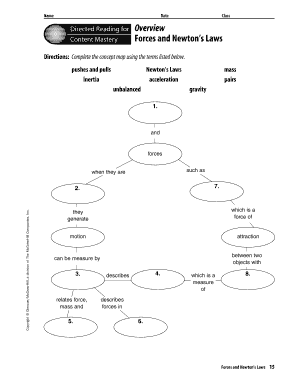
Get Overview Forces And Newton's Laws
How it works
-

Open form follow the instructions
-

Easily sign the form with your finger
-

Send filled & signed form or save
How to fill out the Overview Forces And Newton's Laws online
This guide provides a clear, step-by-step approach to filling out the Overview Forces And Newton's Laws form. Whether you are familiar with physics concepts or new to them, this guide will help you understand the requirements and complete the form successfully.
Follow the steps to complete the Overview Forces And Newton's Laws form effectively.
- Press the ‘Get Form’ button to access the form and open it in your preferred online editor.
- Begin by entering your name in the designated field at the top of the form, ensuring that you provide your full name for proper identification.
- Next, input the date in the appropriate format, typically MM/DD/YYYY, to indicate when you are completing the form.
- Select the class or subject under which you are completing this document—this helps to categorize your responses.
- Move to the concept map section and fill in the blanks using the terms provided such as 'pushes and pulls', 'inertia', and 'gravity'. Make sure to connect these terms logically as indicated by the directions.
- In the next section, answer the true/false questions by writing 'true' or correcting the false statements as required. Review your answers for accuracy.
- Fill in the missing words in the paragraphs using the words listed. Pay attention to context to ensure that you select the most appropriate term.
- Once all sections are complete, review the entire form for any mistakes or omissions to ensure accuracy and completeness.
- Finally, save your changes, and proceed to download, print, or share the completed form as necessary.
Complete your Overview Forces And Newton's Laws form online today and enhance your understanding of these important concepts!
ing to Newton's third law of motion, forces always act in equal but opposite pairs. Another way of saying this is for every action, there is an equal but opposite reaction. This means that when you push on a wall, the wall pushes back on you with a force equal in strength to the force you exerted.