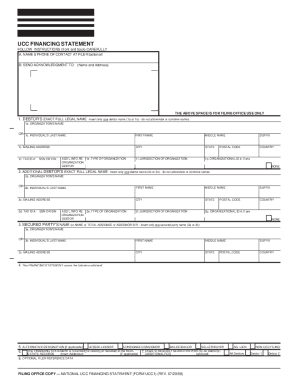
Debtor’s legal name; you may add such other names as additional Debtors if you wish (but this is neither required nor recommended). 2. If an additional Debtor is included, complete item 2, determined and formatted per Instruction 1. To include further additional Debtors, or one or more additional Secured Parties, attach either Addendum (Form UCC1Ad) or other additional page(s), using correct name format. Follow Instruction 1 for determining and formatting additional names. 3. Enter inform.
Open form follow the instructions
Easily sign the form with your finger
Send filled & signed form or save
How to fill out the Form UCC1 online
Filling out the Form UCC1 online can be a straightforward process with the right guidance. This guide provides clear, step-by-step instructions to help users complete the form accurately.
Follow the steps to confidently complete the Form UCC1.
- Click ‘Get Form’ button to obtain the form and open it in the editor.
- Complete item A to provide optional contact information, including name and phone number.
- In item B, fill in the address where you would like to receive the acknowledgment.
- Enter the debtor's exact full legal name in item 1. Choose to list either an organization's name (1a) or an individual's name (1b), and ensure not to abbreviate.
- If an additional debtor is included, complete item 2 using the same formatting rules as item 1.
- Fill out item 3 for the secured party, ensuring accurate naming format as per instructions.
- In item 4, describe the collateral covered by the financing statement. If more space is needed, attach additional pages.
- If applicable, check the box in item 5 to use alternative designations or indicate specific types of filings.
- For fixture filing, complete items 6, 13, 14, and 15 as necessary.
- Optionally check the box in item 7 if you wish to request a search report on the debtor.
- If relevant, fill in item 8 with any identifying information for your records.
- Review all entered information for accuracy. After completing the form, utilize options to save changes, download, print, or share the form.
Start your filing by completing the Form UCC1 online now to ensure your legal interests are properly documented.
Experience a faster way to fill out and sign forms on the web. Access the most extensive library of templates available.
Related content
Please type or print this form. Be sure it is completely legible. Forms with handwritten...
UCC-1 Form (commonly called a UCC financial statement) is a form that creditors should...
(d) financing statements (Forms UCC-1);. (e) insurance certificate, together with a loss...
Get answers to your most pressing questions about US Legal Forms API.
How to get a UCC-1 form?
You can easily obtain a UCC-1 form from various resources, including state government websites and legal service providers. Platforms like US Legal Forms offer user-friendly templates and guidance to help you navigate the filing process effectively. You can fill out Form UCC1 online, ensuring all details are correct and complete before submission. Additionally, utilizing such platforms simplifies your filing experience and reduces the chance of errors.
What is the purpose of a UCC-1 form?
The UCC-1 form serves the crucial role of establishing a security interest in various assets between parties. By completing and filing Form UCC1, you inform third parties that you have a legal claim to the specified collateral. This transparency is vital in lending scenarios, as it ensures all parties understand their rights. The UCC-1 helps clarify the hierarchy of claims, which can be essential during insolvency proceedings.
What does filing a UCC-1 do for you?
Filing a UCC-1 helps you secure legal rights over collateral, such as personal property or land. When you submit a Form UCC1, it creates a public record of your claim, which protects your interests if the debtor defaults. This filing acts as notice to other creditors about your secured interest, reinforcing your position in potential legal disputes. Ultimately, filing this form can improve your ability to recover the amount owed to you.
What is the purpose of the UCC?
The Uniform Commercial Code (UCC) acts as a set of laws governing commercial transactions in the United States. The purpose of the UCC is to standardize legal frameworks, thereby simplifying the process of securing interests in transactions. By using Form UCC1, you can clearly establish your rights over specific assets and enhance your protection under the law. This clarity can foster better business standards and promote trust among parties in a transaction.
Who needs to file an UCC?
Individuals or businesses that want to secure their interests in personal or real property should file a Form UCC1. This includes lenders, creditors, and anyone providing credit based on collateral. Filing the Form UCC1 notifies the public of your claim, ensuring that your rights are protected in case of default. Moreover, filing this form is often a requirement for obtaining financing.
Where to file a UCC fixture filing?
You can file a UCC fixture filing with your state’s Secretary of State office, as many states offer online resources for this process. When utilizing Form UCC1, select the appropriate method for filing based on your state's requirements. Make sure to check local regulations to ensure your filing is correct and effective.
Why would you file a UCC-1 on yourself?
Filing a UCC-1 on yourself can protect your business assets and demonstrate ownership of certain properties. This proactive measure can solidify your claims over specific assets, especially if you plan to borrow against them in the future. Utilizing Form UCC1 fortifies your position in the eyes of potential lenders or creditors.
What is the UCC for dummies?
The UCC, or Uniform Commercial Code, is a set of laws designed to standardize and simplify commercial transactions in the United States. For dummies, think of UCC as the rulebook for businesses regarding sales, leases, and secured transactions. Form UCC1 specifically helps secure loans by detailing collateral interests, which is key for both lenders and borrowers.
What is a UCC filing example?
A UCC filing example typically refers to the submission of Form UCC1, which is a public record that a lender has a security interest in specified collateral. This ensures that anyone searching the public records knows about the lender's claim. It's often used in various financial transactions to safeguard the interests of the lender.
What are examples of UCC?
Examples of UCC include various forms used for securing interests in personal property. For instance, UCC-1 filings secure a lender's claim, while UCC-3 forms amend or terminate a prior filing. Businesses often use these forms to establish clear ownership and rights, making Form UCC1 a crucial aspect of asset protection.
Use professional pre-built templates to fill in and sign documents online faster. Get access to thousands of forms.
If you believe that this page should be taken down, please follow our DMCA take down process here.
This form is available in several versions. Select the version you need from the drop-down list below.