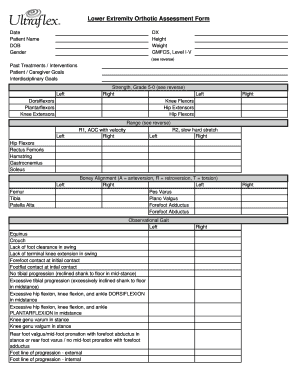
Lower Extremity Orthotic Assessment Form Date Patient Name DOB Gender DX Height Weight GMFCS, Level IV (see reverse) Past Treatments / Interventions Patient / Caregiver Goals Interdisciplinary Goals.

How it works
  • Open form

    Open form follow the instructions

  • Easily sign form

    Easily sign the form with your finger

  • Share form

    Send filled & signed form or save

How to fill out the Lower Extremity Orthotic Assessment Form online

Filling out the Lower Extremity Orthotic Assessment Form accurately is essential for effective orthotic assessment and intervention. This guide will provide you with clear, step-by-step instructions to navigate the online process with confidence.

Follow the steps to complete the form effectively.

  1. Use the 'Get Form' button to access the Lower Extremity Orthotic Assessment Form and open it in the designated editor.
  2. Begin by entering the patient's name and date of birth. Ensure that all personal information is accurate, as it will be used for identification purposes.
  3. Indicate the patient's gender. This information is critical for appropriate assessments and interventions.
  4. Document the diagnosis (DX). It is vital to provide complete and precise medical information for effective evaluation.
  5. Enter the patient’s height and weight. These metrics are essential for custom orthotic fittings.
  6. Assess the Gross Motor Function Classification System (GMFCS) level of the patient, selecting from Levels I-V as outlined in the form.
  7. Outline any past treatments or interventions the patient has received. This section helps the reviewing clinician understand the patient’s history and current needs.
  8. Identify the patient's and caregiver's goals. This ensures that the orthotic solution aligns with the user's expectations and needs.
  9. Fill in interdisciplinary goals to promote comprehensive treatment strategies across various health professionals.
  10. Evaluate and document strength for various muscle groups. Use the provided scale (Grade 5-0) to indicate the patient’s muscle performance.
  11. Record the range of motion details as specified in the form, documenting both dynamic and static ranges as necessary.
  12. Evaluate and note any bony alignment issues and observational gait patterns by following the prompts in the corresponding sections.
  13. Review the entire completed form for accuracy. Once satisfied, save the changes, and choose to download, print, or share the form as needed.

Complete your assessment efficiently by filling out the Lower Extremity Orthotic Assessment Form online today.

Get form

Experience a faster way to fill out and sign forms on the web. Access the most extensive library of templates available.

Related content

Preliminary Evaluation of a Powered Lower Limb...

Oct 3, 2011 — The simplest form of passive orthotics are long-leg braces that...

Learn more
Lower Extremity Orthotics

transfer load from one area to another; reduce joint and/or muscle strain; prevent and/...

Learn more
Clinical Practice Guidelines for Klippel-Trenaunay...

Jan 6, 2016 — typically affects the lower extremity unilaterally. Nevertheless, KTS...

Learn more
Questions & Answers

Get answers to your most pressing questions about US Legal Forms API.

Contact support

How do you assess for orthotics?

Orthotics Assessment will include a detailed history, gait observation (pattern of walking), orthopaedic testing, gait analysis by using a gait scan which scans the foot, maps foot pressure and produces a 3D image to make your custom orthotics.

What are lower limb orthotics? Lower limb orthotics are specialist external devices that are be used in certain areas of the lower limb to correct an abnormal alignment. These include braces, insoles, splints or other devices.

In clinical practice, the most commonly used AFO include plastic AFO, walking boot, UD-Flex, and carbon fiber AFO. In addition, for compensating the demerits of these conventional AFOs, new types of AFOs, including AF Servo, TurboMed, three-dimensionally printed AFO, and AFO made from kenaf composites, were developed.

As we mentioned above, orthotics come in numerous shapes and sizes. However, they usually fall within three general categories: soft, rigid, and semirigid.

People who have chronic foot or leg problems that interfere with the health and functioning of their feet may be prescribed orthoses by their podiatrist. For example, someone prone to calluses can have the pressure of their body weight redistributed across their feet with the aid of custom-fitted shoe inserts.

Lower extremity orthotics are external devices that are attached or applied to a lower limb to improve function by providing support, controlling motion, reducing pain, correcting deformities, and preventing the progression of deformities.

There are three common types of orthotics known as soft, rigid, and semi-rigid. Soft orthotics are made to provide extra cushioning while the foot is planted on the ground. Semi-rigid orthotics, which are often used on flat feet, are designed to provide both cushioning and stability.

Get This Form Now!

Use professional pre-built templates to fill in and sign documents online faster. Get access to thousands of forms.

If you believe that this page should be taken down, please follow our DMCA take down process here.

Get Lower Extremity Orthotic Assessment Form