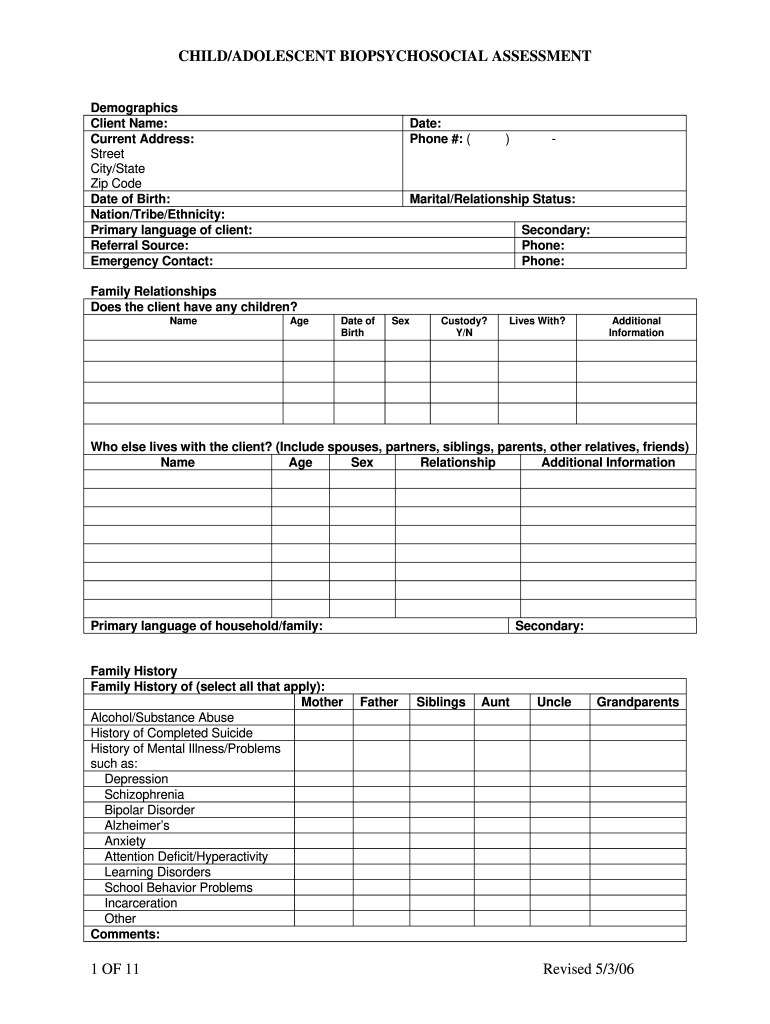
Emergency Contact: Date: Phone #: ( ) - Marital/Relationship Status: Secondary: Phone: Phone: Family Relationships Does the client have any children? Name Age Date of Birth Sex Custody? Y/N Lives With? Additional Information Who else lives with the client? (Include spouses, partners, siblings, parents, other relatives, friends) Name Age Sex Relationship Additional Information Primary language of household/family: Family History Family History of (select all that apply): Mother Alc.
Loading

Open form follow the instructions

Easily sign the form with your finger

Send filled & signed form or save
How to fill out the Child/Adolescent Biopsychosocial Assessment online
The Child/Adolescent Biopsychosocial Assessment is a comprehensive tool designed to evaluate the many factors affecting a child's or adolescent's well-being. This guide will help you navigate each section of the assessment, ensuring that you complete the form accurately and thoroughly online.
Follow the steps to complete the assessment effectively
- Press the ‘Get Form’ button to access the form and open it in your preferred editor.
- Begin by filling out the demographics section. Provide the client’s name, current address, date of birth, ethnicity, primary language, referral source, and emergency contact details.
- Next, complete the family relationships section. Indicate whether the client has any children and provide their names, ages, and custody information. Additionally, list others living with the client and their relationships.
- In the family history section, select any known histories of substance abuse, mental illness, and further describe them if necessary.
- Proceed to the critical population section by selecting all applicable options regarding the client’s social and economic context.
- Fill out the legal involvement section, noting any protective services, court orders, or probation statuses.
- Complete the presentation of the problem by summarizing the client's issues and the expected outcomes from the assessment.
- Detail the client's physical functioning by noting any allergies, medical conditions, medications, and past medical history.
- Continue with the pain questionnaire and nutritional status sections, providing detailed responses as applicable.
- Address the child/adolescent growth and development, detailing prenatal and early developmental influences.
- In the social support section, evaluate the client’s support network and living situation.
- Provide details about the education and leisure activities of the client, including any challenges faced.
- Finish by completing the psychological and behavioral assessments, including mental status and risk evaluations.
- Once the form is complete, you can save your changes, download a copy, print it for physical records, or share it with relevant professionals.
Complete the Child/Adolescent Biopsychosocial Assessment online today to ensure a thorough evaluation.
Experience a faster way to fill out and sign forms on the web. Access the most extensive library of templates available.
Related content
May 3, 2006 — Child/Adolescent Growth & Development. During pregnancy, did the...
MINOR CHILD – PARENT/GUARDIAN HAS GUARDIANSHIP: the client is under age 18 and is not...
... assessment questionnaires. 73. 6.2.5.3 Physical examination and investigations...
Get answers to your most pressing questions about US Legal Forms API.
What is the difference between diagnostic summary and biopsychosocial assessment?
A diagnostic summary typically focuses on identifying specific mental health disorders based on symptoms and diagnostic criteria. In contrast, a Child/Adolescent Biopsychosocial Assessment provides a broader view, encompassing biological, psychological, and social factors. By comparing the two, clinicians gain a richer understanding of the child’s needs, which can lead to more effective treatment options.
What is the intention of the biopsychosocial assessment?
The intention of a Child/Adolescent Biopsychosocial Assessment is to create a holistic understanding of a child's well-being. This approach aims to uncover underlying issues, strengths, and resources that may affect mental health. By doing so, clinicians can provide targeted and effective treatment, fostering better outcomes for the child.
What is the biopsychosocial assessment of the child?
The biopsychosocial assessment of a child is a process that evaluates the various biological, psychological, and social influences affecting that child's development and mental health. This thorough analysis helps clinicians identify specific needs and tailor interventions accordingly. Utilizing a Child/Adolescent Biopsychosocial Assessment ensures that all aspects of a child's life are considered.
What are the three areas assessed in a biopsychosocial assessment?
A Child/Adolescent Biopsychosocial Assessment typically evaluates three critical areas: biological factors, psychological factors, and social factors. Biological factors may include medical history and genetics, while psychological factors focus on mental health and emotional status. Social factors examine family dynamics and community support, allowing for a comprehensive understanding of the child's circumstances.
What is an example of a biopsychosocial assessment?
An example of a Child/Adolescent Biopsychosocial Assessment could involve a clinician gathering information through interviews with the child, parents, and teachers. This assessment may include data on the child's family dynamics, academic performance, and mental health history. By compiling this information, professionals can better understand the child’s overall situation and devise appropriate interventions.
How do you explain the biopsychosocial model?
The biopsychosocial model explains how biological, psychological, and social factors interact to affect a child's behavior and mental health. By recognizing that these elements do not exist in isolation, clinicians can offer a more effective treatment plan tailored to the child's needs. A Child/Adolescent Biopsychosocial Assessment uses this model to ensure all relevant factors are considered.
What are the 4 P's of biopsychosocial assessment?
The 4 P's of a Child/Adolescent Biopsychosocial Assessment are: Predisposing, Precipitating, Perpetuating, and Protective factors. Predisposing factors identify vulnerabilities, while precipitating factors trigger issues. Perpetuating factors maintain problems, and protective factors highlight resilience and strengths. Addressing each of these elements helps provide a nuanced understanding of a child's circumstances.
What is the best way to describe a biopsychosocial approach to assessment?
The biopsychosocial approach to assessment emphasizes the interconnectedness of biological, psychological, and social factors that influence a child's mental health. Instead of focusing solely on symptoms, this approach considers the broader context of a child's life. By understanding these various influences, professionals can create a more accurate and effective Child/Adolescent Biopsychosocial Assessment.
How do you summarize a biopsychosocial assessment?
A Child/Adolescent Biopsychosocial Assessment provides a comprehensive overview of a child's emotional, social, and biological influences. It integrates information from different domains, including the child's family background, social environment, and mental health history. This holistic view helps clinicians formulate effective treatment plans that address various aspects of a child's well-being.
Who can complete a biopsychosocial assessment?
Licensed mental health professionals, including psychologists and social workers, are qualified to complete the Child/Adolescent Biopsychosocial Assessment. These experts have received the necessary training to evaluate various aspects of a child’s life and development. Utilizing platforms like USLegalForms can streamline the process, providing essential resources and tools for effective assessments.
Use professional pre-built templates to fill in and sign documents online faster. Get access to thousands of forms.
If you believe that this page should be taken down, please follow our DMCA take down process here.