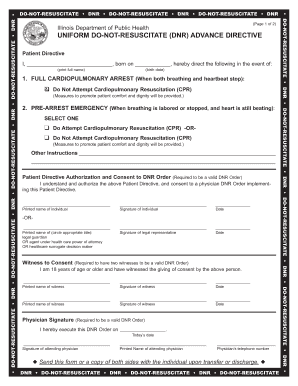
(DNR) ADVANCE DIRECTIVE Patient Directive I, _____________________________, born on ____________, hereby direct the following in the event of: (print full name) (birth date) 1. FULL CARDIOPULMONARY ARREST (When both breathing and heartbeat stop): x K Do Not Attempt Cardiopulmonary Resuscitation (CPR) (Measures to promote patient comfort and dignity will be provided.) 2. PRE-ARREST EMERGENCY (When breathing is labored or stopped, and heart is still beating): SELECT ONE K Do Attempt Cardiopu.
Open form follow the instructions
Easily sign the form with your finger
Send filled & signed form or save
How to fill out the IL Uniform DNR Advance Directive online
This guide provides comprehensive instructions on filling out the Illinois Uniform Do-Not-Resuscitate (DNR) Advance Directive online. By following these steps, users can ensure their healthcare preferences are documented clearly and effectively.
Follow the steps to complete the online form correctly.
- Click ‘Get Form’ button to obtain the document and open it for editing.
- In the first section, write your full name in the space provided, as well as your birth date.
- For the 'Full cardiopulmonary arrest' section, select either 'Do Not Attempt Cardiopulmonary Resuscitation (CPR)' or leave the option unchecked if you want CPR to be attempted.
- Next, in the 'Pre-arrest emergency' section, choose either 'Do Attempt Cardiopulmonary Resuscitation (CPR)' or 'Do Not Attempt Cardiopulmonary Resuscitation (CPR)'.
- If you have additional instructions, write them in the space labeled 'Other Instructions'.
- Sign and print your name in the 'Patient Directive Authorization and Consent to DNR Order' section, along with the date.
- If applicable, have your legal guardian, agent under healthcare power of attorney, or healthcare surrogate decision maker sign and print their name.
- If needed, ensure two witnesses are present to sign in the designated area, along with their printed names and dates.
- The attending physician must sign and print their name, date the form, and include their telephone number.
- Finally, save your completed document, and if you wish, download, print, or share the form as needed.
Ensure your healthcare preferences are clear and fill out the IL Uniform DNR Advance Directive online today.
Experience a faster way to fill out and sign forms on the web. Access the most extensive library of templates available.
Related content
Illinois law allows you to make four types of advance directives: a health care power of...
Power of Attorney for Health Care, Illinois Statutory Short Form - PDF; IDPH Uniform Do...
by R Bratcher · Cited by 1 — dnr Order. A third common advance directive is a DNr...
Get answers to your most pressing questions about US Legal Forms API.
What is the difference between an advance directive and a MOLST?
The primary difference between an advance directive and a MOLST is their function and usage. An advance directive outlines your healthcare preferences, while a MOLST (Medical Orders for Life-Sustaining Treatment) is a medical order that details specific treatment instructions. The IL Uniform DNR Advance Directive is one aspect of advance directives, while a MOLST is typically more applicable in emergency medical situations, making both important to understand in planning your healthcare.
Does an advance directive cover DNR?
An advance directive can indeed cover a Do Not Resuscitate (DNR) order, especially when using the IL Uniform DNR Advance Directive. This directive specifies your preferences for resuscitation in specific medical scenarios. Having a comprehensive advance directive in place helps healthcare providers understand your wishes, providing peace of mind for you and your loved ones.
Does the advance directive include DNR?
Yes, an advance directive can include a Do Not Resuscitate (DNR) order. Specifically, the IL Uniform DNR Advance Directive allows you to express your wishes regarding resuscitation efforts clearly. It is important to ensure that your advance directive accurately reflects your preferences to avoid any confusion during a medical crisis.
Can a medical power of attorney override a DNR?
A medical power of attorney cannot override a Do Not Resuscitate (DNR) order. The IL Uniform DNR Advance Directive is designed to be followed by medical professionals, even if someone has been appointed to make health decisions. Therefore, it’s crucial to clearly communicate your wishes when filling out these documents to ensure they align with each other.
What are the three types of advance directives?
The three primary types of advance directives are the Living Will, which outlines your treatment preferences, the Health Care Power of Attorney, which designates someone to make decisions for you, and the Do Not Resuscitate (DNR) order. The IL Uniform DNR Advance Directive falls under the DNR category, providing clear instructions on resuscitation efforts. Understanding these options empowers you to make informed choices about your medical care.
What are the four types of advanced directives in Illinois?
In Illinois, the four types of advanced directives include the Living Will, the Health Care Power of Attorney, the Do Not Resuscitate (DNR) Order, and the Illinois Uniform DNR Advance Directive. Each of these documents serves a specific purpose in guiding medical decisions when a person cannot speak for themselves. It is essential to understand the roles of these directives to ensure that your healthcare wishes are respected.
Who is responsible for making sure an advance directive is followed?
The responsibility for ensuring an advance directive is followed typically falls on healthcare providers and your designated agents if you have appointed them. It is important to communicate your wishes clearly to your medical team. Using tools like US Legal Forms can help you prepare your IL Uniform DNR Advance Directive correctly, making it easier for everyone involved to understand and act on your preferences.
How to execute an advance directive?
To effectively execute an advance directive, you first need to complete the appropriate forms, such as the IL Uniform DNR Advance Directive. Next, ensure that you sign the document in the presence of witnesses or a notary, as required. Finally, distribute copies to your healthcare team and family members to ensure everyone is aware of your wishes.
What are the 5 steps of advance care planning?
Advance care planning includes five key steps: reflecting on your personal values, discussing your wishes with loved ones, understanding different types of directives, completing the necessary documents, and sharing those documents with your healthcare providers. Each step is crucial in ensuring your healthcare preferences are respected. The IL Uniform DNR Advance Directive plays an important role in this planning.
How do you run an advance directive?
Running an advance directive involves creating a legal document that outlines your healthcare preferences. You start by discussing your wishes with family, then complete the necessary forms, such as the IL Uniform DNR Advance Directive. Finally, ensure that copies of the directive are shared with your healthcare providers and loved ones.
Use professional pre-built templates to fill in and sign documents online faster. Get access to thousands of forms.
If you believe that this page should be taken down, please follow our DMCA take down process here.