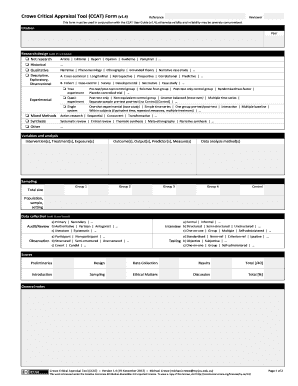
Ed. Citation Year Research design (add if not listed) Article | Editorial | Report | Opinion | Guideline | Pamphlet | … ❏ Not research … ❏ Historical Narrative | Phenomenology | Ethnography | Grounded theory | Narrative case study | … ❏ Qualitative ❏ Descriptive, A. Cross-sectional | Longitudinal | Retrospective | Prospective | Correlational | Predictive | … Exploratory, Observational B. Cohort | Case-control | Survey | Developmental | Normative | Case study | … Experimenta.

How it works
  • Open form

    Open form follow the instructions

  • Easily sign form

    Easily sign the form with your finger

  • Share form

    Send filled & signed form or save

How to fill out the AU Crowe Critical Appraisal Tool (CCAT) Form online

The AU Crowe Critical Appraisal Tool (CCAT) Form is designed to help users evaluate the quality and rigor of research studies. This guide provides clear, step-by-step instructions on how to complete the form online, ensuring a systematic approach to critical appraisal.

Follow the steps to effectively fill out the CCAT Form

  1. Press the ‘Get Form’ button to obtain the AU Crowe Critical Appraisal Tool (CCAT) Form and open it in your editor of choice.
  2. Begin by filling in the citation year and type of research design. Select from options such as article, editorial, guideline, or others as applicable. Mark 'Not research' if it applies.
  3. Specify the variables and analysis section by detailing the interventions, treatments, or exposures used, and describe the outcomes or measures being analyzed.
  4. Complete the sampling section by outlining the groups involved and the overall sample size. Clearly detail the target population as well as the sample collection method.
  5. In the data collection section, indicate whether it is primary or secondary and further specify the types of data collection methods—formal or informal, structured interviews, or literature review.
  6. Proceed by answering the questions related to ethical matters. Address informed consent, privacy considerations, and any ethical approvals required for the study.
  7. Evaluate the results by scoring the integration and interpretation of methods used in the analysis carefully, ensuring consistency with the data presented.
  8. Conclude by discussing the findings in relation to prior evidence, considerations of bias, and the study's strengths and limitations.
  9. Finally, compile all scores from sections 1 to 8 to arrive at a total score, documenting it in the appropriate field.
  10. Once you have completed the CCAT Form, make sure to save changes. You can choose to download, print, or share the filled form as required.

Start filling out your AU Crowe Critical Appraisal Tool (CCAT) Form online today.

Get form

Experience a faster way to fill out and sign forms on the web. Access the most extensive library of templates available.

Related content

Critical Appraisal Tools to Aid Pharmacists in...

by A Blanc · 2023 · Cited by 1 — CCAT (Crowe Critical Appraisal Tool) · General...

Learn more
Gross Motor Assessment Tools for Children 0-12...

by CM Grant · 2023 — A quality assessment was conducted using the Crowe Critical...

Learn more
Questions & Answers

Get answers to your most pressing questions about US Legal Forms API.

Contact support

How to reference critical appraisal tools?

Referencing critical appraisal tools requires adhering to specific citation formats based on your guidelines, such as APA or Chicago style. Include all necessary details like author, year, title, and source of the tool. When using the AU Crowe Critical Appraisal Tool (CCAT) Form, ensure that you follow these conventions for clarity and consistency. Proper referencing ensures that your academic or clinical work remains credible and transparent.

To cite the JBI manual in APA style, include the author, year, title, and any additional publication details. For example, when referencing the AU Crowe Critical Appraisal Tool (CCAT) Form, make sure to format your citation according to the latest APA guidelines. Accurate citations strengthen your work by giving proper credit to the original sources. Therefore, understanding these guidelines is essential for producing polished academic writing.

The Joanna Briggs critical appraisal tool is a resource designed to assist healthcare professionals and researchers in evaluating the quality of health research. This tool promotes critical thinking and enables users to appraise studies effectively. The AU Crowe Critical Appraisal Tool (CCAT) Form is an established component of these tools, providing essential structured questions for comprehensive assessment. Utilizing this resource enhances your ability to make evidence-based decisions in practice.

To set up a critical appraisal, start by selecting a relevant research study and gather necessary materials. Then, utilize the AU Crowe Critical Appraisal Tool (CCAT) Form to guide your evaluation process. Carefully assess each section of the form, answering questions regarding study design, results, and applicability. This structured approach ensures you cover all essential elements, leading to a thorough and effective appraisal.

When citing the Joanna Briggs Institute critical appraisal tool, ensure that you follow the appropriate citation style for your work, such as APA or MLA. Include the author, year of publication, title of the tool, and any relevant details. For instance, when using the AU Crowe Critical Appraisal Tool (CCAT) Form, refer to it accurately to maintain academic integrity. Familiarizing yourself with the citation guidelines will help you avoid common pitfalls in referencing.

Yes, referencing is a crucial part of critical appraisal, especially when utilizing the AU Crowe Critical Appraisal Tool (CCAT) Form. Proper references allow users to trace back to the original study, ensuring transparency and credibility. When you include references, you support your appraisal conclusions with solid evidence, making your overall analysis stronger. This practice enhances the trustworthiness of your work in both academic and clinical settings.

A critical appraisal form is a document used to systematically assess the quality and relevance of research literature. It allows users to evaluate different elements of a study, such as the research design and findings, to determine the reliability of the information presented. The AU Crowe Critical Appraisal Tool (CCAT) Form serves this purpose effectively, guiding users through a comprehensive evaluation process. This helps ensure that only high-quality studies inform clinical and research decisions.

The AU Crowe Critical Appraisal Tool (CCAT) Form is designed to help users evaluate the quality of research studies. It provides a structured framework to assess various aspects of studies, such as methodology and results. By utilizing this tool, researchers can make informed decisions based on the strength of the evidence. This tool is essential for anyone involved in research or evidence-based practice.

The CASP tool is another framework for evaluating research quality, specifically focusing on different study types. It is widely used in healthcare fields to assess studies rigorously. While it differs from the AU Crowe Critical Appraisal Tool (CCAT) Form, both tools aim to strengthen your research evaluation skills.

Using the Crowe critical appraisal tool provides a structured approach to evaluate research quality. It enhances your ability to identify strengths and weaknesses in studies. Moreover, by incorporating the AU Crowe Critical Appraisal Tool (CCAT) Form, you can improve your overall critical thinking and research skills.

Get This Form Now!

Use professional pre-built templates to fill in and sign documents online faster. Get access to thousands of forms.

If you believe that this page should be taken down, please follow our DMCA take down process here.

Get AU Crowe Critical Appraisal Tool (CCAT) Form