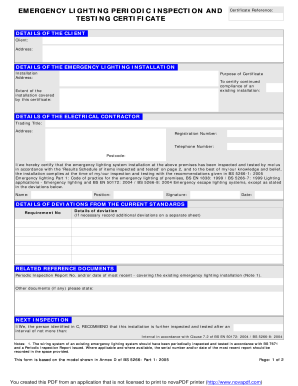
Pose of Certificate To certify continued compliance of an existing installation: Extent of the installation covered by this certificate: DETAILS OF THE ELECTRICAL CONTRACTOR Trading Title: Address: Registration Number: Telephone Number: Postcode: I/we hereby certify that the emergency lighting system installation at the above premises has been inspected and tested by me/us in accordance with the 'Results Schedule of items inspected and tested' on page 2, and to the best of my/our knowledge a.
Open form follow the instructions
Easily sign the form with your finger
Send filled & signed form or save
How to fill out the emergency lighting periodic inspection and testing certificate online
Filling out the emergency lighting periodic inspection and testing certificate is essential for ensuring compliance with safety regulations. This guide provides you with clear and supportive instructions on completing the form online, covering each section meticulously to facilitate a smooth process.
Follow the steps to complete your certificate accurately.
- Click the ‘Get Form’ button to obtain the form and open it in the designated editor.
- In the 'Certificate Reference' section, provide a unique reference number for the certificate to help with future tracking.
- Fill out the 'Details of the Client' section by entering the name of the client and their business address accurately.
- In the 'Details of the Emergency Lighting Installation' section, enter the installation details and its specific location.
- Indicate the purpose of the certificate by selecting 'To certify continued compliance of an existing installation' and specify the extent of the installation being covered.
- In the 'Details of the Electrical Contractor' section, enter the trading title, address, registration number, telephone number, and postcode of the contractor responsible for the inspection.
- Complete the declaration by entering the name, position, signature, and the date of inspection. Ensure all entries match the information in the results schedule.
- If there are any deviations from current standards, detail them in the 'Details of Deviations from the Current Standards' section.
- Complete the 'Related Reference Documents' by noting any periodic inspection report numbers and dates if applicable.
- In the 'Next Inspection' section, recommend an interval for the next inspection following the appropriate standards.
- Review all entered information for accuracy and completeness. Make any necessary edits.
- Once all fields have been filled out and verified, you can save your changes, download the certificate, print it, or share it as needed.
Start filling out your emergency lighting periodic inspection and testing certificate online today for a safer environment.
Experience a faster way to fill out and sign forms on the web. Access the most extensive library of templates available.
Related content
The emergency lighting equipment is required to be fully operational for the duration of...
Emergency lighting for 30 second Test. Monthly. 101:7.9.3.1 duration. (Lighting on...
Periodic Inspection & Test Certificate. BS 5266-1: 2016. Declaration of Conformity...
Get answers to your most pressing questions about US Legal Forms API.
What are the requirements for emergency lighting testing?
Emergency lighting testing requires adherence to specific protocols to confirm system functionality. Regular checks must be conducted to ensure that lights activate and illuminate escape routes as needed. By acquiring an Emergency Lighting Periodic Inspection and Testing Certificate, you not only ensure compliance but also enhance the overall safety of your property. This proactive approach is essential for minimizing risks and maximizing preparedness during emergencies.
What are the OSHA requirements for emergency lighting testing?
The Occupational Safety and Health Administration (OSHA) has specific testing requirements for emergency lighting. OSHA mandates that emergency exit lighting must be inspected and tested regularly to ensure reliable operation during an emergency. Obtaining an Emergency Lighting Periodic Inspection and Testing Certificate helps demonstrate compliance with OSHA regulations, giving you the assurance that your facility meets safety standards. This certification can also prevent potential penalties and enhance safety for all occupants.
What are the requirements for NFPA emergency lighting inspection?
Inspecting NFPA emergency lighting must follow well-defined procedures. These inspections typically include checking the functionality, verifying battery conditions, and ensuring that light levels meet code requirements. Securing an Emergency Lighting Periodic Inspection and Testing Certificate confirms that your building meets all NFPA lighting inspection standards. Regular inspections also keep systems in optimal working condition to support occupant safety.
What are the NFPA emergency lighting requirements?
The National Fire Protection Association (NFPA) has specific requirements for emergency lighting. According to NFPA codes, emergency lighting must activate automatically during a power outage and provide illumination for a specified duration. Adhering to these guidelines is crucial for safety, thus obtaining an Emergency Lighting Periodic Inspection and Testing Certificate ensures compliance with NFPA standards. This compliance helps protect lives in an emergency situation.
What are the requirements for testing emergency lighting?
Testing emergency lighting involves several critical requirements. First, these systems must be checked regularly to confirm that they turn on and provide adequate illumination during a power outage. Additionally, maintaining an Emergency Lighting Periodic Inspection and Testing Certificate ensures that all testing is documented and meets legal standards. Regular inspections also help identify any potential failures before they become serious issues.
Do you need a certificate for emergency lighting?
Yes, a certificate for emergency lighting is essential. This certificate demonstrates compliance with local safety regulations and ensures that your emergency lighting systems function correctly. Obtaining an Emergency Lighting Periodic Inspection and Testing Certificate can give you peace of mind. It also protects occupants during emergencies by confirming that the lighting will operate when needed.
What is the annual 3-hour emergency lighting test?
The annual three-hour emergency lighting test evaluates the system’s ability to function continuously during an extended power outage. This test simulates an actual emergency situation, ensuring that all lights are operational for the required duration. Successfully passing this test is necessary for issuing your Emergency Lighting Periodic Inspection and Testing Certificate.
What do OSHA standards require for emergency lighting?
OSHA requires that emergency lighting systems be functional and usable in case of emergencies. They mandate regular inspections and maintenance of these systems to prevent failures during critical moments. Adhering to these OSHA standards is vital for obtaining a valid Emergency Lighting Periodic Inspection and Testing Certificate.
How often should emergency lighting be inspected and tested?
Emergency lighting systems should be inspected and tested at least once a month, with a more comprehensive annual test lasting three hours. Regular assessments ensure functionality during emergencies. Following this schedule will help you maintain compliance and secure your Emergency Lighting Periodic Inspection and Testing Certificate.
Who can test emergency lighting?
Qualified electricians or certified inspectors can conduct emergency lighting tests. They have the necessary expertise to assess the system's functionality and identify any potential issues. Engaging professionals ensures accurate results and helps you receive a reliable Emergency Lighting Periodic Inspection and Testing Certificate.
Use professional pre-built templates to fill in and sign documents online faster. Get access to thousands of forms.
If you believe that this page should be taken down, please follow our DMCA take down process here.