Loading
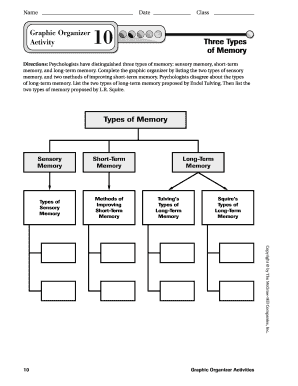
Get Graphic Organizer Activity 10 Three Types Of Memory
How it works
-

Open form follow the instructions
-

Easily sign the form with your finger
-

Send filled & signed form or save
How to fill out the Graphic Organizer Activity 10 Three Types Of Memory online
This guide provides clear instructions on how to effectively complete the Graphic Organizer Activity 10 focusing on the three types of memory. By following these steps, users will gain a better understanding of memory types while effectively organizing their thoughts.
Follow the steps to complete the graphic organizer online.
- Click the ‘Get Form’ button to access the Graphic Organizer Activity 10 for Three Types Of Memory. This action will allow you to obtain the form and open it for editing.
- Begin by entering your name in the designated field at the top of the form. This personal identification will help in organizing the completed work.
- In the 'Date' section, input the date you are completing the activity. This provides context and timeline for your document.
- In the 'Class' field, specify your class or subject related to the activity. This will help in categorizing the document correctly.
- Focus on the 'Types of Memory' section. First, identify and list the two types of sensory memory in the appropriate field.
- Next, write down two methods for improving short-term memory in the designated section.
- In the 'Long-Term Memory' area, list the two types proposed by Endel Tulving. Ensure this is clearly done in the provided space.
- Following that, document the two types of long-term memory proposed by L.R. Squire in the final section.
- Once all fields are complete, review your answers for accuracy. After confirming that everything is correct, you can save your changes, download, print, or share the completed form according to your needs.
Start filling out your Graphic Organizer Activity 10 online today for a clearer understanding of memory types.
The three major classifications of memory that the scientific community deals with today are as follows: sensory memory, short-term memory, and long-term memory. Information from the world around us begins to be stored by sensory memory, making it possible for this information to be accessible in the future.