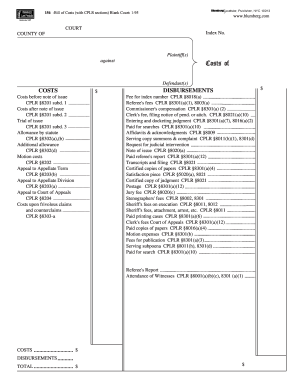
R CPLR §8018(a) Referee's fees CPLR §8301(a)(1), 8003(a) Commissioner's compensation CPLR §8301(a) (2) Clerk's fee, filing notice of pend. or attch. CPLR §8021(a)(10) Entering and docketing judgment CPLR §8301(a)(7), 8016(a)(2) Paid for searches CPLR §8301(a)(10) Affidavits & acknowledgments CPLR §8009 Serving copy summons & complaint CPLR §8011(h)(1), 8301(d) Request for judicial intervention Note of issue CPLR §8020(a) Paid referee's report CPLR §8301(a)(12) Transcripts and filing CP.
Open form follow the instructions
Easily sign the form with your finger
Send filled & signed form or save
How to fill out the NY Blumberg 156 online
Filling out the NY Blumberg 156 form is essential for documenting and claiming costs in legal proceedings. This guide will provide you with clear, step-by-step instructions to help you complete the form accurately online.
Follow the steps to successfully fill out the NY Blumberg 156
- Press the ‘Get Form’ button to access the NY Blumberg 156 form and open it in your preferred online editing platform.
- Identify the 'Court' field and enter the name of the court where your case is being heard, along with the relevant index number for your case.
- In the 'County of' field, provide the name of the county pertaining to the court where the form will be filed.
- List the names of the plaintiff(s) and defendant(s) in the designated fields, ensuring correct spelling and proper titles.
- Fill in the 'Costs' section by accurately entering amounts related to various disbursements, such as fees for index numbers, referee's fees, and any other applicable costs, referencing the CPLR sections as necessary.
- Ensure that the 'Total' costs and disbursements are correctly calculated, providing an accurate overview of the financial claims in your action.
- In the 'Attorney’s Affirmation' section, confirm your status as an attorney admitted to practice, complete the required statements, and provide your signature and date.
- Carefully review the entire form to confirm that all sections are completed and all figures are accurate.
- Save your changes, and then download or print the completed NY Blumberg 156 form for your records and for submission as necessary.
Complete your legal documents online efficiently and accurately today!
Experience a faster way to fill out and sign forms on the web. Access the most extensive library of templates available.
Related content
by A Turgeman · 2021 · Cited by 8 — This single-center, retrospective study revealed...
by KC Ciesielski · Cited by 10 — We discuss an amazing 1922 result of Henry Blumberg...
Apr 25, 2025 — & Blumberg, I. The link between (not) practicing CSR and corporate...
Get answers to your most pressing questions about US Legal Forms API.
How do I file a confession of judgment in New York?
To file a confession of judgment in New York, you need to create a written document that states the debtor's acknowledgment of the debt and specify the terms of repayment. This document then must be filed with the appropriate court. Resources such as NY Blumberg 156 can aid you in drafting and complying with all legal requirements for this process.
How long do you have to file a summary judgment in NY?
You need to file a summary judgment motion in New York within 120 days of the completion of discovery. Timeliness is crucial, as failing to meet this deadline can affect your chances of winning your case. To assist in this, refer to documents like NY Blumberg 156 to ensure compliance with the court's requirements.
How does a confession of judgment work?
A confession of judgment works by allowing a debtor to acknowledge their debt voluntarily, which enables the creditor to obtain a judgment without a court trial. This process is often quicker and less complex than traditional litigation. Utilizing forms such as NY Blumberg 156 can help you in crafting a valid confession of judgment.
How long do you have to file a motion for summary judgment in NY?
In New York, you usually have 120 days from the date of the note of issue to file a motion for summary judgment. This timeline is essential for ensuring that your case moves forward efficiently. Be sure to refer to resources like NY Blumberg 156 to help you navigate the procedure.
What is the difference between confession of judgment and consent judgment?
A confession of judgment allows a creditor to obtain a judgment against a debtor without a trial, as the debtor agrees to the terms upfront. In contrast, a consent judgment is typically the result of negotiations between both parties and requires court approval. Understanding the difference is crucial when dealing with documents such as NY Blumberg 156, which can streamline this process.
How to fill out NY ST 120 form?
Filling out the NY ST 120 form involves entering your basic information, stating the reason for exemption, and outlining the specific purchases made. Ensure that you accurately detail each item to avoid issues with tax compliance. Platforms like uslegalforms can provide you with necessary resources and templates to simplify the process of completing NY Blumberg 156 and other tax-related forms.
What is form 15G with an example?
Form 15G is a declaration that allows individuals to affirm earning below the taxable income limit, preventing tax deduction at source. For example, if your total income is below the basic exemption limit, you can fill out form 15G to ensure no taxes are deducted from your bank interest. When working with NY Blumberg 156, this example illustrates the utility of the form in retaining full earnings.
Is form 15G mandatory?
Form 15G is not mandatory; rather, it is an optional form that you can file if your total income is below the taxable limit. By filing this form, you can prevent tax deductions on your interest income. For those using NY Blumberg 156, understanding whether you need to file form 15G can make a significant difference in your overall tax situation.
What is the difference between 15G and 15H form?
The main difference between 15G and 15H forms lies in the eligibility criteria. Form 15G is applicable for individuals below the age of 60, while form 15H is intended for senior citizens. Both forms aim to help avoid tax deductions on interest earnings, but understanding their distinctions is crucial for accurate completion, especially when dealing with NY Blumberg 156.
How to fill out a 15 H form?
To fill out a 15 H form, begin by providing your personal details such as your name and address. Next, enter your estimated total income for the financial year and confirm your eligibility for tax exemptions. Utilizing platforms like uslegalforms can guide you through the process of completing NY Blumberg 156 and other forms effectively, simplifying your tax filing experience.
Use professional pre-built templates to fill in and sign documents online faster. Get access to thousands of forms.
If you believe that this page should be taken down, please follow our DMCA take down process here.