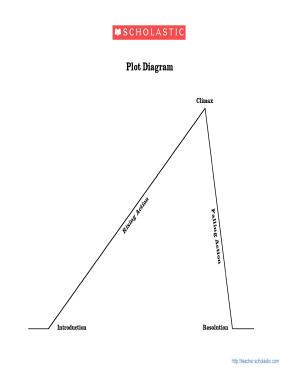
Plot Diagram. A Plot Diagram helps you see how fiction and drama are organized . Use it to analyze the five main parts of a plot. 2) Rising Action. Write what .
Loading
Open form follow the instructions
Easily sign the form with your finger
Send filled & signed form or save
How to fill out the Scholastic Plot Diagram online
Filling out the Scholastic Plot Diagram online is a straightforward process that helps organize narrative elements effectively. This guide will walk you through each step to ensure you complete the form accurately and efficiently.
Follow the steps to successfully complete the Scholastic Plot Diagram online.
- Click ‘Get Form’ button to obtain the form and open it in the online editor.
- Begin by identifying the title of the narrative you are analyzing. Enter this information in the provided section to establish the context of your plot diagram.
- Next, focus on the exposition section. Provide details about the setting, characters, and background information that are critical to understanding the narrative.
- Proceed to the rising action field. Here, list the main events leading up to the climax, highlighting any conflicts, challenges, or developments in the plot.
- In the climax section, describe the turning point of the story. This is where the tension peaks and the main conflict reaches its most intense moment.
- Move on to the falling action. In this section, outline the events that follow the climax, detailing how the characters begin to resolve their conflicts.
- Finally, complete the resolution section. Summarize how the story concludes and the outcomes for the characters, ensuring all narrative threads are tied up.
- Once you have filled out all sections, you may save your changes, download a copy of the form, print it, or share it with others as needed.
Competently complete documents online to enhance your narrative analysis skills.
Experience a faster way to fill out and sign forms on the web. Access the most extensive library of templates available.
Related content
Bar graphs can be used to show how something changes over time or to compare items. They...
Kate Chopin's "The Story of an Hour" is a masterpiece of brevity and psychological...
Aug 10, 2025 — As for the type of question, about 4 questions are asked in the areas of...
Get answers to your most pressing questions about US Legal Forms API.
How do you write a plot diagram?
Writing a plot diagram consists of mapping out the essential elements of your story in a structured format. Start with the exposition, then logically lay out the rising action, climax, falling action, and resolution. A Scholastic Plot Diagram can streamline your efforts, guiding you in creating an effective visual representation of your narrative.
How to write a plot line?
Writing a plot line involves summarizing the main events of your story in a clear and concise manner. Focus on the core sequence of events, including conflicts and resolutions. Utilizing a Scholastic Plot Diagram can enhance this process, helping you craft a compelling narrative trajectory.
How to fill in a plot diagram?
To fill in a plot diagram, outline the main components of your story, including characters, settings, and main events. As you progress, ensure each part contributes to the overall narrative arc. A Scholastic Plot Diagram can provide a structured visual aid, making it easier to organize and present your plot.
How to fill out a plot line?
Filling out a plot line requires you to capture the main events of your story in a linear format. Start by identifying key points from the exposition to the resolution. A Scholastic Plot Diagram can serve as a useful framework to guide you through this process, ensuring that your plot line is coherent and engaging.
How do you complete a line plot?
Completing a line plot involves recording data points on a number line, typically for visual representation of frequency. First, gather your data and determine the range. By applying a Scholastic Plot Diagram, you can organize your data more effectively and reveal insight into patterns or trends.
How do you fill out a plot map?
Filling out a plot map involves outlining the story's major events and identifying key elements like characters, settings, and conflict. Begin by placing the main plot points on the map in the correct sequence. Utilizing a Scholastic Plot Diagram can enhance your plot mapping experience, allowing for a structured approach to your storytelling.
What are the 5 steps of the plot diagram?
The five steps of the plot diagram include the exposition, rising action, climax, falling action, and resolution. Each step plays a crucial role in building your narrative and guiding your audience through the story. By using a Scholastic Plot Diagram, you can effectively organize these steps and ensure a cohesive narrative flow.
How do you fill out a plot graph?
To fill out a plot graph, start by identifying the main elements of your story, such as the introduction, rising action, climax, falling action, and resolution. Next, plot these elements on the graph by marking the points that represent each stage of the story. Using a Scholastic Plot Diagram can simplify this process, allowing you to visualize your story structure clearly.
How to make a plot graph for a book?
To make a plot graph for a book, start by outlining the main components of the story. Identify key moments such as the introduction of characters, conflicts, and the resolution. You can use a Scholastic Plot Diagram to plot these elements visually. This graph will help you understand the pacing and structure of the book, making your reading or analysis more insightful.
What are the 5 elements of a plot diagram?
The five key elements of a plot diagram are exposition, rising action, climax, falling action, and resolution. Each element serves a crucial role in developing the narrative and driving the story forward. Understanding these components through a Scholastic Plot Diagram can improve your analytical skills. This knowledge enriches your reading experience and enhances your storytelling abilities.
Use professional pre-built templates to fill in and sign documents online faster. Get access to thousands of forms.
If you believe that this page should be taken down, please follow our DMCA take down process here.