Loading
Get Short Blessed Test
How it works
-

Open form follow the instructions
-

Easily sign the form with your finger
-

Send filled & signed form or save
How to fill out the Short Blessed Test online
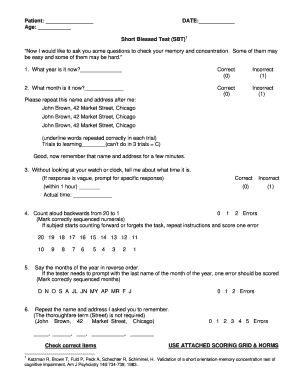
The Short Blessed Test (SBT) is a valuable assessment tool designed to evaluate memory and concentration. This guide will walk you through the process of filling out the SBT online, ensuring clarity and support for all users, regardless of their experience level.
Follow the steps to complete the Short Blessed Test online:
- Press the ‘Get Form’ button to access the form and open it in your editing interface.
- Begin by entering the patient's name in the designated field.
- Fill in the age of the patient in the provided space.
- Record the date of the assessment in the appropriate area.
- Proceed to answer the questions methodically, starting with the first question about the current year. Mark your response as correct or incorrect based on your knowledge.
- Answer the second question concerning the current month, using the same methodology for marking your response.
- Next, listen carefully while the name and address is presented. Afterward, repeat it back, ensuring to follow the instructions and take note of how many attempts were needed.
- For the question regarding the time, provide your best estimate without consulting any timepiece and specify whether your answer falls within the acceptable range.
- For the counting task, count backwards from 20 to 1, being mindful of the requirements that you do not count forward, and note any errors.
- When stating the months of the year in reverse order, begin with the last month and ensure not to skip any.
- Finally, recall the name and address from the initial section, stating each element accurately to avoid errors.
- Once you have completed all questions, review your responses for accuracy. You may then choose to save your changes, download the completed form, print it, or share it as necessary.
Consider completing the Short Blessed Test online for efficient and effective documentation.
Purpose: The Memory Orientation Screening Test (MOST) is compared with standard neuropsychological tests in a sample of elders reflecting the population prevalence of normal cognition, mild cognitive impairment (MCI) and dementia. ... The MOST showed a stronger relationship with dementia severity and list memory than MMSE.