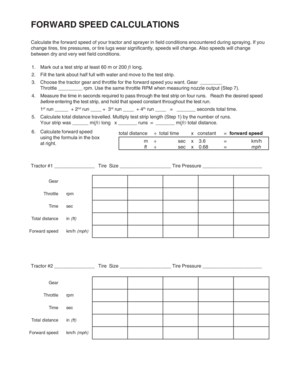
FORWARD SPEED CALCULATIONS Calculate the forward speed of your tractor and sprayer in field conditions encountered during spraying. If you change tires, tire pressures, or tire lugs wear significantly,.

How it works
  • Open form

    Open form follow the instructions

  • Easily sign form

    Easily sign the form with your finger

  • Share form

    Send filled & signed form or save

How to fill out the Sprayer Calibration Worksheet online

Filling out the Sprayer Calibration Worksheet online is a crucial step in ensuring efficient and accurate sprayer operation. This guide will provide you with a detailed, step-by-step approach to complete all necessary sections of the worksheet effectively.

Follow the steps to complete the Sprayer Calibration Worksheet online.

  1. Click the ‘Get Form’ button to obtain the worksheet and open it in your preferred online editor.
  2. Begin by marking out a test strip at least 60 meters or 200 feet long. This is crucial for calculating forward speed accurately.
  3. Fill the tank about half full with water. Then, move your sprayer to the test strip to prepare for testing.
  4. Select the appropriate tractor gear and throttle settings for the desired forward speed. Record the gear and throttle RPM on the form.
  5. Measure the time in seconds required to traverse the test strip across four runs. Input the time taken for each run in the respective fields on the worksheet.
  6. Calculate the total distance traveled by multiplying the length of the test strip by the number of runs performed. Record the total distance in the designated area of the form.
  7. Calculate the forward speed using the provided formula. Refer to the worksheet and ensure you enter your total distance, total time, and the constant for accurate results.
  8. Complete the sprayer setup summary section by entering details such as sprayer setup number, date, delivery rates, tank volume, area sprayed, and all relevant tractor and nozzle specifications.
  9. Review all the information entered for accuracy and completeness. Make any necessary adjustments.
  10. Finally, save your changes, and choose to download, print, or share the completed worksheet as needed.

Ensure accurate calibration by completing the Sprayer Calibration Worksheet online today!

Get form

Experience a faster way to fill out and sign forms on the web. Access the most extensive library of templates available.

Related content

Calibration Practice Questions

the example solutions and do not get the answer on the answer sheet please. FAX your...

Learn more
Sprayer Calibration Worksheet - Division of...

Sprayer Calibration Worksheet. Compiled by Dan Marzu, Agriculture Extension Educator...

Learn more
Polaris 380 Owner's Manual - Royal Swimming Pools

B. Troubleshooting Worksheet . ... the sweep hose from spraying water out of the pool...

Learn more
Questions & Answers

Get answers to your most pressing questions about US Legal Forms API.

Contact support

What is the first step for calibrating a sprayer?

Check pressure all along the boom first because there might be a restriction in the line and uneven pressure. ... Check and compare the cab pressure with boom pressure.

The major components of a sprayer are tank, pump, agitator, flow control, and nozzles. Sprayer tank, wand, pump and gauge. Use synthetic rubber or plastic hoses that have a burst strength greater than peak operating pressures, resist oil and solvents present in pesticides, and are weather resistant.

0:51 4:43 Suggested clip How to Calibrate a Sprayer | Sprayer Tips from ... - YouTubeYouTubeStart of suggested clipEnd of suggested clip How to Calibrate a Sprayer | Sprayer Tips from ... - YouTube

Fill sprayer with water. Set the sprayer pressure to the level you plan to use in the field and place a collection container under each nozzle. Run the sprayer for 3 minutes and 45 seconds. The cups (8 oz) of water collected equals the gallons per hour (GPH) output of the nozzle.

Next, determine the output of the sprayer. Simply incorporate the output of a single nozzle in gallons per minute (GPM) and multiply by 5,940. Then divide by the product of miles per hour (MPH) times the distance between nozzles in inches (width) on the spray boom.

0:00 3:03 Suggested clip How to Calibrate Your Sprayer [8-Step Guide + Formula] - YouTubeYouTubeStart of suggested clipEnd of suggested clip How to Calibrate Your Sprayer [8-Step Guide + Formula] - YouTube

0:00 3:03 Suggested clip How to Calibrate Your Sprayer [8-Step Guide + Formula] - YouTubeYouTubeStart of suggested clipEnd of suggested clip How to Calibrate Your Sprayer [8-Step Guide + Formula] - YouTube

These sprayers can provide low-pressure flow when fitted with proper pressure regulators. To properly select, maintain, and operate your sprayer, you need to know its parts. The major components of a sprayer are tank, pump, agitator, flow control, and nozzles. Sprayer tank, wand, pump and gauge.

Sprayer pumps are designed to push or pull fluid tank contents out to a spray nozzle(s) at specific gallons per minute (GPM) flow rates and pressure delivery. ... The six common pump types are: centrifugal, diaphragm, roller, transfer, piston, and irrigation-injection.

Next, determine the output of the sprayer. Simply incorporate the output of a single nozzle in gallons per minute (GPM) and multiply by 5,940. Then divide by the product of miles per hour (MPH) times the distance between nozzles in inches (width) on the spray boom.

Get This Form Now!

Use professional pre-built templates to fill in and sign documents online faster. Get access to thousands of forms.

If you believe that this page should be taken down, please follow our DMCA take down process here.

Get Sprayer Calibration Worksheet