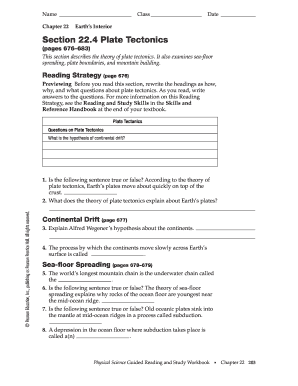
Ate tectonics. It also examines sea-floor spreading, plate boundaries, and mountain building. Reading Strategy (page 676) Previewing Before you read this section, rewrite the headings as how, why, and what questions about plate tectonics. As you read, write answers to the questions. For more information on this Reading Strategy, see the Reading and Study Skills in the Skills and Reference Handbook at the end of your textbook. Plate Tectonics Questions on Plate Tectonics What is the hypothesis.
Loading
Open form follow the instructions
Easily sign the form with your finger
Send filled & signed form or save
How to fill out the Section 22 4 Plate Tectonics online
Filling out the Section 22 4 Plate Tectonics form involves providing essential information about plate tectonics concepts. This guide is designed to help you navigate the process of completing the form effectively and accurately.
Follow the steps to successfully complete the form
- Press the 'Get Form' button to access the form and open it in your browser or designated editor.
- Begin by entering your name in the designated field at the top of the form. Ensure that your name is legible and correctly spelled.
- Input your class and the date in the respective fields. This information is necessary for proper identification of your submission.
- Read through the section titled 'Earth’s Interior' carefully. Familiarize yourself with the key concepts related to plate tectonics, sea-floor spreading, and mountain building.
- For each question under the 'Plate Tectonics' section, provide clear and concise answers based on your understanding and the material covered in the readings.
- Continue to the 'Continental Drift' section and complete the questions by offering explanations and true/false responses where indicated.
- Follow the same procedure for the 'Sea-floor Spreading' and 'The Theory of Plate Tectonics' sections, ensuring your answers reflect the information from the reading material.
- Identify the types of plate boundaries and describe how mountains are formed in the final sections. Provide thorough descriptions as required.
- Once you have answered all questions and reviewed your responses for accuracy, you can save changes or download the completed form in your preferred format.
- Finally, print or share the form as needed to complete your submission process.
Complete your documents online today for a seamless experience.
Experience a faster way to fill out and sign forms on the web. Access the most extensive library of templates available.
Related content
Section 4: Ocean Geologic Features oceanexplorer.noaa.gov. 64. FOCUS. Plate tectonics...
mountain belt can be formed when. Pangaea is reassembled. Wegener's Observations:...
The over-riding plate spreads to fill the gap. With the same volume of lithosphere but...
Get answers to your most pressing questions about US Legal Forms API.
What are the 4 plate boundaries?
There are four main types of plate boundary. These are constructive, destructive, conservative and collision margins.
What are the 4 types of plate boundaries?
Plate Boundaries and Hotspot Demonstration Divergent Plate Boundary. Volcanic eruptions and shallow earthquakes are common where plates rip apart. Convergent Plate Boundary. ... Transform Plate Boundary. ... Hotspot.
How does plate tectonics explain the movement of plates 22?
Convection currents drive the movement of Earth's rigid tectonic plates in the planet's fluid molten mantle. In places where convection currents rise up towards the crust's surface, tectonic plates move away from each other in a process known as seafloor spreading (Fig.
What are the 4 plate boundaries and how do they move?
There are four types of boundaries between tectonic plates that are defined by the movement of the plates: divergent and convergent boundaries, transform fault boundaries, and plate boundary zones. Microplates are smaller fragments of tectonic plates that appear in plate boundary zones.
What are the 4 types of plate boundaries How do they each move?
There are four types of plate boundaries: Divergent boundaries — where new crust is generated as the plates pull away from each other. Convergent boundaries — where crust is destroyed as one plate dives under another. Divergent boundaries: where new crust is generated as the plates pull away from each other.
What is the 3 types of plate boundaries?
There are three kinds of plate tectonic boundaries: divergent, convergent, and transform plate boundaries. This image shows the three main types of plate boundaries: divergent, convergent, and transform. Image courtesy of the U.S. Geological Survey.
How do plates move to each type of plate boundary?
The movement of the plates creates three types of tectonic boundaries: convergent, where plates move into one another; divergent, where plates move apart; and transform, where plates move sideways in relation to each other. They move at a rate of one to two inches (three to five centimeters) per year.
What is 4 a boundary in which two plates move toward each other?
When two plates come together, it is known as a convergent boundary. The impact of the colliding plates can cause the edges of one or both plates to buckle up into a mountain ranges or one of the plates may bend down into a deep seafloor trench.
Use professional pre-built templates to fill in and sign documents online faster. Get access to thousands of forms.
If you believe that this page should be taken down, please follow our DMCA take down process here.