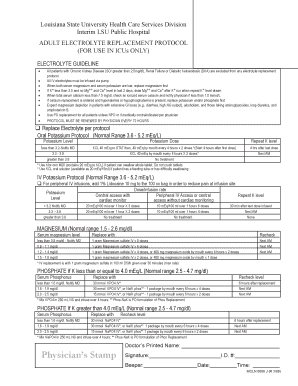
Louisiana State University Health Care Services Division Interim LSU Public Hospital ADULT ELECTROLYTE REPLACEMENT PROTOCOL (FOR USE IN ICUs ONLY) ELECTROLYTE GUIDELINE All patients with Chronic Kidney.
Open form follow the instructions
Easily sign the form with your finger
Send filled & signed form or save
How to fill out the Lsu Electrolyte Replacement online
Filling out the Lsu Electrolyte Replacement form is an essential process for ensuring the effective and safe administration of electrolytes in critical care settings. This guide provides clear and informative steps to help users complete the form accurately and efficiently.
Follow the steps to complete the Lsu Electrolyte Replacement form online
- Press the ‘Get Form’ button to retrieve the Lsu Electrolyte Replacement form and open it in the editing interface.
- Begin filling out the patient's information at the top of the document. Ensure that all fields are completed accurately, including the patient's full name, medical record number, and relevant identifiers.
- Review the clinical guidelines outlined in the protocol, ensuring that any pre-existing conditions such as chronic kidney disease, renal failure, or diabetic ketoacidosis are noted, as these affect eligibility for electrolyte replacement.
- Complete the electrolyte replacement protocol by indicating specific electrolytes that are to be monitored and replaced, such as potassium, magnesium, and phosphate. Carefully input the levels and corresponding dosages as per the guidelines provided.
- Include additional details such as intravenous infusion guidelines, doses, and timing for each electrolyte replacement, based on the patient's current serum levels.
- Make sure to include the physician's information, including their printed name, signature, identification number, beeper, date, and time at the designated section of the form.
- Once all sections of the form are completed, you can save your changes, download, print, or share the document as needed.
Complete your Lsu Electrolyte Replacement form online today for efficient management of electrolyte therapy.
Experience a faster way to fill out and sign forms on the web. Access the most extensive library of templates available.
Related content
Mar 3, 2016 — In a patient with simple potassium depletion, potassium replacement...
Oct 14, 2015 — Electrolyte Replacement Orders · PICC line placement Order Form · DNR...
lsu. GAS STATION INFORMATION. D Fuel selection: Select premium unleaded gasoline with an...
Get answers to your most pressing questions about US Legal Forms API.
What order should electrolytes be replaced in?
1st-line: potassium chloride. 2nd-line: : usually reserved for patients with hypokalemia AND hypophosphatemia. Potassium acetate: usually reserved for patients with hypokalemia AND metabolic acidosis (e.g., renal tubular acidosis, diarrhea)
Should you replace magnesium or potassium first?
Always check the serum magnesium level and replete magnesium prior to repleting potassium. Low magnesium can exacerbate renal potassium losses.
How do you replace electrolytes?
5 Foods to Replenish Electrolytes Dairy. Milk and yogurt are excellent sources of the electrolyte calcium. ... Bananas. Bananas are known to be the king of all potassium containing fruits and veggies. ... Coconut Water. For a quick energy and electrolyte boost during or after a workout, try coconut water. ... Watermelon. ... Avocado.
Do you replace mag or calcium first?
First, identify and treat hypomagnesemia if it is present. You have to do this first in order to effectively correct calcium. Hypomagnesemia is a common cause of hypocalcemia because low magnesium induces resistance to PTH and also diminishes PTH secretion.
What is the IV replacement of electrolytes?
Isotonic IV fluids include normal saline, 5% dextrose solutions dissolved in water, and Lactated Ringer's solutions. These are used for dehydration caused by electrolyte imbalances as well as fluid loss from diarrhea and vomiting.
What is the replacement theory of electrolytes?
Electrolyte replacement therapy. To achieve normal body fluid volume and composition, a replacement of body fluids must be performed. Volume contraction is life-threatening because it compromises the circulatory system, causes blood volumes to drop, heart output to decrease, and microcirculation to become impaired.
Use professional pre-built templates to fill in and sign documents online faster. Get access to thousands of forms.
If you believe that this page should be taken down, please follow our DMCA take down process here.