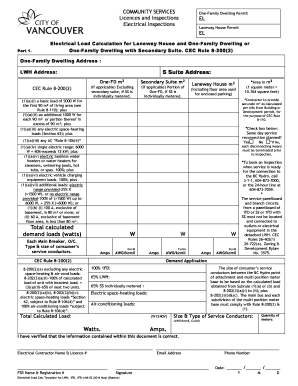
COMMUNITY SERVICES Licences and Inspections Electrical Inspections OneFamily Dwelling Permit EL Laneway House Permit EL Part 1. Electrical Load Calculation for Laneway House and OneFamily Dwelling.
Open form follow the instructions
Easily sign the form with your finger
Send filled & signed form or save
How to fill out the Electrical Load Calculation - Vancouver online
This guide provides a comprehensive overview of the process for completing the Electrical Load Calculation form for a Laneway House or One-Family Dwelling in Vancouver. It is designed to assist users of all experience levels with filling out the form accurately and efficiently.
Follow the steps to complete the Electrical Load Calculation form online:
- Press the ‘Get Form’ button to access the Electrical Load Calculation form, opening it in an editable format.
- Begin by entering the address for the One-Family Dwelling in the designated field. If applicable, provide the address for the Suite and the Laneway House.
- Fill in the total area of the One-Family Dwelling and the Secondary Suite in square meters. If the secondary suite is metered separately, include the specified areas accordingly.
- Input the area in square meters for the Laneway House, including any enclosed parking space as required by the latest electrical code rules.
- Calculate and record the minimum load requirements based on the total living area using the provided guidelines. Ensure to include any additional electric space-heating or air-conditioning loads.
- Complete the section for additional electrical appliances and installations, providing the type and wattage for each electrical component included in the load calculation.
- Verify the total calculated demand loads in watts, and ensure that the information aligns with the Canadian Electrical Code requirements.
- Finally, confirm the accuracy of the information entered, and provide the necessary details for the electrical contractor and FSR, including names, licence numbers, and signatures.
- Once all sections are completed, you can save the form, download it for your records, print a copy, or share it as needed.
Complete your Electrical Load Calculation form online today to ensure compliance and accuracy.
Experience a faster way to fill out and sign forms on the web. Access the most extensive library of templates available.
Related content
Aug 14, 2015 — Zone 5C: Vancouver, BC (cold, marine), Zone 6A: Burlington (cold, humid)...
Vancouver, B.C., Canada aiello@cs.ubc.ca. ABSTRACT ... the use of a power router to allow...
Sep 3, 2013 — International Existing Building Code and Seattle Electrical Code....
Get answers to your most pressing questions about US Legal Forms API.
How do you load a residential calculation?
Table 220.12 in the National Electrical Code considers a residence a listed occupancy at 3 VA per square foot; therefore, the general lighting load is determined by multiplying the square footage. For example, 2,800 square feet times 3 VA is 8,400 VA.
How do you calculate electrical load?
Calculating an Electrical Load in a Simple Circuit Let Power = Voltage * Current (P=VI). Let Current = Voltage/Resistance (I=V/R). Apply Kirchoff's Second Law, that the sum of the voltages around a circuit is zero. Conclude that the load voltage around the simple circuit must be 9 volts.
How do you calculate electrical load of a factory?
Work out the peak load in given time period. 30d x 24 hours a day x 500 kW = 360,000 kW. Divide the average load by the peak load you have calculated. 58,000 kWh ÷ 360,000 kW = 0.1611 kW. Multiply your result by 100 to find your load factor percentage.
How do you calculate load capacity?
Take the total weight of the load and divide this by the number of legs supporting the load. For example, assume a 2,000 pound load is to be supported by 2 legs of a sling. The above will give a total minimum weight on each leg of the sling of 2,000 pounds divided by 2 legs or 1,000 pounds.
How do you calculate load for electricity?
3:12 5:48 Suggested clip electrical load calculation - YouTubeYouTubeStart of suggested clipEnd of suggested clip electrical load calculation - YouTube
How do you calculate the electrical load of a building?
The same formula can be used to determine the capacity of the house's overall electrical service. Because a home's main service is 240 volts, the math looks like this: 240 volts x 100 amps = 24,000 watts. 80 percent of 24,000 watts = 19,200 watts.
How do I calculate the wattage of my house?
Most electrical appliances are rated with watts, while some use amps. To convert amps to watts, multiply the number of amps by 120. You do this because U.S. home electric outlets use 120 volts, and volts multiplied by amps equal watts. The number you want to find is how many kilowatt hours (kWh) you are using.
How do you calculate load required?
Use the formula for power: Power = Voltage x Current, or P = VI. If you are trying to calculate the minimum load and you happen to only know the power and voltage ratings of your power supply, you can use the formula P = V2/R, which can become R = V2/P.
How do you calculate light load?
Calculate the load your lights will place on your circuit by adding together the wattage of each lamp. For example, if you are calculating the lighting load for a special event that uses four 500-watt lights, multiply 4 by 500 to get 2,000, which is your load.
How do you calculate electrical load at home?
Compare the wattage of your air conditioner and furnace. Since you only use one at a time, add only the larger wattage rating to your equation. Divide the resulting number of watts by volts (most homes use 220 volts) to get the number of amps, or the electrical load.
Use professional pre-built templates to fill in and sign documents online faster. Get access to thousands of forms.
If you believe that this page should be taken down, please follow our DMCA take down process here.