Loading
Get History Fair Research Reporting Form
How it works
-

Open form follow the instructions
-

Easily sign the form with your finger
-

Send filled & signed form or save
How to fill out the History Fair Research Reporting Form online
Filling out the History Fair Research Reporting Form is a crucial step in organizing your research effectively. This guide will provide clear, step-by-step instructions to ensure you complete the form accurately and efficiently.
Follow the steps to complete the form with ease.
- Click ‘Get Form’ button to access the form and open it in your preferred editor.
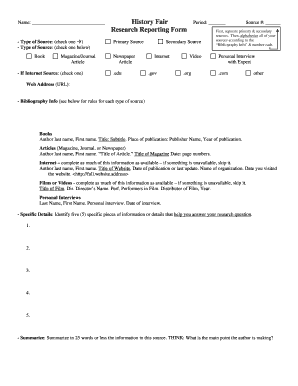
- Begin by entering the name of your source at the top of the form. Ensure that this is clearly written as it will be used in your bibliography.
- Select the type of source by checking the appropriate box. Options include book, magazine/journal article, internet source, video, and personal interview. Make sure to choose one that accurately represents the material you are documenting.
- If your source is from the internet, specify the type of internet source you are using by checking one of the sub-options such as '.edu', '.gov', or other relevant categories.
- Provide the web address (URL) of the internet source for easy reference.
- Fill in the bibliography information according to the guidelines provided for each source type, ensuring you include all necessary details such as author names, titles, and publication dates.
- Identify five specific pieces of information that will help answer your research question. Note these down in the designated section.
- Summarize the information from your source in 25 words or less. Focus on capturing the main point or argument presented by the author.
- Once you have completed all sections, review your entries for accuracy. After ensuring everything is correct, you can save your changes, download a copy, print the form, or share it as needed.
Complete your History Fair Research Reporting Form online today and ensure your research is organized and well-documented.
Log headers are plotted at the top of a log and typically contain textual information (company name, date, etc.), column labels, company logos, etc. Some of the header text is static or unchanging, while some (such as a date) change from log to log.